
What Causes Conductive Hearing Loss?
Learn how earwax, fluid, infections, eardrum damage and middle-ear bone problems cause conductive hearing loss—and how clinicians identify the cause.
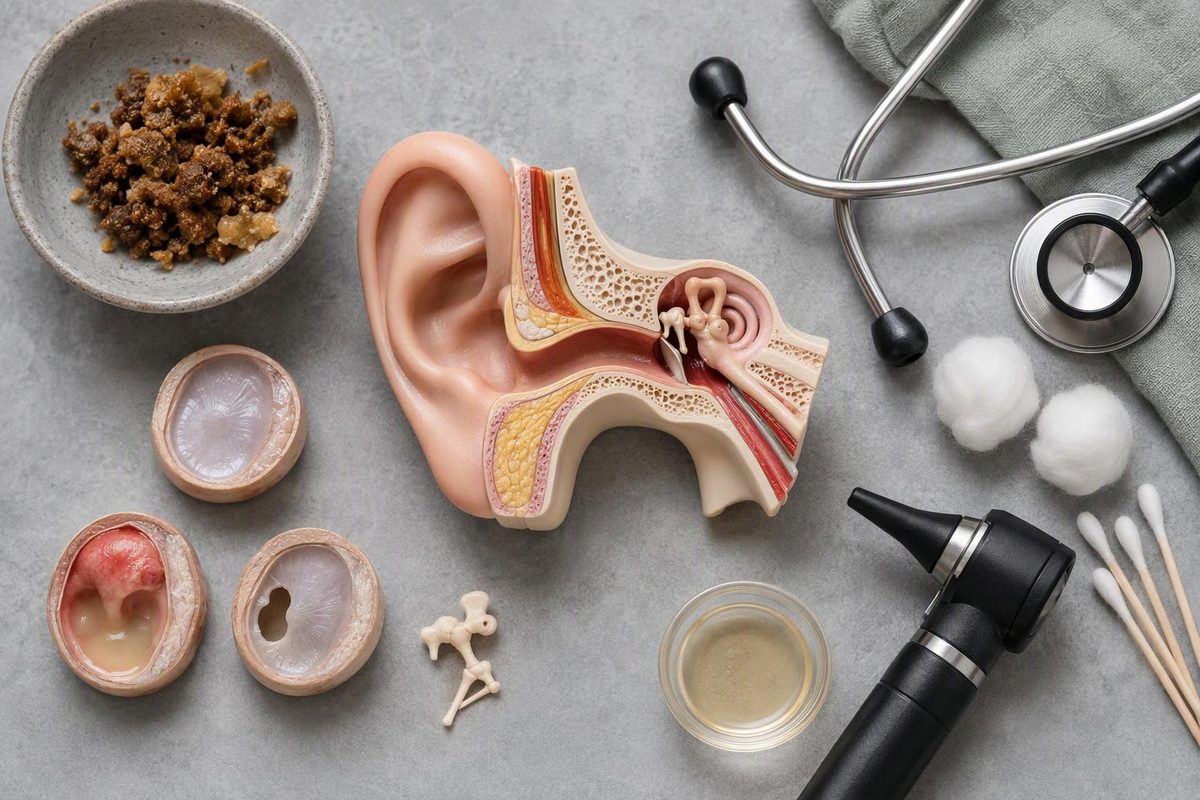
Conductive hearing loss happens when a problem in the outer or middle ear prevents sound from reaching the inner ear efficiently. Causes include impacted earwax, a blocked or inflamed ear canal, middle-ear fluid, a damaged eardrum and problems with the tiny bones that transmit sound. It describes where hearing is disrupted—not one particular disease. ASHA’s adult hearing-loss guidance lists these causes.
Normally, sound travels down the ear canal, vibrates the eardrum and moves three middle-ear bones, called ossicles. Those bones pass the vibrations to the cochlea, the hearing organ in the inner ear. A blockage or mechanical problem along that route weakens sound transmission. NIDCD explains this pathway.
If your hearing drops suddenly, seek medical care today. Do not assume it is wax or congestion, even if the ear feels plugged. Sudden inner-ear hearing loss can feel similar and is a medical emergency; delaying assessment can reduce treatment effectiveness. NIDCD’s sudden-deafness guidance explains why.
Outer-ear causes: sound cannot pass through the canal normally
Impacted earwax or a foreign object
Earwax becomes a conductive problem when it builds up enough to obstruct the canal. An object stuck in the ear can cause the same problem: sound has difficulty reaching the eardrum. Both are recognized causes in ASHA’s guidance.
This is different from simply having some wax, which does not by itself establish the cause of hearing loss. A clinician needs to inspect the canal. Avoid inserting cotton swabs or other tools; Cleveland Clinic recommends keeping objects out of the ear canal.
Ear-canal infection or abnormal development
An infection of the canal—otitis externa, sometimes called swimmer’s ear—can interfere with sound transmission. A missing, closed or underdeveloped canal can also cause conductive loss from birth. Malformations of the middle ear may have a similar effect. These structural causes are distinct from a temporary wax blockage. ASHA lists canal infections and congenital malformations among conductive causes.
Middle-ear causes: the eardrum or bones cannot transmit vibration normally
Fluid, infection and poor Eustachian tube function
Fluid behind the eardrum makes it move less freely. It may accompany a middle-ear infection, but fluid does not always mean an active infection. In children, fluid can remain after an infection has cleared or recur without infection; this is called otitis media with effusion. NIDCD describes these distinctions.
The Eustachian tube connects the middle ear to the back of the throat and helps equalize pressure and drain fluid. When it does not open properly, ventilation and drainage can suffer. Colds and allergies can contribute to this dysfunction, and pressure changes during flying or diving can aggravate its symptoms. Cleveland Clinic explains Eustachian tube dysfunction.
A perforated eardrum or injured middle-ear bones
A hole or tear in the eardrum can reduce sound transmission. Head or ear trauma can also damage the ossicles, disrupting the mechanical pathway between the eardrum and inner ear. These injuries are recognized conductive causes in ASHA’s guidance.
Otosclerosis
Otosclerosis involves abnormal bone remodeling that most often fixes the stapes, one of the ossicles, in place. Because it cannot vibrate normally, less sound reaches the inner ear. Hearing loss usually develops gradually, and the condition can run in families. It is a bone-movement problem, not earwax or trapped fluid. NIDCD explains otosclerosis.
Cholesteatoma and other growths
A cholesteatoma is a buildup of skin cells behind the eardrum. It can develop in a pocket formed by a retracted eardrum or after a ruptured eardrum, and it may damage the middle-ear bones as it grows. Persistent, foul-smelling drainage is a reason to have the ear examined. Unlike ordinary wax, cholesteatoma requires specialist care and surgery to remove it. Cleveland Clinic’s cholesteatoma guidance describes its causes and treatment. Other ear tumors, cysts or growths can also interfere with sound transmission.
How clinicians identify the reason
An ear examination can reveal wax, canal disease or eardrum abnormalities. Hearing testing compares air conduction—sound delivered through earphones—with bone conduction, which uses skull vibrations to stimulate the inner ear, bypassing the outer and middle ear. Tympanometry checks how the eardrum and middle-ear system respond to sound at different air pressures. Together, these findings help distinguish conductive loss from inner-ear loss and guide investigation of the cause. ASHA describes these tests.
Conductive loss can be temporary or permanent; treatment depends on the underlying problem, not just the hearing-test label. If hearing difficulty remains after medical evaluation, see our guide to conductive hearing loss and hearing-aid options.