
What a Hearing Aid Fitting Should Include
Programming software alone does not measure what reaches your eardrum. Ask how output is verified and whether real-ear measurement is offered.
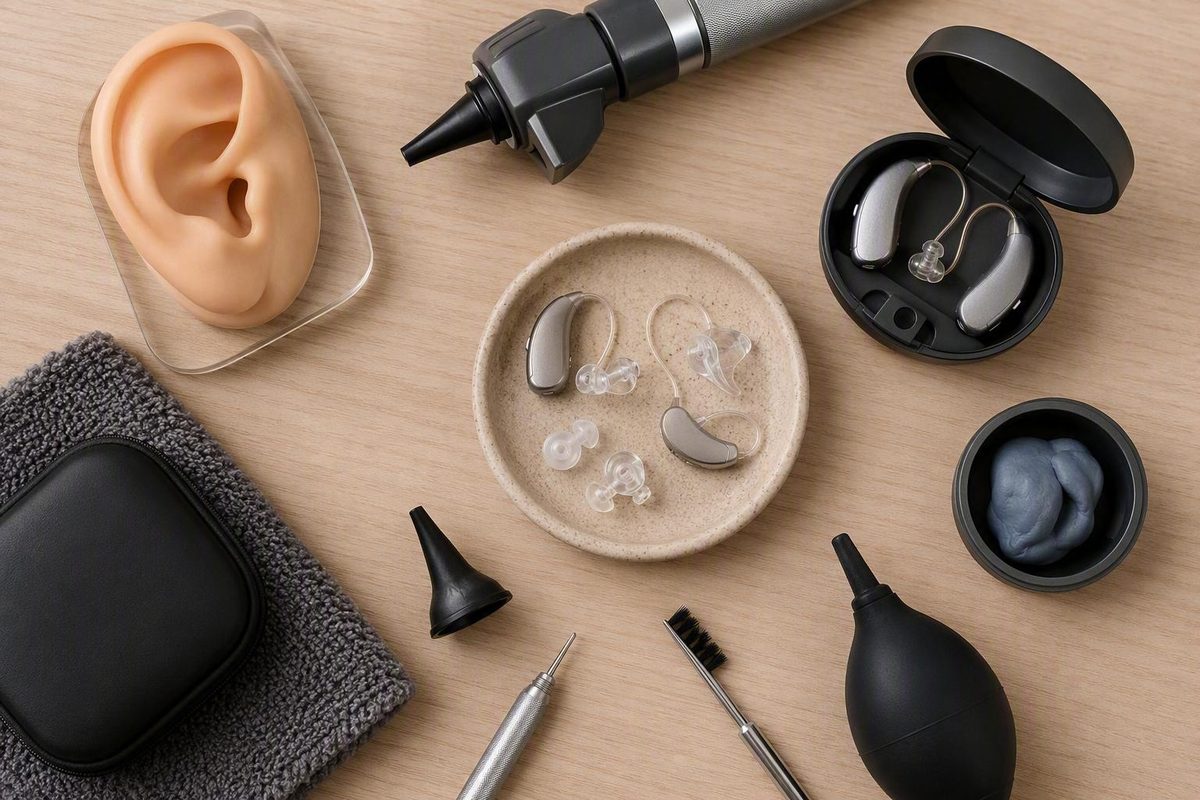
A hearing aid fitting is not simply a device handoff. It is the process of matching hearing aids to your hearing profile, ear anatomy, comfort, communication goals, daily environments, and ability to operate the devices confidently.
That process may combine assessment, device selection, physical fitting, software programming, in-ear verification when available, practical instruction, real-world use, and follow-up adjustments. Some steps may happen in one long appointment; others may be spread across several visits.
The first fitting is therefore a starting point, not a guarantee that every setting will be final. Understanding each stage can help you prepare, ask useful questions, and recognize problems that deserve attention.
What a hearing aid fitting includes—and why the process varies
A complete fitting addresses four related questions:
- Does the device fit securely and comfortably?
- Are its settings based on your hearing information and communication goals?
- Has its output been checked, or have the available verification options been explained?
- Can you use, maintain, and troubleshoot it in daily life?
A common sequence includes:
- Examination of the ears and a hearing assessment, or review of recent results
- Discussion of communication priorities and difficult listening situations
- Selection of an appropriate device style and features
- Ear impressions when a custom shell or earmold is needed
- Physical fitting of the device, dome, ear tip, or mold
- Initial programming based on hearing-test information
- Objective verification, such as real-ear measurement, when included
- Hands-on instruction
- Use in everyday environments
- Follow-up adjustments based on experience
This sequence may occur in one long session or across several appointments. The schedule depends on factors such as whether current hearing-test results are available, whether a custom component must be manufactured, the device style, the user’s experience, and the provider’s process. Provider descriptions confirm that there is no universal two-appointment format for every fitting (Hearts for Hearing).
A custom in-the-ear shell or earmold generally requires an impression or other ear measurement followed by manufacturing. A longtime user having one setting changed may also need less instruction than someone handling hearing aids for the first time.
Appointment length therefore varies widely. A targeted adjustment may be brief, while a visit involving testing, custom-mold work, programming, verification, and instruction may take approximately 45 minutes to two hours or longer (CareCredit). These are examples, not guaranteed durations.
Ask what the appointment includes rather than judging it only by length. A short visit may be appropriate for a focused adjustment. It may be inadequate if you expected a physical-fit assessment, training, or output verification and those tasks did not occur.
Follow-up does not necessarily mean the original fitting failed. A clinic cannot reproduce every conversation, restaurant, car ride, meeting, television program, or phone call you encounter. Fitting is better understood as a cycle: set the devices, use them, document what happens, and refine them.
Before the devices are fitted: ear checks, hearing results, and communication goals
Before programming begins, the person fitting the devices needs relevant information about your ears, hearing, needs, and previous experience.
A typical evaluation may include:
- Looking in the ears for conditions that could interfere with safe or comfortable use
- Conducting a hearing test or reviewing recent results
- Discussing previous hearing-aid experience
- Identifying important voices, settings, and activities
- Reviewing physical limitations that could make small controls, batteries, or earpieces difficult to handle
- Discussing preferences, connectivity needs, appearance, and budget
An audiogram is a graph that displays hearing ability across different frequencies or pitches. Its results commonly provide the starting information for programming, allowing the hearing aids to provide different amounts of amplification at different frequencies rather than treating every sound identically (Bluegrass Hearing Clinic).
The audiogram does not answer every fitting question. Two people with similar test results may have different priorities. One may need to follow meetings at work; another may care most about family conversations, television, music, outdoor activities, or telephone calls.
Device decisions may also reflect:
- Ear anatomy and physical comfort
- Dexterity and vision
- Previous hearing-aid experience
- Cosmetic preferences
- Desired phone, television, or accessory connections
- Ability to manage controls or an app
- Available budget
Style, features, ear-tip or earmold choices, and budget can all influence the fitting, but not every available feature is necessary (Signia). A simpler device that you can operate reliably may be more practical than one with functions you will not use.
Make your goals specific. “I want to hear better” is understandable, but it gives the fitter less useful information than:
- “I miss my spouse’s voice when we are in separate rooms.”
- “I hear voices in restaurants but cannot distinguish the words.”
- “Telephone calls are difficult in my right ear.”
- “I need to follow several people during work meetings.”
- “My previous hearing aids made dishes and cutlery uncomfortably sharp.”
- “Limited hand movement makes small earpieces difficult to insert.”
What to bring
Consider bringing:
- Available hearing-test records
- Current or previous hearing aids, if relevant
- The phone or tablet you want to pair with the devices
- A charger, remote microphone, television accessory, or other relevant equipment
- A written list of difficult listening situations
- Questions about fit, verification, support, and service terms
- Reading glasses or another tool you normally need for small tasks
- Medication or symptom information if the practice requests it
You may also invite a family member or communication partner. This is optional. A companion can help describe communication difficulties, observe the instructions, and remember information after a busy appointment, but your goals and preferences should remain central.
Before the visit, ask:
- Who will examine my ears and conduct or review the hearing test?
- Who will physically fit and program the hearing aids?
- Is real-ear or another form of output verification available?
- How will I practice insertion, charging, cleaning, and controls?
- How are follow-up adjustments arranged?
- Which services and adjustments are included?
- Who should I contact about fit, repair, or connectivity problems?
Physical fit: domes, ear tips, earmolds, and custom shells
Physical fit and sound programming are related, but they are not the same. A hearing aid can have carefully selected software settings and still be difficult to use because the earpiece hurts, slips, whistles, or cannot be inserted consistently.
Many non-custom hearing aids use premade domes or ear tips in different sizes and shapes. Other devices or individual needs call for a custom earmold or shell. A custom component may be selected to improve retention, provide a particular acoustic seal, accommodate the hearing-aid style, or match the shape of the ear.
When a custom component is needed, the provider may take an ear impression. Soft material captures the relevant shape of the ear canal and outer ear, and that impression is used to manufacture the shell or mold (Audibel).
Not every hearing aid requires an impression. A receiver-in-canal device, for example, may use a premade dome, while another person using a similar device may need a custom earmold. Custom is not automatically better, and a premade component is not automatically sufficient. The appropriate choice depends on the ear, device, hearing needs, comfort, and intended acoustic result.
During the physical fitting, the provider may assess:
- Whether the device and earpiece are positioned correctly
- Comfort in the ear canal and around the outer ear
- Retention while talking, chewing, or moving
- Whether the dome, tip, or mold creates the intended seal
- The placement and length of tubing or receiver wires
- Interference from glasses, masks, oxygen tubing, or other equipment
- Whether you can identify the correct orientation
- Whether you can insert and remove the device safely
- Whether feedback or whistling occurs
A secure hearing aid should not require constant pushing or repositioning. Initial awareness of a new object in the ear can occur, but pain should not be treated as a necessary part of adaptation.
Report:
- Pain, soreness, or skin irritation
- Persistent pressure
- A device that repeatedly slips out
- A wire or tube that rubs the ear
- Difficulty inserting the earpiece consistently
- A loose custom shell
- Recurring feedback or whistling
Because the cause is not always the volume setting, recurring whistling should be evaluated rather than managed only by turning the hearing aid up or down.
Programming and real-ear measurement are not the same thing
Initial programming commonly begins with hearing-test results. The hearing aids are connected to fitting software, and settings are selected for different frequencies and input levels. The aim is not simply to make everything louder. Soft, moderate, and loud sounds may require different treatment.
Programming software provides an informed starting point, but it does not by itself measure exactly what reaches a particular person’s eardrum. Ear canals differ in shape and volume, and the earpiece changes how sound behaves. Programming and in-ear verification are therefore not interchangeable.
Real-ear measurement, also called probe-microphone measurement, is an objective method of assessing hearing-aid output in the wearer’s ear. A thin probe tube is positioned in the ear canal near the eardrum while the hearing aid operates and test sounds are presented. The fitter can then measure the sound delivered in that individual ear at different input levels (Independence Hearing).
The results can show whether the measured output is close to the selected fitting targets and where adjustments may be needed. Because the measurement occurs in the user’s ear, it accounts for ear-canal characteristics that software predictions alone do not directly measure.
The three main information sources serve different purposes:
- Hearing-test-based programming provides estimated initial settings based on the hearing profile and fitting approach.
- Real-ear measurement, when used, checks what the hearing aid delivers inside the individual ear.
- User feedback reveals comfort, sound quality, clarity, usability, and performance in real situations.
These sources complement one another. A technical measurement cannot reveal whether an earpiece hurts after several hours, whether you can operate the charger, or whether a colleague remains difficult to understand in a meeting. Conversely, sound seeming acceptable in a quiet office does not objectively establish the device’s output across frequencies and input levels.
Real-ear measurement may be included in a fitting, but the available evidence does not establish it as universal. Ask:
- Do you offer real-ear or probe-microphone measurement?
- Is it included in the quoted service?
- When is it performed?
- How will the results guide programming?
- If it is not offered, how will output and loudness be checked?
- Might verification be repeated after a major programming change or new earmold?
Real-ear measurement is one component of fitting, not a stand-alone guarantee of success. Physical comfort, appropriate programming, device skills, real-world experience, and follow-up still matter.
What you should be able to do before leaving the appointment
A demonstration is useful, but hands-on practice is better. When feasible, the provider should ask you to perform essential tasks yourself. This teach-back approach can expose practical problems before you are alone at home.
Before leaving, try to demonstrate that you can:
- Identify the left and right hearing aid
- Insert each device correctly
- Remove each device safely
- Use the power controls, if present
- Place rechargeable devices in the charger correctly
- Replace disposable batteries, if applicable
- Confirm that each device is powered
- Adjust volume or change programs when those controls are enabled
- Clean the appropriate surfaces and openings
- Store the devices safely and keep them dry
- Recognize a blocked sound opening or wax filter
- Perform the basic troubleshooting steps recommended for your devices
Ask about the left-right markings used on your specific model. Do not leave uncertain about which device belongs in which ear.
Ask the provider to show you how to check its power status, charge or battery, insertion, and sound opening before moving to further troubleshooting.
If your hearing aids support an app, streaming, remote microphones, or other accessories, practice the functions you expect to use. That might include:
- Pairing the hearing aids with a phone or tablet
- Confirming where calls are routed
- Starting and stopping audio streaming
- Changing an app program
- Adjusting permitted user controls
- Reconnecting after restarting the hearing aids or phone
- Using an accessory in a realistic configuration
Not every device has an app, wireless connection, remote control, or user-selectable program. Training should reflect the devices you selected rather than a generic list of technology.
Ask which settings are intended for routine user control. Small volume or program changes may be expected, while repeated large adjustments, uncomfortable loudness, or poor clarity across many environments may call for professional fine-tuning.
Because a first fitting can involve more information than a new user can remember, request printed instructions, digital guides, manufacturer materials, or a personalized checklist. Practice with insertion, removal, cleaning, batteries, and maintenance is commonly included in fitting instruction (Hoffmann Audiology).
Questions about service and ownership
Before buying—or at least before leaving—ask for clear answers about:
- Manufacturer warranty
- Repair procedures and points of contact
- Loss-and-damage terms
- Trial or return policy
- Return or restocking charges
- Included supplies
- Replacement domes, filters, batteries, or drying equipment
- Follow-up fees
- Included programming adjustments
- Charges for real-ear measurement or other verification
- Connectivity assistance
- Loaner-device availability during repairs
- Remote support, if offered
- What happens if the physical style proves unsuitable
Terms, prices, and included services vary. Obtain important terms in writing and note any deadlines rather than assuming that another provider’s policy applies.
Adapting to new sound and using follow-up visits effectively
New hearing aids can make familiar sounds seem unfamiliar. Adaptation varies among users.
Follow the individualized wear guidance provided for your hearing needs and devices rather than adopting another person’s schedule. Adaptation does not mean enduring pain, unsafe loudness, persistent pressure, repeated feedback, poor retention, malfunction, or a sudden hearing change. Those problems should be reported rather than treated as something continued wear will necessarily fix (American Academy of Audiology).
Early experiences may include:
- Greater awareness of soft household sounds
- A changed perception of your own voice
- Needing practice with insertion and controls
- Finding some environments tiring while learning what to notice
- Discovering that one program works better in a particular setting
Contact the provider if you experience:
- Pain, broken skin, or persistent pressure
- Intolerably loud sound
- Repeated whistling
- A device that will not remain in place
- Sound that cuts in and out
- A charger, battery, or hearing aid that appears not to work
- Consistently poor speech clarity
- Inability to insert or remove the hearing aid safely
- A sudden or marked change in hearing
Follow-up is a normal stage of fitting because office conditions cannot reproduce every home, workplace, vehicle, restaurant, telephone call, television program, or family gathering. Some providers describe an initial follow-up within the first few weeks, although no single interval applies to everyone (Northwest Ear Institute).
Keep a listening diary
Specific observations are more useful than saying only that the hearing aids “sound bad.” Use a phone note, notebook, or table:
| Date and environment | Speech clarity | Loudness | Physical comfort | Feedback | Listening effort | Wear time | Connectivity | Changes I made |
|---|---|---|---|---|---|---|---|---|
| Restaurant, four people | Heard voices but could not distinguish words across the table | Dishes sounded uncomfortably sharp | Comfortable | None | High | 2 hours | Not used | Reduced volume once |
| Walking outdoors | Companion clear on left, less clear on right | Comfortable | Right aid slipped twice | Brief whistle after reinsertion | Moderate | 45 minutes | Not used | Reinserted right aid |
| Phone call at home | Call streamed only to left aid | Clear on left | Comfortable | None | Low | 20 minutes | Right aid disconnected | Restarted phone |
Record details such as:
- Who was speaking and how far away they were
- Whether you heard the voice but could not understand the words
- Whether one or both ears were affected
- The type of background noise
- Whether a sound was noticeable or uncomfortably sharp
- How long you wore the devices before discomfort began
- Whether feedback was continuous or occurred only during insertion
- The program and volume used
- Any app adjustment you made
- Whether cleaning or restarting resolved the problem
“Speech was unclear” becomes more actionable when expanded to: “At a restaurant with four people, I understood the person beside me but not the person across the table. Reducing volume made every voice softer without improving clarity.”
Similarly, “The right aid does not fit” is more useful as: “The right dome remains in place while I am seated but slips after I have been walking.” That distinction can help separate a retention problem from a programming complaint.
Hearing aids can improve access to sound and support communication, but they do not cure hearing loss or guarantee effortless understanding in every noisy environment. Realistic expectations do not mean accepting poor performance without investigation. They mean evaluating improvement against meaningful goals while recognizing the limits of amplification.
Professional fitting versus OTC self-fitting
A professionally supported pathway and an over-the-counter self-fitting pathway assign responsibilities differently.
With professional fitting, a hearing-care professional typically evaluates or reviews hearing, helps select the device, checks the physical fit, programs it, explains available verification, teaches device use, and provides a route for adjustments.
With an OTC pathway, the purchaser is generally responsible for choosing the device, fitting it to the ear, and tuning its sound. A self-fitting product may use an app or accessory that presents signals and creates a listening program from the user’s responses.
American Academy of Audiology consumer guidance describes OTC hearing aids as intended for adults age 18 or older with perceived mild-to-moderate hearing loss. It also notes that the consumer handles setup and tuning, although professional testing and support may still be obtained. These criteria should not be extended to children or used to dismiss warning symptoms that need evaluation.
| Fitting responsibility | Professionally fitted pathway | OTC self-fitting pathway |
|---|---|---|
| Hearing evaluation | Commonly conducted or reviewed by a professional | Consumer may need to arrange it separately |
| Ear inspection | May be included before fitting | Not automatically included with purchase |
| Physical fitting | Provider selects or adjusts the earpiece and checks comfort | Consumer selects and positions supplied components |
| Initial tuning | Uses hearing information, fitting software, and professional input | Completed by the consumer, often through an app or accessory |
| Objective in-ear verification | May be available through professional services | May be obtained separately from an audiologist |
| Training | Provider may demonstrate and supervise practice | Consumer generally follows product instructions or remote support |
| Troubleshooting | Practice may provide ongoing assistance | Depends on the manufacturer, retailer, or separately purchased support |
| Follow-up | Often arranged through the fitting practice | Usually initiated by the consumer unless a support plan is included |
This is not a simple comparison between “good” and “bad” fitting. OTC devices may offer an accessible route for eligible adults who can manage setup. Professional support may be especially useful when the hearing picture, physical fit, technology, dexterity, or communication demands are more complicated.
The pathways can also be combined. An adult may purchase an OTC hearing aid and later consult an audiologist for hearing testing, physical-fit help, in-ear output measurement, troubleshooting, or fine-tuning.
Comparative research should be interpreted cautiously. A randomized clinical trial involving 64 participants compared an OTC self-fitting hearing aid with an audiologist-fitted hearing aid and assessed outcomes after two and six weeks. It included self-reported benefit and speech-in-noise measures, with broadly similar results on some measures and measure-specific differences on others (JAMA Otolaryngology–Head & Neck Surgery).
The study does not establish that every OTC device performs as well as every professional fitting. Its sample was small, the comparison involved particular devices and procedures, and follow-up lasted only weeks. Short-term benefit or satisfaction cannot establish universal suitability or long-term equivalence.
A Cincinnati Children’s summary of related research also reports encouraging outcomes for selected users of specific self-fitting devices while emphasizing the need for larger, more diverse, longer-term studies across additional products and support models.
When comparing pathways, ask who will be responsible for:
- Determining whether your hearing needs fit the pathway
- Looking in your ears
- Selecting and retaining a comfortable earpiece
- Checking actual output in the ear
- Addressing feedback or sound-quality problems
- Teaching cleaning and maintenance
- Handling repairs and connectivity
- Reassessing the devices if your hearing changes
The most appropriate choice depends on your needs, ability to self-manage, access to support, and willingness to seek help when something is not right.
When to pause self-fitting and seek professional evaluation
Pause routine fitting or OTC setup and seek prompt professional evaluation if you have:
- Sudden hearing loss
- Hearing that is worsening rapidly
- A marked one-sided or asymmetric change
- Ear pain
- Recent ear drainage
- Dizziness
- Substantial earwax or a foreign object in the ear
- An injured or malformed ear
Professional audiology guidance identifies these as warning signs that should not be managed simply by increasing amplification or continuing to experiment with device settings (American Academy of Audiology). A sudden hearing change belongs in the prompt-evaluation category, not on a list of issues to revisit at a routine fitting appointment.
Distinguish these signs from ordinary technical or fitting problems. A phone that will not pair, an unfamiliar app, or a program that needs fine-tuning may call for technical support. Sudden or rapidly changing hearing, drainage, significant pain, or dizziness calls for professional evaluation.
Contact the fitting provider promptly if a device:
- Causes pain or skin injury
- Produces intolerably loud sound
- Whistles repeatedly
- Will not stay in place
- Cannot be inserted or removed safely
- Stops working or works intermittently
- Becomes damaged
- Seems to perform differently after a sudden hearing change
Do not force an earpiece past pain or resistance. If the device appears to function but your hearing has changed abruptly, treat that as a hearing concern rather than merely a programming problem.
Use this provider-neutral quality check:
- Goals: Were your communication priorities and difficult environments discussed?
- Physical fit: Were comfort, position, retention, insertion, removal, and feedback checked?
- Programming: Were the initial settings tied to hearing information and your needs?
- Verification: Was output checked, or were the available verification methods explained?
- Skills: Did you practice the tasks needed to use and maintain the devices?
- Support: Were you given a clear route for follow-up, repairs, and sound adjustments?
A useful fitting should leave you able to answer four practical questions: Is the device comfortable and secure? Are its settings tied to my hearing information and goals? Has its output been checked, or have my verification options been explained? Can I operate it confidently in daily life?
Treat later adjustments as a normal part of fitting, document real-world problems clearly, and seek prompt evaluation for pain, unsafe loudness, sudden or asymmetric hearing changes, drainage, or dizziness. This article provides general educational information and cannot diagnose hearing loss or replace individualized care.
Hearing aid fitting FAQs
How long does a hearing aid fitting take?
It depends on what the appointment includes. A targeted adjustment may be brief. A visit involving hearing testing, physical fitting, custom-mold work, programming, verification, and instruction may take approximately 45 minutes to two hours or longer. Some providers divide the work across multiple visits.
Ask for the expected duration and agenda in advance. The important question is not only “How long will it take?” but also “Which fitting, verification, and training tasks will be completed?”
Who can perform a hearing aid fitting?
Professional fittings may be performed by an audiologist or another appropriately authorized hearing-care professional, such as a hearing-aid specialist. Titles, credentials, permitted services, and supervision requirements may differ by jurisdiction, so these professionals should not be assumed to have identical scopes of practice.
Ask who will examine your ears, test or interpret your hearing, take impressions, select and program the devices, perform verification, and provide follow-up.
Should I ask for real-ear measurement during my fitting?
Yes. It is reasonable to ask whether real-ear measurement is offered, what it measures, how the findings guide programming, and whether it is included in the service.
The procedure provides information that software programming alone does not directly measure: the hearing aid’s output in your own ear canal. It is not the only part of a successful fitting, however. Comfort, hearing-based programming, communication goals, practical skills, and follow-up also matter.
If real-ear measurement is unavailable, ask how output and loudness will be checked and what alternative verification methods the provider uses.
Is it normal for new hearing aids to sound strange or need several adjustments?
Newly amplified speech, environmental sounds, and your own voice may initially seem unfamiliar. The adaptation period varies, and later adjustments are common because real environments expose issues that may not appear in a quiet office.
Pain, intolerable loudness, recurring feedback, poor retention, malfunction, or a sudden hearing change should not be dismissed as ordinary adaptation. Report those problems rather than waiting indefinitely for continued wear to resolve them.
Can an audiologist help me fit an OTC hearing aid?
Yes. An adult who purchases an OTC hearing aid may still consult an audiologist for a hearing evaluation, help assessing the device’s suitability, physical-fit troubleshooting, in-ear output measurement, or fine-tuning.
Availability and fees vary. Ask whether the practice supports consumer-purchased devices and which services it offers. This hybrid approach can preserve consumer choice while adding professional help where needed, but it does not make every OTC device suitable for every hearing concern.