
Rechargeable Hearing Aids: What to Check Before Buying
Compare rechargeable hearing aids by fit, real-world runtime, charger design, battery service, return terms, and OTC or prescription support.
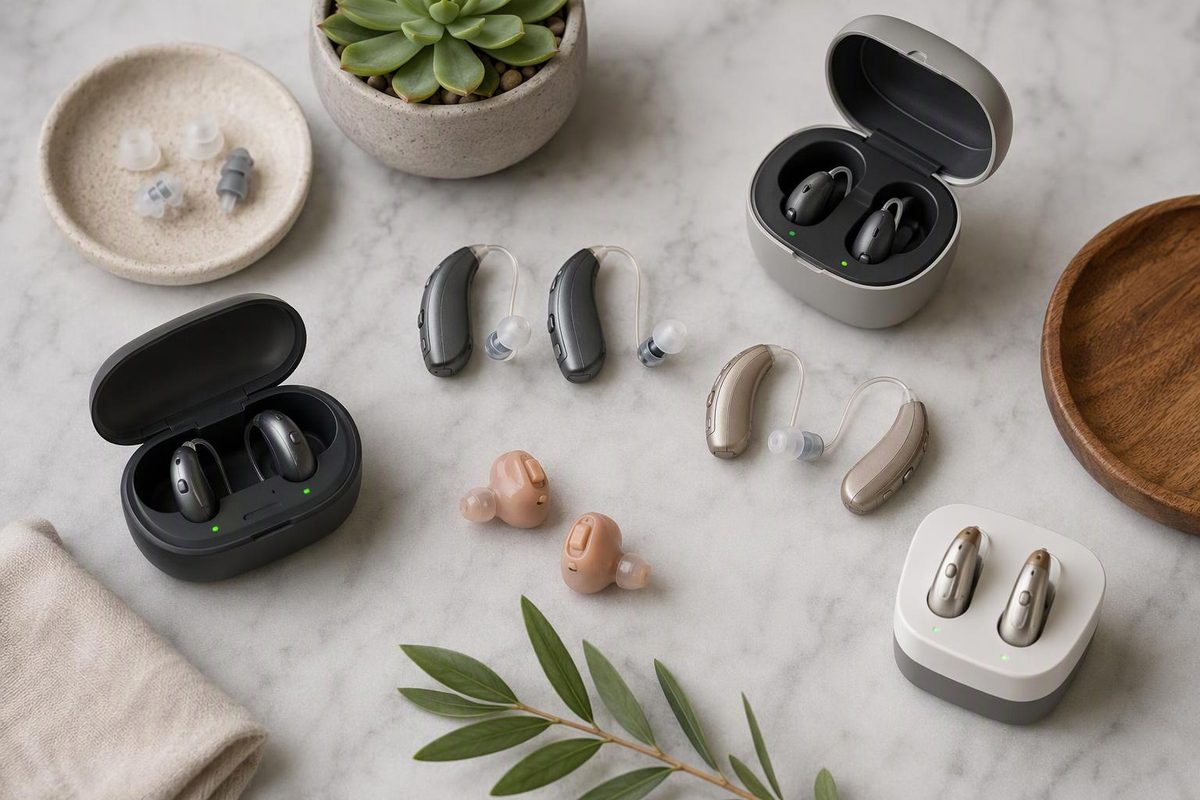
Rechargeable hearing aids remove the need to handle tiny disposable batteries. For many people, placing two devices in a charger each night is easier than opening battery doors and replacing zinc-air cells.
But “rechargeable” describes the power source—not how well a hearing aid treats your hearing loss. The better choice is a device that can be fitted appropriately, lasts through your day and has a charging routine you can manage reliably.
Rechargeable vs. disposable-battery hearing aids
| Consideration | Rechargeable | Disposable battery |
|---|---|---|
| Daily routine | Charge, usually overnight | Replace cells periodically |
| Dexterity | No tiny cell or battery tab to handle | Cell and battery door may be difficult to grip |
| Backup power | May require an outlet or a charged portable case | Spare cells are easy to carry |
| Battery service | A built-in battery may require professional or manufacturer service | The user can usually replace a depleted cell |
| Travel | Charger and cable must come with you | Spare cells provide an immediate backup |
Neither design is automatically better for speech understanding. Performance depends on the hearing aid, its physical fit and its programming.
Six checks before you buy
1. Confirm that the aid suits your hearing loss
Rechargeable options include both over-the-counter (OTC) and prescription hearing aids. In the United States, OTC aids are intended for adults 18 or older with perceived mild-to-moderate hearing loss. Prescription aids are obtained through a licensed hearing professional and may be appropriate for a wider range of ages and hearing losses, depending on the device’s intended use, according to the FDA’s explanation of the two categories.
Ask the questions that matter regardless of battery type:
- Does the device have enough fitting range for my audiogram?
- Is the earpiece comfortable and secure?
- Can it make speech audible without making loud sounds intolerable?
- Do I need one aid or two?
- Who will adjust it if the first settings do not work well?
An unusual audiogram needs particular care. Choosing hearing aids for low-frequency hearing loss, for example, depends on programming and acoustic coupling—not rechargeability.
For a prescription fitting, ask whether the service includes real-ear measurement. This procedure places a small probe-microphone tube in the ear canal to measure what the aid actually delivers and compare it with prescriptive targets. The American Speech-Language-Hearing Association considers real-ear measures the gold standard for hearing-aid fitting verification in its adult hearing-aid guidance.
2. Translate the runtime claim into your day
“All-day power” is not a universal number. Runtime can vary with the model, hours worn, wireless streaming, accessories, settings and battery condition.
Phonak’s current product information illustrates the differences within one manufacturer’s range: it says streaming uses more battery energy, while its chargers vary from plug-in models to cases with enough stored power for multiple recharges. Check the specifications for the exact aid and charger rather than assuming all rechargeable models behave alike (Phonak battery and charger information).
Estimate your longest normal day, then ask:
- What runtime is expected with my settings?
- How much phone, music or TV streaming is included in that estimate?
- How long does a full charge take?
- What does a 15- or 30-minute quick charge provide?
- Will I receive a warning before the aids shut down?
Someone who wears hearing aids for 10 hours with little streaming has a different requirement from someone who starts at 6 a.m., attends an evening event and streams calls throughout the day.
3. Test the charger
Try placing and removing each aid before the return period expires. Small charging wells, unclear indicator lights or precise alignment requirements can undermine the convenience.
Check whether the charger:
- needs to remain plugged in or contains its own battery;
- holds the aids securely when closed;
- clearly indicates charging, completion and faults;
- uses a readily available cable and wall adapter;
- accommodates your earmolds or custom earpieces;
- can provide multiple charges away from an outlet, if that matters to you.
Charger behavior is model-specific. Oticon, for example, says compatible aids can remain on and continue losing power if placed in an unplugged charger whose internal power bank is empty. Its indicator lights also distinguish charging, completion and low charger power (Oticon charging instructions). Read the manual for the charger you are buying.
4. Ask how battery service works
A rechargeable battery’s useful runtime can decline over the life of the device, and replacement arrangements vary. Get written answers before buying:
- Can the battery be replaced locally, or must the aid go to the manufacturer?
- Is loss of battery capacity covered by the warranty?
- What are the expected turnaround time and out-of-warranty cost?
- Is a loaner available during service?
- Does the charger have separate warranty terms?
Treat lifespan claims cautiously. Check the footnotes for the test conditions, assumed streaming time and the manufacturer’s definition of acceptable remaining capacity.
5. Check the return policy and total package
FDA rules require an OTC hearing-aid package to state the manufacturer’s return policy—or say that there is none. The package must also disclose the battery type and whether a phone or remote is necessary to control the aid. Federal OTC rules do not require a warranty, so read the return and warranty terms before paying (FDA buying guidance).
Confirm whether the advertised price includes:
- one hearing aid or a pair;
- the charger, cable and wall adapter;
- a portable charging case;
- app or remote support;
- professional adjustments and follow-up;
- repairs and replacement parts.
Use the return period to try the aids during conversations, television, outdoor listening, phone calls and the noisy situations that matter to you. Keep the packaging and note the return deadline and any nonrefundable fees.
6. Make sure the care routine works
Charging does not replace cleaning. Wax blocking the sound outlet can make a powered hearing aid seem weak or dead. Use only tools approved for the model, and make sure replacement hearing-aid wax filters match your device.
The National Institute on Deafness and Other Communication Disorders advises keeping hearing aids away from heat and moisture and cleaning them as instructed (NIDCD care guidance). Follow the model’s manual for drying and charging; do not use household heat or an unspecified charger.
Stop using an aid that becomes unusually hot, appears swollen or damaged, or causes a burn. The FDA asks consumers to report hearing-aid injuries and malfunctions through MedWatch and lists burns from an overheated battery as a possible adverse event (FDA OTC hearing-aid safety guidance).
Who is a good candidate for rechargeability?
Rechargeable aids can be practical if you have reduced vision or hand dexterity, follow a dependable nighttime routine and have reliable access to power. A portable charging case may make them more workable for travel and long days.
A disposable-battery model may be preferable if you spend extended periods without electricity, want to restore power immediately with a spare cell or cannot risk sending a built-in-battery device away for service. If uninterrupted hearing access is essential, ask about a loaner policy or a backup device.
Before buying OTC, seek medical care rather than self-fitting if you have ear pain, drainage, substantial wax or a possible object in the ear; marked dizziness; a sudden or fluctuating hearing change; worse hearing in one ear; or ringing in only one ear. These are among the warning signs required on OTC hearing-aid packaging. Children and people who may have severe or profound hearing loss need professional evaluation instead of an OTC aid.
The deciding test is straightforward: can this exact hearing aid be fitted for your hearing, run through your longest day, and be charged and serviced without disrupting your routine? If those answers are documented rather than merely promised, rechargeability can be a meaningful convenience.