
Can Hearing Aids Cause Vertigo? Not Commonly
Physical discomfort, excessive amplification or a programming change may be relevant; severe or persistent symptoms need medical evaluation.
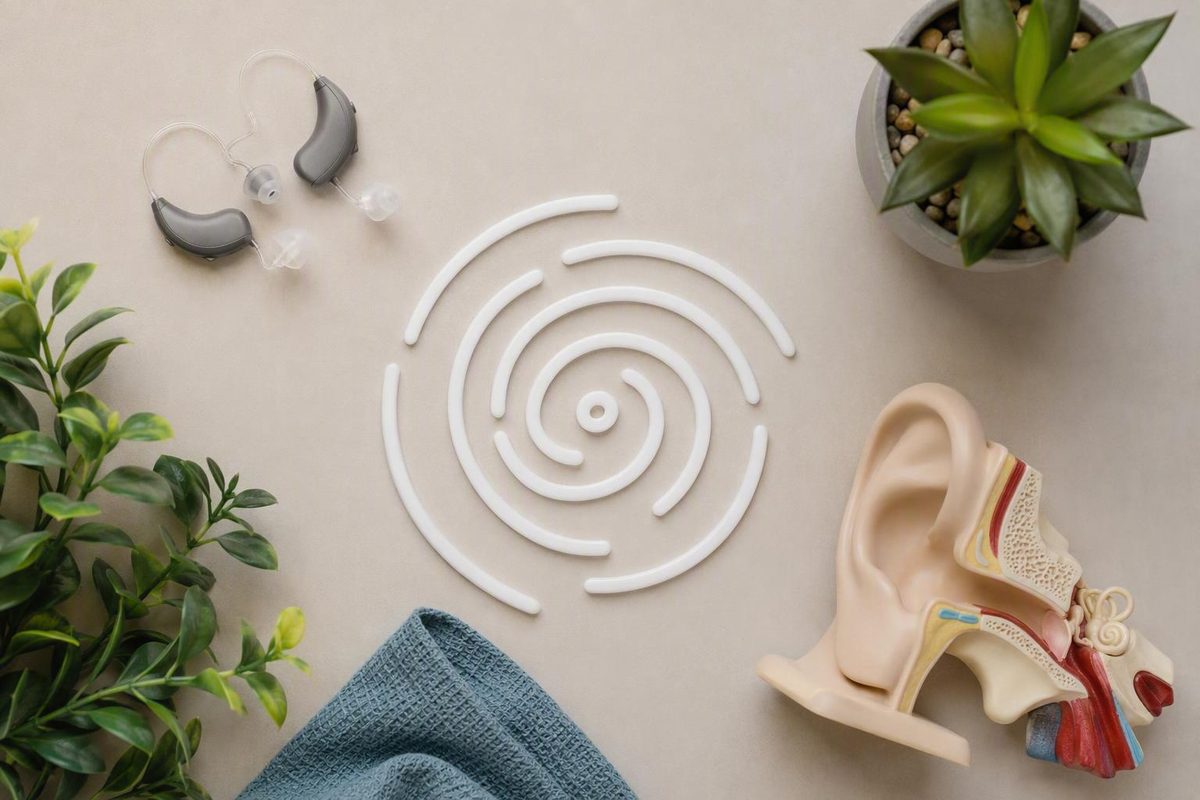
Conventional hearing aids are not established as a common direct cause of true vertigo. If dizziness begins after inserting a new aid, raising its volume, or changing its programming, sit or lie down, pause device use, and avoid driving or stairs until you are steady. Have an audiologist check the fit and settings.
The short answer: hearing aids are not an established common cause of vertigo
Some people report dizziness, imbalance, or spinning when they begin wearing hearing aids or after a fitting or setting change. That timing makes the device worth checking, but it does not prove that the hearing aid caused the symptom.
Vertigo is a false sensation that you or your surroundings are moving, spinning, or tilting. It is different from:
- Lightheadedness: feeling faint or as though you may pass out
- Unsteadiness: feeling unstable while standing or walking
- Disequilibrium: a general loss of balance without a spinning sensation
- Faintness: a symptom that may have non-ear causes
The distinction matters because these symptoms can require different evaluations. True vertigo often directs attention toward the vestibular system, while lightheadedness or faintness may need a broader medical assessment.
The evidence around conventional hearing aids and vertigo is limited. Reliable incidence figures, a proven universal “auditory adaptation” mechanism, and a standard recovery period have not been established. FDA consumer guidance discusses ordinary hearing-aid adjustment and sounds initially seeming too loud, but it treats vertigo or severe dizziness as a reason to consult a doctor rather than identifying vertigo as an expected device effect (FDA hearing-aid guidance).
That does not mean a hearing aid can never contribute to an individual’s symptoms. Physical discomfort, excessive amplification, a recent programming change, or a particular sound may be relevant. The safest conclusion is narrower: symptoms associated with hearing-aid use deserve troubleshooting, while persistent, severe, or otherwise concerning symptoms deserve medical evaluation.
Possible explanations: use the symptom pattern, not assumptions
Look for a reproducible pattern rather than relying only on when the symptoms first appeared. Does the dizziness begin when the aid is inserted but switched off? Only when amplification starts? Only with one device? After a volume increase? Around a particular sound? Does it stop after removal?
Commercial hearing-care providers identify fit, volume, earwax, new auditory input, and pre-existing vestibular conditions as troubleshooting possibilities. These reports do not establish that any one factor caused true vertigo, so the table should be used to guide professional evaluation—not self-diagnosis (hearing-aid dizziness guidance).
| Possible explanation | Useful clues | Immediate response | Appropriate professional |
|---|---|---|---|
| Poor physical fit or earmold pressure | Pressure, pain, or discomfort begins with insertion, especially with one device | Remove it temporarily; do not force it back in | Audiologist or hearing-aid dispenser |
| Excessive volume or programming change | Symptoms follow a louder setting, new program, or particular sound | Pause use and avoid the triggering setting | Audiologist |
| Earwax or an ear-canal problem | Blocked sensation, feedback, discomfort, or difficulty inserting the aid | Avoid deep self-removal or inserting tools | Qualified clinician or audiologist |
| Proposed sensory adjustment | Mild disorientation begins with unfamiliar amplified sound and no warning signs | Pause if needed and ask about a gradual schedule | Audiologist |
| Underlying inner-ear or vestibular condition | Symptoms continue without the aid or accompany tinnitus, hearing changes, fullness, nausea, or sound sensitivity | Arrange medical assessment | Physician or ENT |
| Sound-sensitive vestibular disorder | Dizziness repeatedly follows loud or specific sounds | Avoid repeated triggering and document the pattern | ENT and audiologist |
Fit, volume, and earwax are issues to have checked, not proven explanations for vertigo. If wax may be blocking the aid or affecting insertion, ask a qualified professional to inspect the ear.
“Sensory adjustment” also requires caution. Hearing-care providers sometimes use the term to describe mild disorientation after new amplified input, but a clinically proven mechanism and dependable timeline have not been established. Severe spinning or substantial imbalance should not be treated as an adaptation exercise.
One uncommon alternative is superior canal dehiscence, an inner-ear disorder that can produce dizziness, nausea, or disequilibrium in response to loud or everyday sounds. In someone with that condition, amplified sound might trigger symptoms without causing the underlying disorder (ASHA review of superior canal dehiscence).
What to do when dizziness starts
Reduce the immediate risk of a fall:
- Sit or lie down somewhere safe.
-
Remove or turn off the hearing aid during the episode.
-
Ask for help if you cannot walk safely.
- Seek urgent care if warning signs are present.
Do not continue wearing the device through severe spinning or significant imbalance simply to “get used to it.” Once you are stable, and provided there are no emergency symptoms, contact your audiologist. Ask for an inspection of the dome or earmold, ear canal, device output, volume, and programming.
If symptoms are mild and there are no warning signs, shorter wearing sessions or a modest reduction through the aid’s normal user-accessible volume control may be reasonable while you wait for advice. Do not make large unsupervised programming changes, use unofficial fitting software, or repeatedly test a setting that causes spinning.
Keep a brief symptom diary that records:
- Which ear and hearing aid were involved
- Whether the aid was inserted, switched on, or streaming
- The volume and listening program
- Any recent fitting or programming changes
- How long the aid had been worn
- Whether a particular sound triggered the episode
- How long the symptoms lasted
- Whether removal stopped the symptoms
- Any nausea, tinnitus, fullness, pain, drainage, hearing change, or neurological symptom
A pattern associated only with insertion may make physical fit more relevant. Symptoms beginning only when amplification is active may point the audiologist toward output, programming, or a sound trigger. None of these patterns proves causation by itself.
There is no dependable number of days or weeks within which vertigo associated with hearing-aid use should resolve. Do not postpone assessment because someone has promised that severe or persistent symptoms are a normal adjustment effect.
When vertigo needs urgent medical evaluation
Sudden hearing loss with dizziness is a medical emergency, particularly when the hearing change affects one ear. Sudden sensorineural hearing loss can develop at once or over several days and may occur with dizziness, tinnitus, or ear fullness. The National Institute on Deafness and Other Communication Disorders advises treating sudden-deafness symptoms as a medical emergency (NIDCD sudden hearing loss guidance). Do not assume the hearing aid caused the change or wait for the fitting to be adjusted.
Seek prompt medical or ENT evaluation for:
- Severe, recurrent, worsening, or persistent vertigo
- A fall, head impact, or other injury
- Significant nausea or repeated vomiting
- Ear pain, blood, fluid, pus, or other drainage
- Ear fullness accompanying vertigo
- Fluctuating, sudden, one-sided, or markedly asymmetric hearing
- New or one-sided tinnitus
- Symptoms that continue without the hearing aid
- Vertigo repeatedly triggered by sound or pressure
The FDA lists vertigo or severe dizziness, sudden or fluctuating hearing loss, ear pain or drainage, and one-sided hearing concerns as reasons to consult a doctor, preferably an ear specialist. This is a warning to obtain medical evaluation—not evidence that the hearing aid caused the problem. Suspected hearing-aid injuries, malfunctions, or other adverse events can also be reported through MedWatch after immediate care needs have been addressed (FDA hearing-aid safety guidance).
The professional roles are different:
- An audiologist can test hearing and inspect the ear canal, physical fit, device function, output, and programming.
- A physician or ENT can evaluate possible medical, neurological, inner-ear, and vestibular causes.
Depending on the symptom pattern, you may need both.
The hearing loss and vertigo may share an underlying cause
The inner ear contributes to hearing and balance, so one condition can produce hearing loss and vestibular symptoms at the same time. Beginning hearing-aid use while such a condition is active may create an apparent connection without showing that the device caused the disorder.
Ménière’s disease is a well-supported example. It can cause vertigo, tinnitus, hearing loss, and a feeling of fullness or congestion in the ear. Hearing aids may still be considered for the associated hearing loss; they are not presented as the cause of the disease. Diagnosis requires clinical assessment because no single symptom establishes Ménière’s disease (NIDCD overview of Ménière’s disease).
Depending on the pattern, clinicians may also consider benign paroxysmal positional vertigo, vestibular neuritis, labyrinthitis, vestibular migraine, or infection. These conditions can overlap in how they feel, so readers cannot reliably distinguish them from a symptom list alone.
Recurrent sound-triggered dizziness deserves particular attention. Rather than concluding that hearing-aid amplification generally causes vertigo, note the exact sound, volume, affected ear, and whether coughing, straining, or another pressure change also triggers symptoms. That information can help an ENT, audiologist, or vestibular specialist evaluate a possible sound-sensitive disorder.
The practical distinction is straightforward: symptoms reproducibly tied to insertion, one device, volume, or a recent programming change call for an audiologist check. Symptoms that continue without the aid, recur independently, or appear with hearing, ear, or neurological warning signs require physician or ENT evaluation.
Can Bluetooth hearing aids cause vertigo?
The available hearing-aid guidance does not establish that Bluetooth signals cause vertigo. A Bluetooth model can still present the same practical issues as another hearing aid, including uncomfortable fit, excessive volume, or unsuitable programming.
If symptoms occur only while streaming, record the app or source device, listening program, volume, content, affected ear, and whether ordinary non-streamed amplification produces the same response. Ask an audiologist to review the setup rather than assuming the wireless signal itself is responsible.
Should someone with existing vertigo buy an OTC hearing aid?
Discuss unexplained vertigo or dizziness with a physician before relying on an OTC hearing aid. OTC hearing aids are intended for adults age 18 or older who believe they have mild to moderate hearing loss, but vertigo may indicate an underlying condition that needs medical assessment.
The American Speech-Language-Hearing Association lists vertigo or dizziness as a reason to consult a physician before purchasing an over-the-counter hearing aid. An audiologist can then help determine whether an OTC device or a professionally fitted prescription aid is appropriate.
Do not assume that severe dizziness is simply part of getting used to hearing aids. Pause use during the episode, protect yourself from falls, document the pattern, and arrange a fit and programming check. Seek prompt medical care when symptoms are severe, persistent, recurrent, or independent of the device—and treat sudden hearing loss with dizziness as an emergency.