
Can TMJ Cause Hearing Loss? Possible, Rarely Proven
Fullness and muffling can occur with normal hearing; rare TMJ pathology has directly caused conductive loss. Ear exams and audiometry distinguish them.
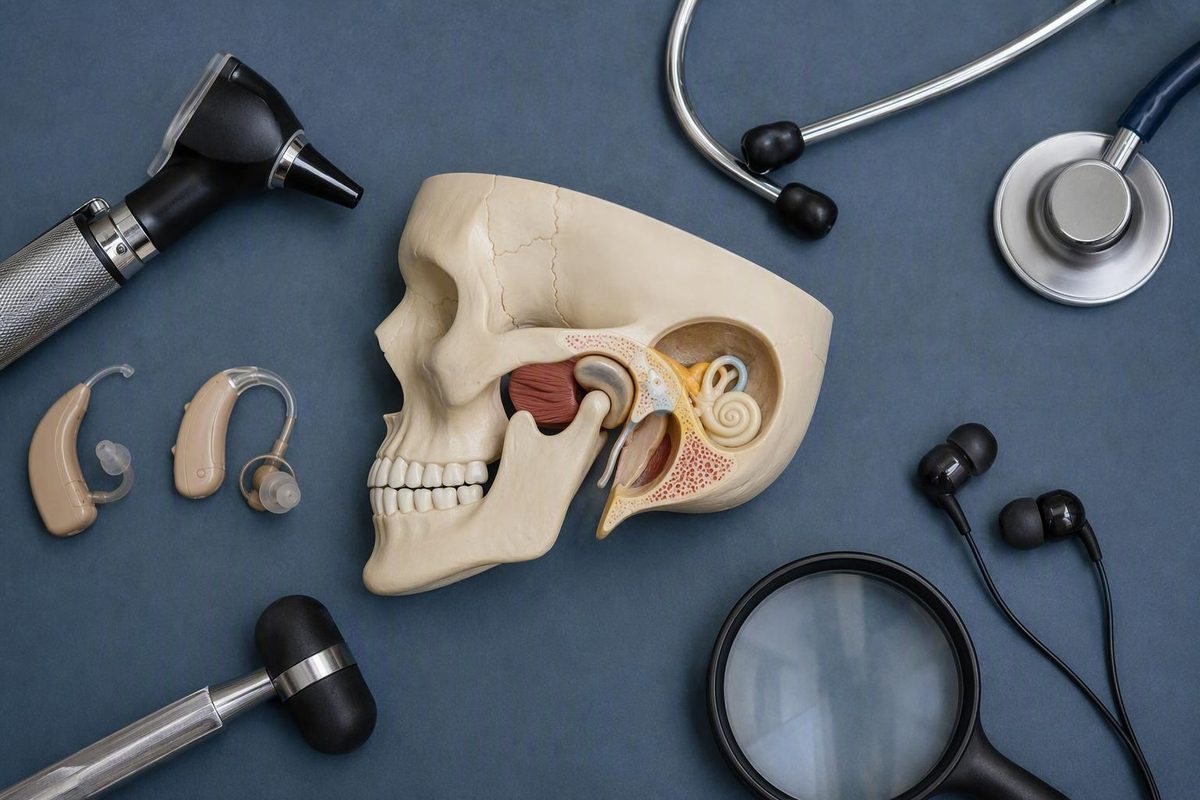
The short answer: a possible connection, not a safe assumption
Can TMJ cause hearing loss? Possibly—but the answer needs qualification. Temporomandibular disorders (TMD) can accompany ear fullness, tinnitus, ear pain, dizziness, and perceived muffling. Limited observational research has also found associations between TMD and objectively measured hearing loss. In addition, a rare structural jaw-joint abnormality has directly caused conductive hearing loss by obstructing the ear canal.
What the evidence does not establish is that routine TMD commonly causes permanent hearing loss or directly damages the inner ear.
It helps to organize the evidence as a three-step ladder:
- Subjective ear symptoms are recognized in people with TMD. These include pressure, fullness, earache, tinnitus, dizziness, and muffled sound.
- Measured hearing loss has been associated with TMD in observational studies. Association means the conditions appeared together; it does not prove that the jaw disorder caused the loss.
- Direct causation has been documented in a rare structural case. Displaced, calcified jaw-joint tissue physically narrowed one patient’s ear canal and produced position-dependent conductive hearing loss.
The central distinction is between an ear sensation and a measurable reduction in hearing. Tinnitus is sound perceived without an external source. Fullness is a clogged or pressure-filled sensation. Referred pain can be felt near or inside the ear even when its source is the jaw. Subjective muffling means sound seems dull or distant. None of those symptoms, alone or together, confirms that hearing thresholds have declined.
In fact, people whose ear pain is attributed to TMD may describe a stuffy or clogged ear even though their hearing is unaffected, according to a patient-education article from Berger Henry ENT (TMD-related ear pain and clogged-ear sensations).
Having jaw pain and muffled hearing at the same time also does not establish causation. The symptoms might be connected, might have separate causes, or might partly overlap. A person can have clenching-related jaw pain and an independent ear condition at the same time.
The practical takeaway is straightforward: **persistent hearing changes need an ear examination and objective hearing testing rather than self-diagnosis based on jaw symptoms. **
TMJ is the joint; TMD is the disorder
The terms TMJ and TMD are often used interchangeably, but they refer to different things.
The temporomandibular joint, or TMJ, is the hinge connecting the lower jaw to the temporal bone of the skull. There is one joint on each side of the face near the ears. Together with the surrounding muscles, these joints allow the jaw to open, close, and move during speaking, chewing, and yawning.
A temporomandibular disorder, or TMD, is a condition affecting one or both joints, the surrounding muscles, or related structures. People commonly say they “have TMJ” when they mean they have a TMJ disorder.
Common TMD features include:
- Jaw or facial pain
- Clicking, popping, or grinding during movement
- Jaw stiffness
- Locking in an open or closed position
- Limited mouth movement
- Difficulty or discomfort while chewing
- Headaches
- Tooth clenching or grinding
- Neck or shoulder discomfort
Earache and tinnitus can also occur among TMD symptoms. Cleveland Clinic’s medically reviewed overview includes earaches and ringing in the ears while describing TMD as a group of conditions involving the jaw joints and surrounding muscles (Cleveland Clinic overview of TMD symptoms, diagnosis, and treatment). Neither earache nor tinnitus, however, proves that hearing sensitivity has declined.
The jaw joint’s position near the ear makes symptom overlap plausible, but anatomical proximity is not evidence of causation. Pain may be referred into a nearby area without changing auditory function. Jaw movement may alter pressure or sound sensations without producing hearing loss. Conversely, an unrelated ear condition can occur alongside TMD.
A symptom cluster can still help guide an evaluation. Ear fullness accompanied by jaw clicking, chewing pain, restricted movement, stiffness, or clenching gives a clinician a reason to assess the jaw. It does not eliminate the need to examine the ear or measure hearing.
Ear fullness and muffling are not necessarily hearing loss
“I can’t hear normally” can describe several different experiences. A person may mean that the ear feels blocked, voices sound distant, tinnitus is interfering with listening, or formal testing has demonstrated reduced sensitivity. Those experiences can overlap, but they are not interchangeable.
| Experience | What it means | Does it prove hearing loss? | What can help clarify it? |
|---|---|---|---|
| Ear fullness or pressure | A plugged, blocked, heavy, or pressure-filled sensation | No | Ear examination, history, and sometimes tympanometry |
| Tinnitus | Ringing, buzzing, humming, or another sound perceived without an external source | No | Hearing evaluation and assessment of associated symptoms |
| Referred ear pain | Pain felt in the ear region even though its source may be the jaw or another nearby structure | No | Examination of the ear and possible non-ear sources |
| Subjective muffling | Sound seems dull, distant, underwater, or less clear | No | Audiometry to measure hearing thresholds |
| Objectively measured hearing loss | Testing demonstrates reduced hearing sensitivity or another auditory deficit | Yes | Audiometry and related tests used to classify the pattern |
Someone with TMD may genuinely experience a clogged or muffled ear even when hearing thresholds remain unaffected. Sensation alone cannot reliably distinguish the two.
When hearing loss is found, an important distinction is whether it is conductive, sensorineural, or mixed:
- Conductive hearing loss occurs when sound does not travel efficiently through the outer or middle ear.
- Sensorineural hearing loss involves damage to the cochlea in the inner ear or the auditory nerve.
- Mixed hearing loss includes both conductive and sensorineural components.
Symptoms may offer clues, but they cannot reliably classify the loss. Muffled sound is not exclusive to conductive loss, and difficulty understanding speech does not by itself diagnose sensorineural loss. Comparing air- and bone-conduction thresholds during audiometry helps clinicians distinguish these patterns (conductive and sensorineural hearing loss explained).
This distinction also matters when monitoring recovery. If TMD treatment reduces pain, pressure, tinnitus, or a blocked sensation, that improvement is meaningful. It does not necessarily mean measured hearing thresholds have returned to their previous level. Repeat hearing testing is needed to verify threshold recovery.
Persistent measured loss should not automatically be folded into a TMD diagnosis, particularly if the jaw symptoms improve while the hearing difficulty remains. The loss may have an independent cause requiring continued ear or hearing evaluation.
What the evidence actually shows
Research can show that TMD and hearing loss occur together within a sample without proving that one caused the other. This is the difference between association and causation.
An association may exist because the jaw disorder affects ear function, because an ear problem changes symptom reporting, because both conditions share another contributing factor, or because the study groups differ in relevant ways. Establishing causation requires stronger evidence addressing timing, alternative explanations, reproducibility, and mechanism.
A study of young university students
A 2011 observational study included 464 healthy Greek university students between ages 18 and 26. TMD severity was classified largely through a validated self-report questionnaire. Hearing was assessed with tympanometry and pure-tone audiometry across multiple frequencies.
The researchers reported that moderate TMD was associated with median-tone hearing loss, while severe TMD was associated with low-tone loss. All participants had normal tympanometry. These findings went beyond symptom reporting because hearing was objectively tested, but the study could not establish that TMD caused the measured differences (2011 observational study of TMD signs and hearing loss).
Several limitations affect how broadly the findings can be applied. The participants were young, healthy students from one Greek institution. TMD classification relied substantially on reported symptoms rather than a detailed clinical diagnosis for every participant. Because the study was observational, it could not determine the direction or mechanism of the association.
Its severity categories should not be interpreted as proof that progressively worse TMD necessarily produces progressively worse hearing. The researchers found particular frequency relationships within one population, not a universal dose-response rule.
A clinical comparison of TMD patients and controls
A prospective case study published in 2016 compared audiometric findings from 104 patients with TMD and 110 control participants. Within the TMD group, 25% had unilateral or bilateral hearing loss. The loss was usually mild and predominantly sensorineural (2016 clinical study of otological symptoms and audiometric findings in TMD).
That 25% figure is a result from one clinical sample. It is not the prevalence of hearing loss among everyone with TMD and should not be treated as an estimate of an individual patient’s risk. People receiving care in a clinical setting may differ from the wider population. In addition, only the study abstract was available in the supplied material, limiting assessment of recruitment, confounding factors, and diagnostic details.
The predominantly sensorineural findings also do not prove that TMD damaged participants’ cochleae or auditory nerves. The authors described the origins of the symptoms and causes of hearing loss as unknown. They proposed altered pressure equilibrium between the middle and inner ear as an explanation, but a proposed explanation is not a demonstrated mechanism.
The two observational studies do not tell a single, consistent story. One identified frequency-specific associations in young university students; the other found usually mild, predominantly sensorineural loss in a clinical TMD group. Together, they support further investigation and objective testing—not a blanket conclusion that routine TMD causes a predictable form of hearing loss.
A rare case with a directly observed mechanical cause
The strongest direct causal evidence comes from a single structural case. A 68-year-old woman developed left-sided hearing impairment and fullness after her jaw joint dislocated while she yawned. Her symptoms improved when she opened her mouth.
With her mouth closed, clinicians saw a mass obstructing the external auditory canal. The obstruction disappeared when she opened her mouth. Audiometry showed a 20-decibel air-bone gap with the mouth closed, and the gap normalized with opening. CT and MRI identified displaced, calcified TMJ disc tissue behind the jaw condyle that narrowed the ear canal. Her symptoms resolved after partial removal of the tissue and canaloplasty (case report of dynamic conductive hearing loss from displaced TMJ disc tissue).
This case documented:
- A visible structural obstruction
- A conductive audiometric pattern
- Hearing changes directly linked to jaw position
- Imaging that identified the abnormal tissue
- Symptom resolution after correction of the obstruction
That chain of evidence supports causation far more strongly than symptoms merely occurring together. Even so, this was a single rare structural presentation. It shows what is mechanically possible, but it does not show that ordinary jaw clicking, clenching, muscular pain, or routine TMD usually obstructs the ear canal or causes permanent hearing loss.
The most accurate conclusion is therefore measured: TMD can coexist with objective hearing loss, and rare TMJ pathology can directly cause conductive loss. Current evidence does not establish routine TMD as a common direct cause of permanent or sensorineural hearing loss.
How might a jaw disorder affect hearing?
Several mechanisms have been proposed to explain why jaw disorders and ear symptoms can appear together. Most remain hypotheses rather than established facts.
Eustachian-tube interference
The Eustachian tube helps regulate pressure between the middle ear and the back of the nose and throat. One proposal is that swelling, muscle tension, or altered movement around the jaw interferes with this function. In theory, that could contribute to pressure, fullness, impaired middle-ear drainage, or muffled sound.
Clinical educational sources discuss Eustachian-tube interference and impaired drainage as possible explanations while acknowledging that experts do not know exactly how TMD relates to hearing problems (DeFatta Health discussion of proposed mechanisms and testing). The important word is possible: the available evidence does not establish Eustachian-tube obstruction as the routine mechanism behind TMD-associated ear symptoms.
Changes in pressure regulation
Another proposal is that TMD alters pressure relationships involving the middle ear or, indirectly, the inner ear. The 2016 clinical study proposed altered middle-ear to inner-ear pressure equilibrium, but it did not demonstrate that pathway.
Pressure sensations are also nonspecific. Feeling pressure does not prove that middle-ear pressure is abnormal. Likewise, normal tympanometry does not explain every possible episode of tinnitus, fullness, or perceived muffling. Symptoms and test findings must be interpreted together.
Effects involving muscles or the eardrum
Researchers have also proposed effects involving middle-ear muscles or the tympanic membrane. Muscular, ligamentous, or nerve relationships might help explain why jaw movement or tension changes ear sensations in some people.
These anatomical relationships provide biological plausibility, not proof. They do not establish that a particular hearing deficit was caused by the jaw, and they do not show that untreated TMD routinely damages the cochlea or auditory nerve.
Direct external-ear-canal compression
The rare structural case provides a different kind of evidence. In that patient, displaced calcified TMJ disc tissue visibly obstructed the external auditory canal when her mouth was closed. The obstruction interfered with sound transmission and produced dynamic conductive hearing loss.
That was a demonstrated mechanical mechanism, but it is not representative of ordinary TMD. The case involved displaced, perforated, calcified disc tissue and visible canal narrowing. It should not be used to infer that common TMD routinely compresses the ear canal.
Overall, the proposed mechanisms justify considering the jaw when ear symptoms track with chewing, clenching, or jaw position. They do not establish that one pathway explains every case, that untreated TMD commonly damages the inner ear, or that more severe jaw symptoms necessarily produce more severe hearing loss.
Clues that TMD may be contributing—and clues that require a broader evaluation
A jaw connection becomes more plausible when ear complaints occur alongside a recognizable TMD pattern.
Supporting features may include:
- Pain or tenderness near one or both jaw joints
- Jaw or facial pain
- Clicking, popping, or grinding
- Stiffness or locking
- Limited or uneven mouth opening
- Pain or difficulty while chewing
- Clenching or grinding the teeth
- Headaches
- Neck or shoulder discomfort
Timing can be especially informative. Tell the clinician if pressure, ear pain, tinnitus, or perceived muffling:
- Begins or worsens while chewing
- Changes during yawning
- Is worse after prolonged clenching
- Is more noticeable after possible nighttime grinding
- Changes as the mouth opens or closes
- Appears during a flare of jaw pain or stiffness
Hearing that changes with jaw position is worth reporting. It was an important feature in the rare mechanical obstruction case, where mouth opening relieved both the visible blockage and the conductive audiometric finding. It is not, however, a validated home test for ordinary TMD-related hearing loss. Jaw movement can alter the perception of pressure, tinnitus, or sound without proving that the TMJ caused the change.
A broader assessment remains important because ear pain and blockage have other possible explanations. Berger Henry ENT lists ear infection, swimmer’s ear, and impacted earwax among alternatives to TMD-related ear pain. That is not a complete differential diagnosis, but it illustrates why someone should examine the ear rather than assume nearby jaw pain explains everything.
Even a strong cluster of jaw findings cannot rule out an independent ear condition. A person can grind their teeth and also have wax obstruction, middle-ear dysfunction, or separate sensorineural hearing loss. Parallel jaw and hearing assessments may therefore be appropriate.
Before an appointment, record:
- Whether the change affects the left ear, right ear, or both
- When it began
- Whether onset was sudden or gradual
- Whether it is constant or fluctuating
- Whether speech sounds quieter, less clear, or both
- Whether jaw movement changes the sensation
- Whether chewing, yawning, or clenching triggers it
- Whether tinnitus, dizziness, pain, or fullness accompanies it
- Whether the jaw symptoms began before, after, or at the same time
- Whether the hearing change continues when the jaw discomfort improves
This record cannot diagnose the cause, but it can help a clinician distinguish a meaningful timing pattern from an assumption of causation.
How clinicians separate TMD symptoms from hearing loss
The evaluation instead addresses several narrower questions:
- Is hearing objectively reduced?
- What type and pattern of loss are present?
- Is there an outer- or middle-ear explanation?
- Are signs of TMD present?
- Is imaging clinically appropriate?
1. Symptom and medical history
The clinician may ask about onset, duration, fluctuation, whether one or both ears are affected, associated symptoms, and relevant jaw features. Medical history and possible ear-related conditions or exposures may also matter.
Timing provides context but does not prove cause. A symptom that varies with chewing may justify a closer jaw assessment, while a sudden or one-sided change requires attention as a hearing problem rather than an automatic TMD diagnosis.
2. Examination of the ear
Looking into the ear canal and at the eardrum can reveal visible obstruction or findings suggesting an outer- or middle-ear problem. This step matters because a sensation of blockage cannot establish where—or whether—sound transmission is impaired.
The rare structural case demonstrates the value of direct examination: clinicians could see the obstruction when the patient’s mouth was closed and its disappearance when she opened it. Most people with TMD will not have that finding.
3. Objective hearing assessment
Pure-tone audiometry measures the quietest tones a person can detect at different pitches.
Comparing these thresholds helps classify the hearing pattern. When bone-conduction thresholds are better than air-conduction thresholds by a clinically meaningful amount, the difference is called an air-bone gap. That finding can support a conductive component, but it must be interpreted by a qualified clinician alongside the complete audiogram and examination.
Speech testing evaluates aspects of speech detection or understanding. It helps show how audiometric findings relate to communication, although speech performance and pure-tone sensitivity are not identical measures.
Tympanometry evaluates middle-ear function by measuring how the eardrum responds as pressure changes in the ear canal. It can provide information about the eardrum and middle-ear system, but it does not explain every hearing complaint.
Depending on the circumstances, clinicians may also use:
- Auditory brainstem response testing, which records electrical responses along the auditory pathway
- Otoacoustic emissions, which assess responses generated by the cochlea
These are possible additional tests, not requirements for every patient. Clinical hearing-center guidance lists pure-tone audiometry, speech testing, tympanometry, auditory brainstem response, and otoacoustic-emission testing among the tools that may be considered when investigating hearing complaints (overview of hearing tests used with suspected TMD-related symptoms).
4. Jaw examination
A TMD assessment may consider:
- The location of pain
- Tenderness in the jaw muscles or joints
- The range and path of jaw opening
- Stiffness, locking, clicking, or popping
- Whether chewing or movement reproduces symptoms
- Clenching or grinding history
- Relevant injury, dental, and medical history
The purpose is to determine whether a jaw disorder is present and characterize it. A positive jaw examination does not automatically make TMD the cause of a measured hearing deficit.
5. Selective imaging
Imaging is not necessary for every jaw click, ache, or episode of muffling. When the history or examination suggests a structural problem, a clinician may consider dental X-rays, CT, or MRI.
Imaging was essential in the rare canal-obstruction case because it identified the displaced calcified disc tissue. That does not mean everyone with TMD symptoms requires advanced imaging.
Ultimately, the relationship between jaw and hearing findings is a clinical judgment based on the complete pattern. No single symptom, jaw click, audiogram shape, imaging finding, or response to treatment proves by itself that TMD caused the hearing change.
Treatment expectations, follow-up, and when not to wait
TMD management depends on the suspected cause, severity, examination findings, and effect on daily function. It generally begins with noninvasive care. Depending on the individual findings, a clinician may consider habit modification, physical therapy, or an oral appliance such as a mouth guard or splint. These are options, not universal prescriptions; Cleveland Clinic notes that treatment depends on the cause and severity and generally begins with noninvasive measures.
If clenching, muscular tension, or another jaw problem is contributing to pressure or perceived muffling, improvement in the TMD may reduce those associated sensations. Current evidence does not support promising that TMD treatment will restore objectively measured hearing.
Keep two outcomes separate:
- Symptom improvement: less jaw pain, pressure, tinnitus, or perceived blockage
- Threshold recovery: improvement demonstrated through objective hearing testing
The first does not prove the second. Someone may feel substantially better while an audiogram remains unchanged. If hearing loss was measured before treatment, repeat testing is the appropriate way to determine whether thresholds improved.
Persistent perceived or measured hearing loss after jaw symptoms settle warrants continued ear and hearing evaluation. It should not be dismissed as residual TMD discomfort. Conversely, ongoing jaw pain, locking, or limited movement deserves assessment even if hearing tests are normal.
Care may span both systems. An audiologist or ear clinician can assess hearing and ear function, while a dentist, oral-health professional, physical therapist, or clinician experienced in TMD can assess the jaw. No one specialty is necessarily the correct entry point for every patient.
Do not assume sudden, rapidly worsening, or one-sided hearing loss is caused by TMD. Seek urgent medical assessment. A feeling of fullness or blockage does not establish that the problem is merely jaw-related, and the presence of clicking or clenching should not delay evaluation.
For non-sudden symptoms, arrange an assessment when muffling or reduced hearing persists, interferes with communication, repeatedly returns, worsens, or remains unexplained. Professional assessment is also recommended when TMD-related ear complaints are persistent or disruptive (clinical overview of TMD and hearing complaints).
The qualified answer remains the safest one: jaw disorders can produce convincing ear symptoms and may be associated with measured hearing loss, while a rare structural TMJ abnormality can directly cause conductive loss. Routine TMD, however, should not become a catch-all explanation for reduced hearing. Distinguish relief of pressure from verified hearing recovery, obtain objective testing for persistent changes, and pursue a jaw assessment when TMD clues are present.
Can TMJ cause permanent hearing loss?
Routine TMD is not established as a common cause of permanent hearing loss. Observational studies have identified measured hearing loss in some people with TMD, but they do not prove that the jaw disorder caused the loss or establish that it was permanent.
A single rare case documented position-dependent conductive hearing loss caused by calcified TMJ disc tissue obstructing the ear canal. The obstruction and hearing deficit changed with mouth position, and the symptoms resolved after surgical correction (case report of TMJ tissue obstructing the ear canal). That structural case cannot be generalized to ordinary TMD or used as evidence that TMD routinely causes permanent inner-ear damage.
Persistent hearing loss should be evaluated independently even when jaw pain, clicking, or clenching is present.
What type of hearing loss has been linked with TMD?
Both sensorineural and conductive patterns appear in the evidence, but in different contexts.
A 2016 clinical study found that hearing loss among affected patients in its TMD sample was usually mild and predominantly sensorineural. It did not prove that TMD damaged the cochlea or auditory nerve. The rare structural case, by contrast, directly documented conductive loss caused by jaw-joint tissue obstructing the ear canal.
A separate observational study associated moderate TMD with median-tone loss and severe TMD with low-tone loss in its young university sample (frequency-specific findings in the 2011 observational study). These differing results mean there is no single established audiogram pattern for “TMD hearing loss.” Air- and bone-conduction testing is needed to classify an individual’s loss.
Can TMJ make an ear feel clogged even when hearing is normal?
Yes. TMD can accompany fullness, pressure, referred ear pain, tinnitus, and perceived muffling even when hearing thresholds are unaffected. Berger Henry ENT specifically notes that hearing is often unaffected in patients reporting TMD-related ear pain and a stuffy or clogged sensation (TMD-related clogged-ear sensations).
Because genuine conductive or sensorineural loss can also feel muffled, the sensation alone cannot settle the question. Persistent blockage or muffling should be assessed with an ear examination and hearing test.
Does hearing that changes when I open my mouth point to TMJ?
It can be a useful clue, particularly when the change consistently follows jaw position and occurs with other jaw symptoms. It is not proof.
In the documented structural case, an ear-canal obstruction and a 20-decibel air-bone gap appeared with the mouth closed and normalized when the patient opened her mouth. That was a rare mechanical disorder with visible obstruction, imaging findings, and position-dependent audiometry—not a typical TMD presentation.
Report jaw-position-dependent hearing or pressure changes to a clinician, but do not use mouth opening as a home test to diagnose TMD or rule out an ear condition.
Will a mouth guard or other TMD treatment bring my hearing back?
A mouth guard, splint, another oral appliance, or physical therapy may be considered depending on the type and severity of the jaw disorder. Such treatment may improve jaw symptoms and could reduce associated fullness or perceived muffling in some people, but it cannot be assumed to restore measured hearing.
Symptom relief is not proof of threshold recovery. If hearing loss has been documented, repeat hearing testing can show whether it changed. If perceived or measured loss continues after the jaw problem improves, continue the ear and hearing evaluation rather than escalating TMD treatment on the assumption that the jaw must be the cause.