
4 Muffled Hearing Checks and When to Get Help
A sudden, unexplained change, especially in one ear or noticed on waking, calls for same-day assessment. Check onset, side, symptoms and trigger.
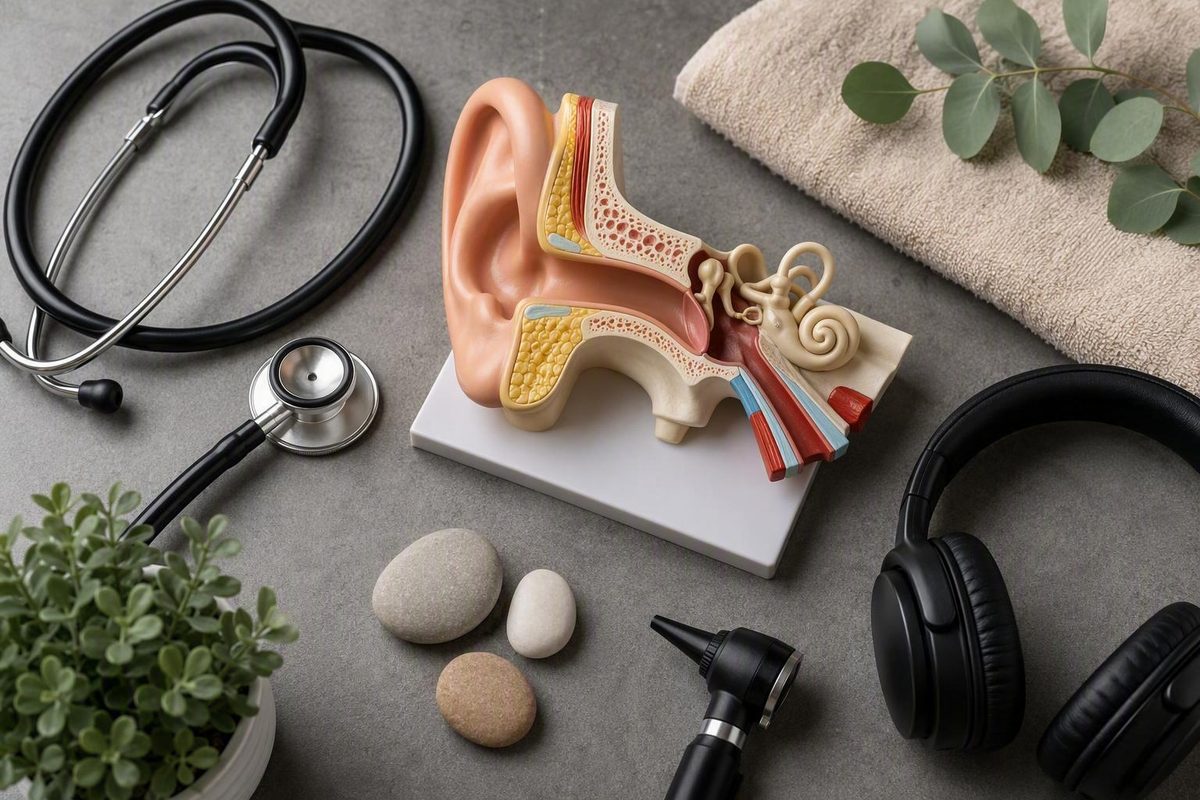
What muffled hearing means—and the warning to read first
Seek prompt, same-day medical assessment for sudden, unexplained muffled hearing—especially when it affects one ear or was present when you woke up. Do not assume it is wax, congestion, or the way you slept. Sudden sensorineural hearing loss—an inner-ear or hearing-nerve loss rather than a simple blockage—can initially feel like an ordinary plugged ear and may occur without pain. An otolaryngologist writing for MED-EL recommends urgent evaluation for a sudden or overnight one-sided hearing change.
“Muffled hearing” means reduced sound clarity. You may still hear voices, music, and environmental sounds, but they seem dull, distant, faint, cotton-filled, blocked, or as though you are underwater. Speech may be audible without being easy to understand.
The change can affect one ear or both. It may arrive abruptly, develop over several hours, or become noticeable gradually. It can remain stable, fluctuate, recur, improve, or worsen.
Muffling is not necessarily complete hearing loss, but that distinction should not be taken as reassurance. A person can retain some hearing while having a measurable reduction at certain pitches or across a broader range. “I can still hear something” does not rule out an important hearing change.
The blocked feeling also does not identify the cause. Earwax, trapped water, congestion, middle-ear fluid, pressure imbalance, and inner-ear hearing loss can produce similar sensations. Pain is not a reliable dividing line because some inner-ear hearing changes can be painless.
The safest first step is to consider four features:
- Onset: Was the change sudden, overnight, or gradual?
- Side: Is one ear affected, or both?
- Associated symptoms: Is there tinnitus, dizziness, pain, drainage, bleeding, imbalance, or another new symptom?
- Trigger: Did it follow illness, flying, diving, swimming, loud noise, injury, or a medication change?
These details help determine urgency, but they cannot establish a diagnosis at home. This article provides general educational guidance, not an assessment of your individual symptoms. Hear Review describes its material as being for general reading and makes no warranty about completeness in its site terms.
A triage guide based on onset, side, symptoms, and trigger
Abrupt onset matters more than how mildly “blocked” the ear feels. If hearing changed suddenly or overnight without a clear, harmless explanation—particularly in one ear—seek a same-day medical assessment rather than assigning yourself a watch-and-wait period.
The appropriate accessible service may be primary care, urgent care, an ENT service, or another medical service able to examine the ear and arrange prompt hearing testing. Clinical summaries also identify new tinnitus with sudden hearing loss, dizziness, balance problems, drainage, severe pain, head injury, and recent intense-noise exposure as reasons for prompt medical attention.
| Pattern | Examples | Urgency | Next step |
|---|---|---|---|
| Sudden or overnight hearing change | One ear sounds blocked on waking; hearing abruptly drops without a clear cause; sudden muffling with new tinnitus | Prompt, same-day assessment | Contact an accessible medical service that can examine the ear and arrange urgent hearing evaluation. Do not wait for pain to develop. |
| Acute neurological symptoms or major trauma | New facial weakness, numbness, trouble speaking, severe confusion, collapse, or significant head injury | Potential emergency | Seek immediate medical help; use local emergency services when symptoms are severe or an emergency is suspected. |
| Sudden change with concerning associated symptoms | New tinnitus with hearing loss, vertigo, marked imbalance, severe pain, drainage, or bleeding | Prompt medical attention | Obtain urgent clinical assessment. The setting depends on symptom severity and local access. |
| After intense noise or injury | Hearing changes after a gunshot, explosion, machinery exposure, blow to the head, or ear injury | Prompt assessment | Move away from further noise and seek medical evaluation, particularly for sudden, one-sided, persistent, or worsening symptoms. |
| After diving | Persistent hearing reduction, severe pain, bleeding, drainage, or marked dizziness after a dive | Prompt assessment | Avoid forceful attempts to clear the ear and arrange medical evaluation. |
| Persistent, worsening, progressive, recurring, or unexplained change | Muffled hearing keeps returning, gradually worsens, remains after an illness, or continues after wax removal | Professional evaluation needed | Arrange primary-care, ENT, or audiology assessment according to local access and associated symptoms. |
| Mild symptoms with an obvious pressure trigger and no warning signs | Both ears feel mildly blocked during airplane descent without severe pain, dizziness, bleeding, or sudden unexplained loss | Gentle comfort measures may be reasonable | Try swallowing, yawning, or chewing. Seek care if symptoms persist, worsen, recur, or develop warning signs. |
There is no universal number of hours or days that is safe for every mild case. “Muffled hearing” is not one condition: a minor pressure imbalance and an inner-ear hearing change can initially feel alike. Abrupt onset and warning signs override routine monitoring.
When arranging care, be ready to state:
- When the change began.
- Whether it was sudden, overnight, or gradual.
- Whether one or both ears are affected.
- Whether it is improving, stable, fluctuating, or worsening.
- Whether you have pain, tinnitus, dizziness, vertigo, imbalance, drainage, bleeding, or neurological symptoms.
- Whether it followed illness, a flight, diving, swimming, loud noise, or injury.
- Whether you recently started or changed a medication.
- Whether you used cotton swabs, drops, irrigation, earplugs, earbuds, or hearing aids.
Do not delay urgent care merely to assemble a complete history. The purpose of these details is to help a clinician understand the pattern quickly.
Possible causes, organized by where sound is being disrupted
The ear can be considered in three broad regions: the ear canal, the middle ear behind the eardrum, and the inner ear and auditory nerve. Problems in any of these regions can reduce clarity, but they do so in different ways.
Ear-canal causes: sound is physically obstructed
A conductive problem prevents sound from travelling efficiently through the canal or middle ear before it reaches the inner ear. The inner ear may still function, but less sound reaches it.
Possible canal causes include:
- Impacted earwax. Wax can partially or fully obstruct the canal. It may produce fullness, tinnitus, itching, discomfort, or progressive hearing reduction.
- Trapped water. Water after swimming or showering may temporarily block the canal or shift existing wax.
- A foreign object or other material. An object, debris, or canal swelling can interfere with sound transmission.
Symptoms cannot confirm wax. Fullness and muffling can also occur with fluid, infection, pressure dysfunction, or inner-ear hearing loss. A clinician confirms impaction by inspecting the canal, usually with an otoscope, before choosing an appropriate removal method, as explained in Cleveland Clinic’s guidance on earwax blockage.
Earwax is normally protective: it helps trap debris and maintain the canal environment. The goal is not to create a perfectly clean canal but to address wax when it is actually impacted, interferes with examination, affects hearing, or obstructs a hearing device.
Middle-ear causes: pressure, fluid, inflammation, or infection
The middle ear is an air-filled space behind the eardrum. A Eustachian tube connects that space with the back of the nose and throat and helps regulate pressure.
A cold, allergy symptoms, or nasal inflammation can interfere with this pressure-regulating function. The result may be pressure, popping, fullness, or muffled sound. Fluid behind the eardrum can also dampen eardrum movement and reduce sound transmission.
Possible middle-ear explanations include:
- Eustachian-tube dysfunction.
- Fluid behind the eardrum.
- Middle-ear infection.
- Pressure imbalance after flying or rapid elevation change.
- Pressure injury associated with diving.
- Eardrum damage or perforation.
Outer-ear infection or canal inflammation can also produce muffling, often with pain, tenderness, swelling, or discharge. Those features require examination rather than an assumption that the ear merely contains water.
Inner-ear or auditory-nerve causes: sound is not processed normally
Sensorineural hearing changes involve the inner ear or auditory pathway rather than a physical blockage in the canal. They may affect loudness, pitch perception, or the ability to understand speech clearly.
Possibilities include:
- Sudden sensorineural hearing loss. This may present as abrupt one-sided muffling, fullness, or reduced clarity and can occur without pain.
- Noise-related damage. A single intense exposure or repeated loud sound can produce temporary or lasting hearing changes.
- Age-related hearing loss. This often develops gradually and may affect higher-frequency hearing and speech clarity, but age alone does not establish the diagnosis.
- Ménière’s disease. Recurrent episodes involving hearing fluctuation or muffling, tinnitus, ear fullness, and vertigo may occur with this condition. That pattern warrants evaluation; it is not sufficient for self-diagnosis.
- Uncommon structural or auditory-nerve disorders. Persistent asymmetric hearing findings may sometimes lead a clinician to investigate less common causes.
Tinnitus is best treated as an associated symptom or diagnostic clue, not as a routine explanation for why hearing is muffled. Its timing, side, and relationship to the hearing change can nonetheless help with assessment. Gradual high-frequency loss can reduce speech clarity, while recurrent muffling with tinnitus, fullness, and vertigo is among the patterns that warrant hearing and medical evaluation.
If symptoms began after a new prescription, dose change, or treatment course, contact the prescriber promptly. Do not stop a prescribed medication independently; the prescriber can assess the timing, risks, urgency, and possible alternatives.
A broad cause list should inform rather than alarm. Muffled hearing alone does not establish a tumor, neurological disorder, eardrum injury, or Ménière’s disease. Less common diagnoses are investigated when the history, examination, hearing pattern, asymmetry, or progression gives a clinician a reason to consider them.
Common scenarios: after a cold, flight, swimming, loud noise, or waking
A trigger can suggest a mechanism, but it does not prove one. The appropriate next step still depends on onset, affected side, severity, associated symptoms, and whether the change is improving or worsening.
After a cold or during allergies
Congestion and inflammation can interfere with Eustachian-tube function. Middle-ear pressure may become abnormal, and fluid may collect behind the eardrum, making sound seem dull or distant.
If symptoms are mild, affect both ears, and developed gradually with an ordinary respiratory illness, cautious monitoring may be reasonable in the absence of warning signs. Avoid invasive ear cleaning: a middle-ear pressure problem cannot be removed from the canal with a cotton swab.
Arrange evaluation if the muffling:
- Began abruptly rather than gradually with the illness.
- Is strongly one-sided or worsening.
- Persists after other symptoms improve.
- Keeps recurring.
- Occurs with severe pain, drainage, bleeding, significant dizziness, imbalance, sudden tinnitus, or another warning sign.
Do not assume all cold-related ear symptoms require antibiotics, decongestants, or antihistamines. Treatment depends on whether the problem is pressure dysfunction, fluid, infection, canal inflammation, or something unrelated to the cold.
After flying or an elevation change
Rapid environmental-pressure changes can create a temporary pressure mismatch across the eardrum. Mild fullness, popping, or muffling during takeoff, landing, mountain travel, or another elevation change may reflect that imbalance.
Gentle swallowing, yawning, or chewing may help the Eustachian tube open. These measures are for mild, ordinary pressure symptoms—not severe pain, bleeding, major dizziness, or unexplained sudden hearing loss. Airplane-ear symptoms vary in severity, and pain or bleeding is more concerning than routine pressure and popping, according to Valley Audiology’s overview of pressure-related muffled hearing.
After diving
Do not repeatedly or forcefully try to “pop” an ear that hurts or has reduced hearing after a dive.
Seek prompt medical assessment for:
- Severe or persistent pain.
- Bleeding or drainage.
- Marked dizziness, vertigo, or imbalance.
- Persistent hearing reduction.
- A sudden change that does not fit a mild, momentary pressure sensation.
Avoid another dive while an unexplained hearing change, significant pain, bleeding, or dizziness remains unassessed.
After swimming or showering
Water can temporarily obstruct the canal, especially if wax is already present. The ear may feel full, sound gurgly, or seem blocked.
Do not insert cotton swabs, fingers, pins, or other objects to absorb or retrieve the water. These can push wax deeper or injure the canal or eardrum.
Pain, fever, discharge, canal tenderness, foul odor, or ongoing hearing reduction may indicate more than trapped water. An examination can distinguish retained water or wax from infection, inflammation, or a middle-ear problem.
After a concert, machinery, gunshot, or explosion
Move away from further noise and protect your ears from additional exposure. Hearing changes after loud sound can be temporary or lasting, and the sensation alone cannot determine which.
Obtain prompt assessment when the change is:
- Sudden or clearly one-sided.
- Persistent or worsening.
- Associated with tinnitus, dizziness, vertigo, or imbalance.
- Related to a gunshot, explosion, or other intense impulse sound.
- Accompanied by pain, drainage, bleeding, or trauma.
Do not test the ear by exposing it to more loud sound.
After waking with one muffled ear
A suddenly muffled ear noticed on waking deserves same-day assessment. Do not conclude that sleep position, congestion, or wax is responsible merely because the symptom appeared overnight.
The concern is greater when the change is one-sided or accompanied by new tinnitus, dizziness, vertigo, or imbalance. A painless blocked sensation is not enough to rule out an inner-ear problem.
Gradual difficulty following conversation in both ears
If speech has slowly become harder to understand—particularly in groups, restaurants, or rooms with background noise—age-related or cumulative noise-related hearing loss is possible. Other explanations remain possible, including wax, middle-ear problems, and hearing-device issues.
A formal hearing evaluation can determine which pitches are affected, whether the ears differ, and how clearly words are understood. Do not rely on age alone as the diagnosis.
No scenario has a guaranteed recovery time. Water, wax, pressure dysfunction, middle-ear fluid, infection, and sensorineural injury do not share one timeline. Prognosis follows the eventual diagnosis, not the word “muffled.”
Safe comfort measures—and home treatments to avoid
Home measures should be limited to mild symptoms with a clear, low-risk trigger and no warning signs. Comfort measures do not confirm the cause and cannot treat every possible diagnosis.
For mild pressure symptoms during ordinary air travel, reasonable measures include:
- Swallowing.
- Yawning.
- Chewing.
- Sipping a drink.
Use gentle actions rather than aggressive pressure equalization. Stop an action that causes pain or dizziness.
Avoid:
- Cotton swabs.
- Ear candles.
- Hairpins, tweezers, keys, or improvised tools.
- Fingers inserted deeply into the canal.
- High-pressure water devices.
- Aggressive or repeated irrigation.
- Forceful, repeated attempts to pop the ears.
- Repeatedly adding different drops when the cause is uncertain.
Objects can push wax deeper, injure canal skin, or damage the eardrum. Ear candles can cause burns, add debris, or injure the ear; they are not a safe substitute for examination.
Wax-softening drops are not harmless in every situation. They can temporarily make an ear feel more blocked if wax absorbs moisture, swells, shifts, or remains lodged in the canal. Worsening after drops does not necessarily mean that more drops or stronger flushing are needed.
Wax drops or irrigation may be inappropriate when you have:
- Ear tubes.
- A known or possible eardrum perforation.
- Drainage or bleeding.
- Significant pain.
- Previous ear surgery.
- Marked dizziness.
- Uncertainty about what is causing the hearing change.
RK Audiology’s earwax safety guidance cautions against drops in several of these circumstances and recommends an examination rather than escalating to repeated or high-pressure flushing.
Medication is not one-size-fits-all either. Decongestants, antihistamines, antibiotics, and other drugs should not be recommended universally for muffled hearing. Suitability depends on the diagnosis, medical history, other medicines, contraindications, and advice from a clinician or pharmacist. Antibiotics, for example, do not address wax, ordinary pressure imbalance, or sensorineural hearing loss.
If you suspect that a prescription is affecting hearing or balance, contact the prescriber. Do not stop it independently unless a qualified professional instructs you to do so.
Most importantly, home treatment should not postpone assessment of sudden unexplained hearing change. The possibility of time-sensitive treatment is a reason to seek evaluation sooner, not a reason to wait while trying multiple remedies.
How clinicians determine what is causing the muffling
An assessment usually begins with the history. The clinician may ask:
- Exactly when did the muffling begin?
- Was it sudden, overnight, or gradual?
- Does it affect one ear or both?
- Is it continuous, intermittent, improving, or worsening?
- Is there pain, pressure, tinnitus, dizziness, vertigo, imbalance, fever, discharge, or bleeding?
- Was there a recent cold, allergy flare, flight, dive, swim, loud-noise exposure, or injury?
- Have you had previous ear infections, surgery, perforation, or hearing loss?
- Do you use hearing aids, earplugs, earbuds, or cotton swabs?
- Which prescription and over-the-counter medicines do you take, and did any dose recently change?
The examination and tests are selected to answer different questions.
Otoscopy: what is visible?
Otoscopy means looking into the ear with a lighted instrument. It allows a clinician to inspect the canal and eardrum for:
- Impacted wax.
- A foreign object.
- Canal swelling or inflammation.
- Infection-related findings.
- Drainage.
- A possible perforation.
- Visible clues of middle-ear fluid.
- Other structural abnormalities.
A visible wax blockage may explain the muffling, but hearing that remains reduced after removal can require further testing.
Pure-tone audiometry: which sounds can you hear?
Pure-tone audiometry measures the quietest tones you can hear at different frequencies in each ear. Testing sound through earphones and, when needed, through bone conduction can help classify hearing loss as:
- Conductive: sound is obstructed in the canal or middle ear.
- Sensorineural: the inner ear or auditory pathway is affected.
- Mixed: both components are present.
This distinction matters because a blocked canal, middle-ear fluid, and inner-ear hearing loss require different responses.
Speech testing: how clearly are words understood?
Hearing is not only about detecting a beep. Speech testing assesses how clearly you recognize or understand words, sometimes at different volume levels.
Someone may hear that speech is present but struggle to distinguish consonants or follow conversation. Speech results therefore provide information that pure-tone thresholds alone may not capture.
Tympanometry: how is the middle ear working?
Tympanometry assesses how the eardrum responds as pressure changes in the ear canal. It provides information about eardrum movement and middle-ear mechanics.
Depending on the findings, it may help assess:
- Middle-ear pressure.
- Fluid behind the eardrum.
- Eustachian-tube dysfunction.
- Eardrum perforation.
- Reduced movement of the eardrum or middle-ear system.
Tympanometry does not diagnose every cause of muffling by itself, but it can help separate a middle-ear problem from other possibilities.
Otoacoustic emissions and selected additional tests
It may be useful in selected assessments but is not necessary for every muffled ear.
Imaging, balance testing, allergy evaluation, or blood tests may be considered when the history, asymmetry, examination, or initial hearing results raise a specific question. They are not routine for everyone. A Mid-Michigan ENT overview describes otoscopy, pure-tone and speech audiometry, tympanometry, and otoacoustic emissions as possible components of a muffled-hearing evaluation.
Online and app-based hearing tests can be useful screening tools. They cannot look for wax, fluid, infection, injury, or perforation. Mayo Clinic distinguishes mobile screening from the physical examination and formal audiometer testing used in a diagnostic hearing evaluation.
No single professional is always the best first contact. Depending on urgency, access, findings, and local referral pathways, care may begin with:
- An emergency service when severe acute symptoms or major trauma suggest an emergency.
- Urgent care or primary care for prompt examination and referral.
- An ENT service for medical and structural ear assessment.
- An audiologist for diagnostic hearing testing, often alongside medical evaluation when onset is sudden or ear disease is possible.
The practical priority is reaching an appropriate service promptly—not waiting for an ideal appointment while an abrupt hearing change remains unassessed.
Treatment and recovery depend on the confirmed cause
Muffled hearing is a symptom, so there is no single treatment appropriate for everyone. Treatment should target what the examination and testing show.
Confirmed earwax impaction
Possible clinician-directed approaches include:
- Wax-softening treatment.
- Irrigation when safe and appropriate.
- Suction.
- Manual removal with specialized instruments.
The method depends on wax consistency, canal anatomy, symptoms, eardrum status, prior surgery, and clinical judgment. Earwax normally has a protective role and does not need to be completely removed when it is not causing a problem.
If wax is the main obstruction, hearing may improve after it is cleared. Improvement is not guaranteed to be immediate or complete, particularly if another hearing problem is also present. Persistent muffling after removal should prompt consideration of remaining canal obstruction, middle-ear disease, inner-ear loss, an auditory-nerve issue, or a hearing-device problem.
Infection, inflammation, congestion, pressure dysfunction, or fluid
Treatment depends on the specific diagnosis. An outer-ear infection, middle-ear infection, Eustachian-tube problem, and noninfectious middle-ear fluid are not interchangeable.
A clinician may recommend observation, targeted medication, treatment of an underlying nasal or allergy problem, or another intervention according to the findings. Antibiotics and decongestants are not automatically appropriate for every painful or blocked ear.
Sudden sensorineural hearing loss
Sudden unexplained hearing loss requires urgent assessment. Clinicians may consider corticosteroid treatment when appropriate, but the decision depends on the hearing pattern, timing, medical history, contraindications, and specialist judgment. Steroids should not be started, borrowed, or dosed without clinical evaluation.
Eardrum damage, structural disease, or persistent middle-ear problems
Eardrum injury, recurrent middle-ear disease, persistent fluid, or another structural abnormality may require monitoring or specialist management. Selected procedures or surgery may be considered after evaluation, but a muffled sensation alone cannot establish whether any procedure is appropriate.
Lasting hearing loss
For diagnosed, lasting hearing loss, selected options may include:
- Hearing aids.
- Bone-conduction systems.
- Cochlear implants.
- Communication strategies and assistive listening technology.
Suitability depends on whether the loss is conductive, sensorineural, or mixed; its severity; its effect on speech understanding; differences between ears; and the person’s medical and communication needs.
Mayo Clinic likewise presents wax removal, selected surgery, hearing aids, and cochlear implants as options chosen according to the cause and severity of hearing loss.
Recovery is therefore conditional. A temporary obstruction or pressure problem may resolve or improve when the cause is corrected. Middle-ear recovery depends on the underlying condition. Noise-related, age-related, and other sensorineural damage may persist. The muffled sensation alone cannot predict the outcome.
Protect your hearing and prepare for an appointment
Use appropriate hearing protection around loud machinery, concerts, firearms, and other intense sound. Move away from an exposure if your hearing changes, and do not return simply to test whether the ear feels better.
Avoid routine canal cleaning with cotton swabs, candles, or improvised instruments. If you use hearing aids, follow the manufacturer’s instructions for cleaning external components and filters, but do not insert tools deeply into your ear. Wax can obstruct both the ear canal and parts of a hearing device.
During ordinary air travel, favor swallowing, yawning, or chewing over forceful pressure clearing. Treat diving-related pain, dizziness, bleeding, or reduced hearing with greater caution.
If allergy or sinus symptoms repeatedly coincide with ear problems, discuss long-term management with an appropriate healthcare professional. Repeated unsupervised use of decongestants, antihistamines, or other medicines may be ineffective or unsuitable.
Before an appointment, prepare three short lists.
Symptom diary
- Exact or closest known onset.
- Sudden, overnight, or gradual course.
- Left ear, right ear, or both.
- Continuous, intermittent, or fluctuating pattern.
- Improving, stable, or worsening.
- Pain or tenderness.
- Pressure or fullness.
- Tinnitus.
- Dizziness, vertigo, or balance change.
- Drainage, odor, or bleeding.
- Fever or recent illness.
- Facial weakness, numbness, speech trouble, or other neurological symptoms.
Exposure and ear-history checklist
- Recent cold, allergy flare, or sinus symptoms.
- Swimming or showering.
- Flight or altitude change.
- Diving.
- Concert, machinery, firearm, or explosion.
- Head or ear injury.
- Cotton-swab or tool use.
- Ear drops or irrigation.
- Earplug, earbud, or hearing-aid use.
- Previous infections, perforation, tubes, or ear surgery.
- Recent professional wax removal or hearing-device cleaning.
Medication checklist
- All prescription medicines.
- Over-the-counter products and supplements.
- Recent new treatments.
- Dose increases or decreases.
- Timing of each change relative to the hearing symptoms.
Do not stop prescribed treatment without speaking to the prescriber.
Tell the clinician if muffling remains after professional wax removal or hearing-device cleaning. That detail can redirect attention toward middle-ear mechanics, inner-ear hearing, the auditory pathway, remaining canal obstruction, or another device problem rather than repeated cleaning.
The practical action rule is:
- Sudden hearing change means prompt assessment.
- Warning signs increase the urgency.
- Persistent, worsening, progressive, or recurring muffling needs evaluation.
- Only gentle comfort measures are appropriate for mild, clearly pressure-related symptoms without warning signs.
Frequently asked questions
Can sudden sensorineural hearing loss feel like nothing more than a clogged or muffled ear?
Yes. It may initially feel like fullness, cotton in the ear, or an ordinary blockage, and it may occur without pain. That is why sudden unexplained muffling—particularly in one ear or first noticed on waking—should receive prompt same-day assessment rather than being treated automatically as wax or congestion. The MED-EL clinical overview specifically warns that a sudden one-sided blocked sensation may require urgent evaluation.
New tinnitus, dizziness, vertigo, or imbalance alongside the sudden change makes prompt evaluation especially important. Their absence, however, does not establish that the change is harmless.
How long should I wait for muffled hearing to clear?
There is no universal safe waiting period because causes with very different urgency can feel similar.
Do not wait when the change is sudden or overnight, especially in one ear. Seek prompt attention when sudden hearing change occurs with tinnitus, vertigo, marked imbalance, severe pain, drainage, bleeding, neurological symptoms, head injury, or intense-noise exposure.
Mild, clearly pressure-related symptoms without warning signs may permit gentle monitoring. Persistent, worsening, recurring, progressive, or unexplained muffling needs professional evaluation. Do not use an expected recovery time from a cold, flight, or swim to override a concerning pattern.
How can I tell whether muffled hearing is caused by earwax?
You usually cannot confirm it from symptoms alone. Wax may cause fullness, itching, tinnitus, discomfort, or progressive hearing reduction, but fluid, infection, pressure dysfunction, and inner-ear hearing loss can feel similar.
A clinician can inspect the canal and eardrum with an otoscope. Cleveland Clinic notes that earwax impaction is diagnosed through examination, after which softening, irrigation, or professional removal may be selected as appropriate in its earwax diagnosis and treatment guidance.
Do not assume sudden one-sided muffling is wax, and do not probe the ear with a cotton swab or tool to find out.
Will my hearing return after the cause is treated?
Possibly, but the answer depends on the cause. Hearing may improve when water drains, pressure normalizes, middle-ear disease resolves, or confirmed wax is safely removed. Improvement may be partial, delayed, or absent if another condition is also present.
Noise-related, age-related, or other sensorineural damage may persist. Lasting hearing loss may be managed with hearing devices or other selected interventions, but no treatment can be guaranteed to restore normal hearing.
If the ear remains muffled after wax removal or treatment of an assumed trigger, request reassessment rather than repeating the same treatment indefinitely.
Should I see primary care, urgent care, an ENT, or an audiologist?
Choose according to urgency, symptom severity, and local access:
- Emergency services or an emergency department: when acute neurological symptoms, major head trauma, or another severe presentation suggests an emergency.
- Urgent care, primary care, or an accessible ENT service: for a sudden or overnight hearing change requiring prompt ear examination and hearing assessment.
- Primary care or ENT: for persistent pain, drainage, recurring pressure problems, suspected infection, or structural concerns.
- Audiologist: for formal hearing testing, speech assessment, and classification of hearing loss, often in coordination with medical care when onset is sudden or ear disease is possible.
No option is universally best. For a sudden change, the best starting point is an appropriate service you can reach promptly that can examine the ear and arrange urgent diagnostic hearing testing or referral.
The bottom line
Do not dismiss sudden or one-sided muffled hearing as a simple blockage. Do not put cotton swabs, improvised objects, candles, or high-pressure water into an ear that has not been examined. Arrange professional evaluation when symptoms are abrupt, accompanied by warning signs, persistent, worsening, progressive, or recurring.
The likely outcome depends on whether the cause is a reversible obstruction or pressure problem, a middle-ear condition, or an inner-ear hearing change.