
Bone Conduction Hearing Aids: Who They Help and Options
Learn who bone conduction hearing aids suit, how nonsurgical and implanted systems differ, and what to check before choosing one.
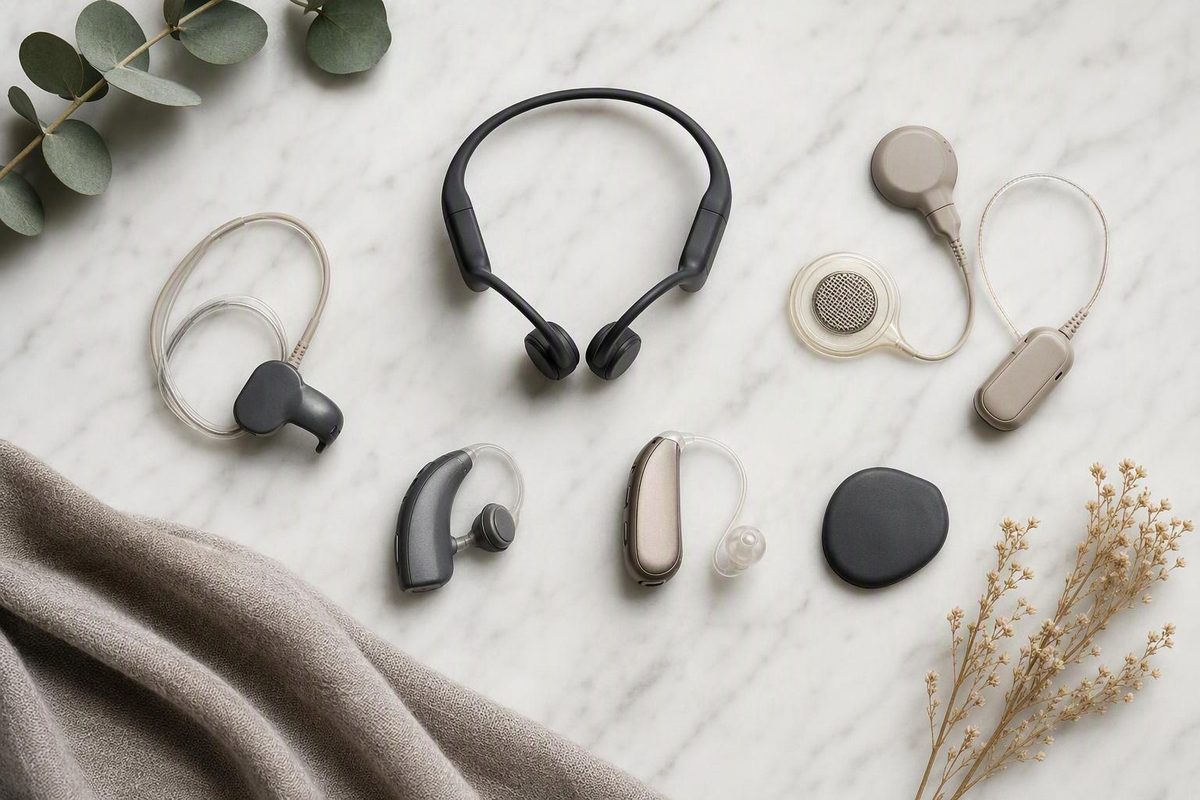
Bone conduction hearing aids send sound to the inner ear through vibrations in the skull, rather than through the ear canal and middle ear. They can help some people with conductive or mixed hearing loss, and selected people with single-sided deafness. They are not simply a more powerful alternative to ordinary hearing aids for every type of hearing loss. The American Academy of Otolaryngology–Head and Neck Surgery, in guidance reviewed in July 2025, supports these uses and recommends specialist assessment.
The first decision is whether this sound pathway fits your hearing loss. Only then does it make sense to compare a headband or adhesive device with a surgically implanted system.
How they work—and who they help
A microphone picks up sound, a processor adjusts it, and a vibrating component delivers it through the skull to the cochlea, the hearing organ in the inner ear. This provides an alternative route around problems in the outer or middle ear. It still relies on a cochlea capable of responding to that vibration. A clinical review of bone conduction devices explains this mechanism and the main indications.
The potential benefit depends on the hearing-loss pattern:
- Conductive hearing loss: Sound has difficulty traveling through the outer or middle ear. Bone conduction may be useful when an absent or narrowed ear canal, chronic ear disease, or altered anatomy makes conventional hearing aids difficult to use.
- Mixed hearing loss: There is both a sound-transmission problem and inner-ear hearing loss. A bone conduction system may help, but the remaining inner-ear hearing must fall within the particular device’s fitting range.
- Single-sided deafness: One ear has severe or profound inner-ear hearing loss while the other has normal or near-normal hearing. A device on the deaf side can route sound through the skull to the better-hearing cochlea.
These are reasons for an evaluation, not automatic eligibility. Anatomy, hearing thresholds, ear health and the specific device’s labeling all matter. Bone conduction systems are generally not the usual starting point for hearing loss caused by inner-ear damage in both ears without a conductive component. Clinical device review
If your hearing has suddenly dropped, especially in one ear, seek medical care immediately rather than shopping for a device. The NIDCD treats sudden deafness as a medical emergency; delaying assessment and treatment can reduce treatment effectiveness.
Nonsurgical versus implanted systems
“Bone conduction” describes the sound pathway. “Bone-anchored” usually refers to a system with a surgically placed implant. Not all bone conduction hearing aids require surgery.
| System | How it attaches and delivers sound | Main trade-off |
|---|---|---|
| Nonsurgical | A headband, softband or adhesive attachment holds the vibrating processor against the skin. | Avoids surgery; skin and soft tissue can reduce vibration transmission, and comfort depends on the attachment. |
| Skin-penetrating connector (percutaneous) | The processor clips onto an abutment—a small connector extending through the skin from an implant. | Direct vibration transmission, but the exposed skin site needs care and can develop reactions or infection. |
| Passive, under-skin magnetic system | Magnets hold the external processor over an implant; vibrations pass through intact skin. | No exposed connector, but tissue reduces transmission and magnet pressure can cause discomfort. |
| Active, under-skin system | The external processor sends an electronic signal to an implanted vibrating component. | Generates vibration beneath the skin, reducing tissue-related signal loss, but still requires surgery. |
These differences are described in a review of hearing rehabilitation options. They do not establish one design as best for everyone.
A nonsurgical device may be a longer-term option for someone who does not want surgery or is not a surgical candidate. It is also useful for a demonstration before implantation. Cleveland Clinic describes headband and adhesive options and recommends discussing candidacy with an ear, nose and throat specialist (ENT) and audiologist.
What benefit should you expect?
For conductive or mixed hearing loss, the goal is to make sound more accessible without depending on the impaired outer- or middle-ear route. Leaving the ear canal open can also be useful when an earmold is unsuitable because of ear disease or anatomy. Clinical device review
For single-sided deafness, expectations need particular care. Routing sound to the better ear does not restore independent hearing in the deaf ear. It can improve awareness of someone speaking from that side, but it does not restore true two-ear hearing or reliably solve sound-localization problems. Review of single-sided deafness treatments
Benefits in noise depend on where speech and competing noise originate. In an adult single-sided deafness trial, bone conduction improved speech understanding when speech came from the poorer side and noise from the better side—but worsened it when those positions were reversed.
If you have single-sided deafness, ask to compare bone conduction with CROS, a nonsurgical hearing-aid system that sends sound from the poorer side to the better ear. Also ask whether cochlear implant assessment is appropriate: unlike rerouting devices, a cochlear implant can provide input to the deaf ear by electrically stimulating its auditory nerve. Candidacy and outcomes require separate assessment. Treatment comparison
What to check before choosing one
Ask an audiologist and ENT to explain these points:
- Your hearing-test results. What do the air-conduction and bone-conduction thresholds show? For mixed loss, is your inner-ear hearing within the proposed processor’s fitting range?
- A demonstration or trial. Compare aided and unaided listening, including speech in noise where possible. Use your actual priority—work meetings, conversation from the poorer side, or daily comfort—not just whether sounds seem louder. A skin-worn demonstration is useful, but its transmission differs from an implant’s.
- Daily care and wearability. Ask about attachment comfort, cleaning, batteries, glasses, headwear, streaming and what happens if the processor needs repair.
- Surgery and activation. Ask about your risks, healing time and when the processor can be fitted. Implant-related complications can include inflammation, infection and failure to integrate with bone; activation is not necessarily immediate. Cleveland Clinic’s patient guide
- Future MRI needs. Get the exact implant model and its MRI conditions in writing, and share them with the imaging team before a scan. Requirements differ even between generations of the same system; some scans may require special preparation or magnet removal. External processors must also be removed as directed. Cochlear’s U.S. MRI guidance illustrates these model-specific differences.
These hearing systems should not be confused with bone-conduction headphones sold for music. Nor are they part of the U.S. OTC hearing-aid category: the FDA defines OTC hearing aids as nonimplanted air-conduction devices.
Cost and insurance: check the device category
Request an itemized estimate covering the processor, implant if applicable, surgery, anesthesia, programming, follow-up and replacement parts. An implant quote and a nonsurgical processor quote may cover very different services.
As of October 2026, Original Medicare distinguishes excluded hearing aids from certain covered auditory prostheses. Its Benefit Policy Manual, Chapter 16, section 100 includes qualifying osseointegrated implants among prosthetic devices, while excluding scalp-stimulating bone conduction hearing aids. The manual specifies that these prosthetic devices are indicated when hearing aids are medically inappropriate or cannot be used because of congenital malformations, chronic disease, severe sensorineural hearing loss or surgery.
That is not blanket coverage for every bone conduction product or patient. Have the clinic confirm the proposed device’s classification, medical-necessity requirements and your expected share before proceeding. For the broader distinction, see our Medicare hearing-aid coverage guide.