
How Hearing Aid Glasses Work and Who They Suit
Fit-sensitive feedback, 6-10-hour battery estimates and no conventional streaming limit their role as replacements for conventional hearing aids.
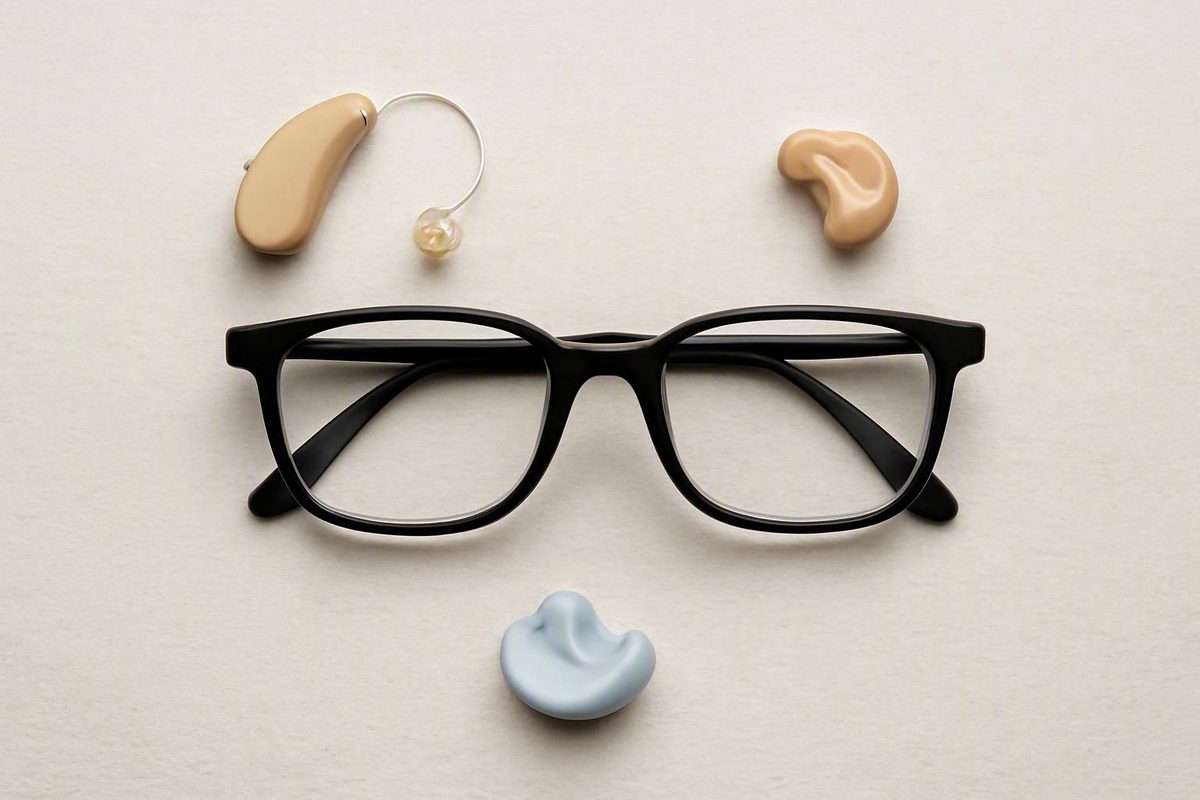
Hearing aid glasses combine eyewear and hearing assistance in one frame. For someone who already wears glasses and mainly struggles to follow selected conversations, the concept is appealing: the ear canal stays open, no separate hearing-aid case occupies the space behind the ear, and directional processing may make a person in front easier to hear.
The evidence base is much narrower than the product category suggests. Most detailed testing, pricing, and feature information concerns Nuance Audio Glasses. Current findings should therefore be read primarily as evidence about that product—not proof that every device marketed as “hearing glasses” will perform the same way.
Even for Nuance, several ownership questions remain unresolved in the supplied evidence, including complete warranty coverage, prescription-product return conditions, repair turnaround, battery service, replacement lenses, specialty-prescription compatibility, and whether an in-person fitting is required. That uncertainty matters because one failure can interrupt both hearing assistance and vision correction.
The best-supported use case is situational speech assistance for some adults with very mild or mild hearing loss. Preset amplification, limited output, fit-sensitive feedback, reported battery estimates of roughly 6–10 hours, and no conventional audio streaming all limit the case for treating current hearing glasses as a universal replacement for conventional hearing aids.
Related: Fluttering Sound in Ear: Causes, Warning Signs and Next Steps.
What hearing aid glasses are—and what the term does not mean
“Hearing aid glasses” is an imprecise label. It can refer to regulated hearing devices built into optical frames, bone-conduction systems, older spectacle-mounted aids, or consumer smart glasses that amplify conversation. Those products do not necessarily use the same technology or have the same regulatory status.
| Product category | How sound is delivered | Typical purpose | Is it automatically a hearing aid? |
|---|---|---|---|
| Integrated air-conduction hearing glasses | Frame microphones capture sound; speakers near the ears deliver amplification through the air | Combined vision correction and open-ear hearing assistance | No; status depends on the specific product |
| Bone-conduction glasses | The frame transmits vibration through contact with the skull | Selected clinical hearing needs after professional assessment | Not automatically; classification and candidacy vary |
| Audio smart glasses or hearables | Open-ear speakers play media or enhance selected sounds | Calls, music, digital assistants, or conversation enhancement | No |
| Retrofit spectacle aids | A hearing device or attachment is mounted to an existing frame | Combining separate hearing hardware with eyewear | Depends on the attached device |
| Conventional hearing aids with ordinary glasses | A BTE, RIC, ITE, CIC, or other device delivers sound independently of the glasses | Ongoing hearing support across a broader range of needs | Yes, when sold as a hearing aid |
In the narrowest sense, hearing aid glasses are optical frames with hearing-assistance electronics built into or attached to the temples. Depending on the product and prescription, the frames may accept prescription lenses, reading lenses, sunglasses, or non-prescription lenses.
Integrated air-conduction designs generally place microphones and processing hardware in the frame. Speakers near the ears project processed sound through the air while leaving the canals open. Some systems use directional microphones or beamforming to give greater emphasis to sound arriving from a selected direction.
Bone-conduction glasses are different. They transmit vibration through the skull rather than projecting amplified sound toward the ear canal. Although that approach may be considered for selected clinical needs, candidacy depends on the cause and pattern of hearing loss. It should not be chosen simply because a product description mentions a particular diagnosis. A commercial hearing-care overview likewise separates integrated, retrofit, smart-glasses, and bone-conduction hearing-glasses designs.
Bluetooth creates another source of confusion. Glasses can connect to a phone, play audio, or include a conversation-enhancement feature without being regulated hearing aids. A sponsored HearingTracker category guide, for example, describes Nuance Audio as an OTC hearing product but classifies Ray-Ban Meta glasses with Conversation Focus as hearables rather than OTC hearing aids. That distinction is useful, although the guide’s sponsorship means it should not be treated as independent clinical evidence about effectiveness.
Third-party sources describe Nuance Audio Glasses as FDA-cleared, preset OTC hearing devices for adults with perceived mild-to-moderate hearing loss. The underlying FDA record and its exact intended-use language were not supplied for this review, so the regulatory description should remain attributed to those sources rather than treated as independently verified. The available evidence also supports describing the product as preset—not as a self-fitting system precisely matched to an individual audiogram. HearingTracker’s category guide provides the third-party regulatory characterization and distinguishes hearing aids from general-purpose hearables.
Most of the detailed evidence that follows concerns Nuance. Its microphone arrangement, presets, battery performance, fit problems, and laboratory results should not be generalized to every frame advertised as hearing glasses.
How integrated hearing glasses pick up and deliver sound
An integrated air-conduction system follows a basic signal path:
- Microphones collect surrounding sound.
- Digital processing analyzes and amplifies it.
- Directional processing gives greater emphasis to a selected area, such as the space in front of the wearer.
- Speakers in or under the temple arms project processed sound toward the ears.
Nuance is the best-documented example. Reviews report six microphones, external open-ear speakers, and two broad listening patterns: frontal and all-around. Its mobile app provides volume, background-noise, listening-direction, sound-profile, and battery controls. HearingTracker also reports that saved settings remain available after setup, so the app does not have to stay open continuously. Its review identifies four presets—flat mild, sloping mild, flat moderate, and sloping moderate—and explains the microphone system, app controls, and saved settings.
Frontal listening is intended to make a speaker ahead of the wearer more prominent. That may help across a table, at a service counter, or in a meeting where one person is presenting. It does not create an acoustically isolated channel. Side conversations, dishes, music, reverberation, wind, and nearby speakers can still reach the microphones and the wearer’s open ears.
All-around mode is more suitable when useful voices may come from several directions. The tradeoff is that more competing sound may also be admitted. Frontal mode can help when the target is predictable; all-around mode may be more practical in a small group where speakers take turns from different positions.
The four broad profiles are not equivalent to programming a hearing aid from a complete audiogram. Four presets cannot represent every variation.
Supported app controls reportedly include:
- Overall volume
- Background-noise adjustment
- Frontal or all-around listening direction
- Selection among four amplification profiles
- Battery monitoring
Initial setup and fine-tuning require a compatible mobile device. Smartphone compatibility and confidence using an app are therefore part of candidacy, not merely conveniences. Someone who finds phone menus difficult may need reliable setup help and assistance with later adjustments.
A separate pocket-sized remote has also been reported. Its functions and inclusion appear to vary by source or seller: the manufacturer describes an optional remote for volume, while Soundly reports volume and listening-mode controls. Buyers should verify the current functions, price, and box contents rather than assuming that the remote is included. Soundly’s commercially connected review describes the app, directional modes, and separate remote.
Focused listening should be understood as a change in emphasis, not noise cancellation in the everyday sense.
Who may benefit—and who should look beyond hearing glasses
Nuance has been marketed to adults with perceived mild-to-moderate hearing loss. That describes who may be eligible to consider the product; it does not establish who will receive sufficient amplification.
Audiologist Cliff Olson reported that real-ear testing found under-amplification beyond mild loss, especially at higher frequencies. His testing also measured about a 5 dB front-versus-back advantage over part of the speech-frequency range and up to 5 dB of noise reduction in a lowered-noise setting. Those findings suggest that the product’s strongest use case may be very mild or mild loss with a predictable speaker position, but they reflect one reviewer’s test protocol rather than guaranteed individual results. The same review cites a battery estimate of up to eight hours and explains the real-ear and directional findings.
A plausible candidate
Hearing glasses may be worth investigating if most of the following are true:
- You already wear glasses for much of the day.
- Your hearing difficulty appears mild and is most noticeable in selected conversations.
- You want support in meetings, office interactions, quiet visits, or moderate background noise.
- You can usually face the person you want to hear.
- You are comfortable using a smartphone app or have dependable setup help.
- You can plan around a possible charging break.
- One of the available frames fits your head and prescription.
- You do not require the glasses to stream calls, music, television, or podcasts.
- You are willing to treat them as situational support unless testing shows that they work adequately as your primary device.
Plausible situations include a quiet one-to-one conversation, a meeting in which the principal speaker sits ahead, or an office interaction where moderate ambient noise makes speech harder to follow. Benefit will still depend on the wearer’s hearing profile, speaker position, room acoustics, chosen mode, volume, and frame fit.
Someone who wears one pair of glasses throughout the day may find integration simpler than someone who switches among reading glasses, distance glasses, sunglasses, and safety eyewear. Hearing assistance tied to one frame disappears whenever another pair is worn.
Reasons to compare conventional hearing aids first
Professionally fitted or more customizable alternatives deserve priority when you have:
- Hearing loss greater than mild
- Substantial high-frequency loss
- A need for more gain than external frame speakers can provide
- A need for precise audiogram-based programming
- Complex speech-in-noise difficulty
- All-day amplification needs
- Frequent changes among several pairs of glasses
- A strong need for calls, television, or media streaming
- A preference for ongoing audiology support and verification
Those patterns raise questions that should be evaluated rather than addressed solely by purchasing an amplifier. An audiology-clinic overview similarly recommends professional assessment when choosing between integrated hearing glasses and professionally fitted hearing aids.
OTC availability means that a qualifying product can be bought without a prescription. It does not establish that a hearing evaluation is unnecessary or that every perceived hearing problem is suitable for an OTC device.
The most realistic role for current hearing glasses is therefore situational assistance. Some wearers may obtain enough benefit to use them as a primary device, but that conclusion should follow appropriate assessment and real-world testing—not the assumption that an integrated frame can automatically replace a conventional hearing aid.
What testing suggests about speech, noise, feedback, and comfort
The most specific controlled results in the supplied evidence come from HearAdvisor testing reported by HearingTracker. Nuance Audio Glasses received an overall score of 4.1 out of 5 and an A SoundGrade. Speech performance was reported as well above average in quiet and above average in noise, while feedback performance was below average. These are laboratory results, not promises about performance in a particular restaurant, workplace, car, or home. The sponsored category guide summarizes the HearAdvisor scores and performance categories.
A bounded interpretation is more useful than a blanket claim:
- In quiet: A person facing the wearer may become easier to hear, particularly when the wearer needs mild amplification.
- In moderate background noise: Directional processing may improve access to a target speaker ahead.
- In a crowded restaurant: Nearby conversations, music, dishes, and reverberation may continue to compete with speech.
- In a group: Frontal focus may favor one participant while making it less natural to follow people seated around the wearer.
- Outdoors: Wind passing over frame microphones may complicate listening.
- In a large reverberant room: Amplification cannot remove delayed reflections already reaching the microphones.
Controlled results should be separated from reviewer impressions. Soundly reports using the glasses in restaurants, offices, air travel, homes, and a test studio, while other reviewers describe personal impressions of comfort, clarity, and their own voice. Such reports can identify conditions worth testing, but one reviewer’s experience does not predict another wearer’s result.
The open-ear tradeoff
Leaving the canal unobstructed may reduce the plugged-up sensation associated with some in-ear devices. It also preserves direct access to surrounding sound, which some people may find more comfortable or natural.
The compromise is available output. A speaker outside the ear has less control over how much amplified sound reaches the eardrum than a receiver positioned in or close to the canal. Some sound escapes into the surrounding air, which can limit useful gain—particularly when greater high-frequency amplification is needed.
Speaker position is therefore critical. If a wide head or poorly adjusted frame places the temple speakers farther from the ears, more volume may be needed to obtain the same benefit. Raising the volume can make feedback more likely.
Fit is consequently an acoustic issue as well as an optical one. Frame width, temple angle, head shape, speaker-to-ear distance, hair, hats, and other headwear can all change the relationship among the microphones, speakers, and ears. A frame can look acceptable and still perform poorly if its speakers sit too far away.
Some wearers may initially perceive their own voice as louder, processed, or echo-like because the microphones pick up their speech and reproduce it through nearby speakers. That perception may become less noticeable with adaptation or different settings, but adaptation is not universal and should not be assumed.
Neither an A laboratory grade nor a favorable individual review proves that the glasses will outperform prescription hearing aids for a particular person. A properly fitted conventional aid may offer more gain, more precise frequency shaping, and better feedback control. The relevant question is whether each device supplies adequate and comfortable amplification for the wearer’s actual hearing profile and listening environments.
Battery, Bluetooth, fit, and everyday use
Published battery estimates conflict. HearingTracker reports approximately 6–8 hours of normal use, while Soundly reports 8–10 hours. Cliff Olson’s review cites up to eight hours. Together, those figures support planning around roughly 6–10 hours, not assuming reliable all-day operation. HearingTracker also reports an IPX4 rating, which indicates limited splash resistance rather than waterproofing, immersion protection, or established dust resistance. Its review documents the 6–8-hour estimate and IPX4 rating.
Soundly’s higher 8–10-hour estimate illustrates why runtime should be treated as variable rather than fixed. The same review reports that Nuance does not provide conventional Bluetooth audio streaming for calls, music, or podcasts. Soundly reports both the battery estimate and streaming limitation.
Charging creates a distinctive dual-function problem. If the wearer depends on prescription lenses, removing the glasses to charge them also removes vision correction. A separate hearing aid can usually be charged while the person continues wearing ordinary glasses; an integrated product does not preserve that separation.
Consider a commuter who puts the glasses on at 7 a.m., attends meetings through the afternoon, and wants hearing support during dinner. Even an eight-hour charge may end before the workday does. That wearer needs a charging opportunity and a backup plan—perhaps spare prescription glasses, another hearing device, or acceptance that amplification will be unavailable for part of the day.
Bluetooth terminology also requires care. Bluetooth Low Energy can support communication between the glasses and their control app without supporting ordinary audio streaming. App connectivity therefore does not mean the wearer can send calls, music, television, or podcasts directly to the frame.
Someone whose priorities include phone calls, direct television audio, music, or podcasts should compare conventional hearing aids with explicit streaming support, dedicated hearables, headphones, or an appropriate television accessory.
Fit affects both vision and hearing
An optical frame must hold prescription lenses in the correct position. A hearing frame must also place its speakers appropriately near the ears. Buyers should assess:
- Frame width relative to head width
- Temple pressure and behind-ear comfort
- Whether the bridge slips during movement
- Speaker distance from each ear
- Whether the frame remains level
- Feedback at a useful volume
- Comfort with usual hair, hats, or headwear
- Lens position for progressive or specialty prescriptions
A frame that is too wide may place the speakers too far from the ears and weaken the acoustic benefit. One that is too narrow may create pressure during extended wear. Optical adjustments can therefore change both comfort and sound.
The reported IPX4 rating should not be interpreted as permission to immerse the glasses, wear them while swimming, or treat them as rugged outdoor electronics. The supplied evidence also does not establish dust protection. Buyers should obtain written care instructions from the seller.
Integration creates a single point of failure. A depleted battery, broken temple, damaged lens, lost frame, or electronics repair can remove both hearing and vision support. Anyone who depends heavily on either function should keep backup glasses and decide in advance what hearing option will be used during charging or repair.
Price, lenses, styles, and the real cost of ownership
As checked in August 2026, the manufacturer lists configurations starting at $699. Historical third-party reviews report materially higher totals: Soundly listed about $1,200 before separately purchased prescription lenses, while Cliff Olson reported a $1,100 frame price and estimated that lenses and selected upgrades could bring the total to about $1,500. These figures come from different dates and configurations, so they should be treated as a range of reported purchase scenarios rather than a single current price.
The manufacturer currently presents prescription and non-prescription configurations, Square and Panthos frame shapes, and lens choices that include clear, Transitions, and blue-violet-light-filtering options. Its page also advertises configurations starting at $699 and free returns within 30 days, although the supplied material does not establish all conditions for personalized prescription products. Nuance Audio’s product page lists the current starting price, configurations, lens categories, and return claim.
Cliff Olson’s review supplies the separate $1,100 frame and approximately $1,500 upgraded total estimates. Those figures should not be assumed to apply to every prescription, seller, or current configuration, but they illustrate why the entry price may understate the eventual cost for a prescription wearer. The review explains its frame and upgraded-price estimates.
Sources conflict on the exact number of frame colors and sizes. Some describe two colors, others describe multiple colors, and the manufacturer’s later page shows additional configurations. Inventory may also differ by region. Verify the exact shape, size, color, and lens combination before ordering.
Build a written total
Ask for a quote covering:
- Frame and hearing-electronics configuration
- Single-vision, bifocal, progressive, or other prescription lenses
- High-index materials, coatings, tinting, or light-responsive treatments
- Optional remote
- Shipping, collection, or in-store fitting
- Audiology evaluation or programming services
- Financing charges or payment terms
- Replacement lenses after a prescription change
- Frame and electronics repair
- Battery service after capacity declines
- Taxes and nonrefundable charges
Insurance acceptance is not the same as reimbursement. The manufacturer says that it works with many insurance plans, but coverage, deductibles, network rules, exclusions, and out-of-pocket costs depend on the individual plan. Request a written estimate of both insurer payment and your expected balance before ordering. The manufacturer’s page describes its insurance and financing claims.
FSA or HSA treatment should also be confirmed for the specific transaction. Soundly describes potential eligibility, but that does not establish that every plan administrator will approve the full cost of a combined optical-and-hearing purchase. Documentation requirements and the treatment of lenses, frames, hearing electronics, and upgrades may differ.
The manufacturer advertises free returns within 30 days, but the supplied evidence does not establish complete terms for prescription products or document full warranty, accidental-damage, repair, battery-service, and replacement-lens policies. Personalized lenses may be treated differently from standard non-prescription stock.
Before paying, ask the seller to answer these questions in writing:
- What is the complete price with my exact prescription and lens options?
- Can the frame support progressives, prism, high-index lenses, or my other specialty requirements?
- When does the trial period begin?
- Are prescription lenses refundable?
- Are fitting, shipping, or professional-service charges excluded from refunds?
- What does the warranty cover for the frame, electronics, battery, and lenses?
- What happens if only the optical component or only the hearing component fails?
- Where are repairs performed, and what is the expected process?
- Can the battery be serviced or replaced?
- Can new lenses be installed after my prescription changes?
- Is an in-person fitting required, recommended, or optional?
- Is a loaner or backup available during repair?
- Is the remote included, optional, or unavailable in my configuration?
- Will using another optical laboratory affect the warranty?
The real cost of ownership extends beyond the initial frame. It may include prescription updates, battery aging, repairs, replacement lenses, professional assistance, and backup devices for two essential functions. Until written ownership terms are available, those unknowns should be treated as purchase risks rather than minor details.
Hearing glasses vs. conventional hearing aids
No single style is best for every glasses wearer. Integrated hearing glasses reduce crowding behind the ear, but conventional devices preserve frame choice and may provide more individualized amplification.
| Option | Amplification and customization | Directionality and streaming | Battery and support | Fit and failure tradeoff |
|---|---|---|---|---|
| Integrated hearing glasses | Preset, relatively limited output; best-documented use is mild situational support | Directional speech modes; Nuance lacks conventional media streaming | Reported Nuance runtime is roughly 6–10 hours; audiology support may be separate | Open canals and no separate aid behind the ear, but hearing is tied to one frame |
| Professionally fitted hearing aids | Audiogram-based adjustment, verification, and potentially greater output | Model-dependent directionality and streaming | Product-dependent battery life with professional follow-up | Independent of eyewear; may occupy behind-ear or in-ear space |
| Conventional OTC hearing aids | Varies from basic presets to supported self-fitting systems | Features vary widely | Support and battery vary by brand | Preserves frame choice but requires separate handling |
| RIC/RITE hearing aids | Broad fitting range and professional customization | Directional and connectivity options commonly vary by model | Separate hearing device and power system | A relatively small case behind the ear generally leaves more room than a traditional BTE |
| Traditional BTE hearing aids | Can provide substantial output and flexible earmold options | Features vary by model | Separate, serviceable hearing system | A larger case may compete with thick frame temples |
| Custom ITE/CIC devices | Custom shell; capability depends on anatomy, size, and hearing needs | Smaller devices may involve feature or handling tradeoffs | No hardware behind the ear | Avoids competition with glasses, but tiny devices may be harder to handle |
| Bone-conduction glasses | Distinct transmission method for selected clinical needs | Product-dependent | Requires careful clinical and physical fitting | Hearing remains tied to frame position and contact |
| Audio smart glasses | Usually intended for media or general sound enhancement rather than individualized hearing-loss treatment | Streaming and smart functions may be stronger | Consumer-electronics support model | Open-ear convenience, but not automatically a hearing aid |
The central advantage of integrated hearing glasses is consolidation. There is no separate hearing-aid case competing with a frame temple and no in-ear component to insert. For someone who wears the same glasses consistently, that may simplify the daily routine.
Consolidation also creates dependency. Hearing assistance is available only when the integrated glasses are worn, charged, working, and correctly positioned. Someone who alternates among several optical frames may obtain more continuity from a separate hearing aid.
Professionally fitted hearing aids generally allow more individualized frequency adjustment and may provide more amplification for greater hearing loss. An audiologist can assess whether prescribed output reaches the eardrum as intended and adjust the device around comfort, feedback, and speech priorities.
RIC or RITE devices place the receiver in the ear while keeping a relatively small processor case behind it. Their smaller cases may fit beside glasses more easily than traditional BTE devices while allowing the wearer to choose from a much broader range of frames.
ITE and CIC devices avoid behind-ear competition because their principal components sit in the outer ear or canal. Candidacy depends on hearing needs, ear anatomy, comfort, dexterity, and desired features. A very small device is not necessarily easier for someone who has difficulty seeing or handling tiny controls.
Traditional BTE hearing aids can still be worn with glasses. Thin temples, careful positioning, and an appropriately sized case can reduce crowding. A commercial provider’s guide explains the differences among BTE, RIC/RITE, ITE, and CIC designs and notes that RIC/RITE and in-ear styles generally leave more room for glasses.
Bone-conduction eyewear should not be treated as merely another open-ear amplifier. It uses a different sound pathway and may require precise contact and clinical selection. Audio smart glasses are different again: media playback, calls, and conversation-enhancement features do not by themselves make a product a hearing aid.
A practical decision path is:
- Choose integrated hearing glasses when combined convenience, open ears, discreet appearance, and situational mild support are the priorities.
- Compare RIC or custom in-ear devices when you want broader frame choice and less competition behind the ear.
- Seek professional fitting when stronger amplification, precise frequency shaping, verification, complex listening support, or ongoing care matters most.
A practical checklist before buying
A useful trial should evaluate hearing, optics, technology, and ownership together. A suitable sound setting cannot rescue an ill-fitting optical frame, and an excellent lens prescription cannot compensate for inadequate amplification.
Audiology checklist
Ask an audiologist or hearing professional:
- What is the degree and pattern of my hearing loss?
- Is it within the range that preset open-ear amplification can plausibly address?
- Do I need substantial high-frequency gain?
- Are my main difficulties in quiet, noise, at a distance, or with several speakers?
- Is a broad preset likely to be adequate?
- Can real-ear verification be performed with the glasses?
- Do asymmetry, sudden change, conductive findings, poor speech recognition, or other features require further assessment?
- Would a conventional OTC, RIC, BTE, or custom device provide more appropriate output?
- What professional support is available after purchase, and what does it cost?
Optical checklist
Ask the optician or seller:
- Is my exact prescription compatible?
- Are progressive, high-index, prism, occupational, or specialty lenses supported?
- Does the frame width match my head?
- Where will the speakers sit relative to my ears?
- Can the temples be adjusted without damaging or misaligning the electronics?
- Does the bridge keep the frame stable while walking or turning my head?
- What happens when my prescription changes?
- Can another optical laboratory replace the lenses without voiding coverage?
Technology checklist
Confirm:
- Phone operating-system compatibility
- Whether you can install and confidently use the app
- Whether setup help is available
- That app Bluetooth does not imply calls or media streaming
- Realistic battery expectations rather than best-case advertising
- Where and when charging will occur
- Whether the remote is available and what it controls
- Which backup vision and hearing options you will keep
Ownership checklist
Obtain written terms for:
- Trial-period length and start date
- Prescription-product return restrictions
- Frame, electronics, battery, and lens warranties
- Accidental-damage coverage
- Repair location and expected process
- Battery service
- Replacement frames and lenses
- Prescription updates
- The procedure if only one component fails
- Any required in-person fitting
- Loaners or alternatives during repair
Treat unresolved questions about warranties, battery aging, repairs, replacement lenses, specialty prescriptions, or fitting requirements as reasons to pause.
Test the situations that matter
Do not judge performance only in a quiet optical store. If the trial terms permit, test the glasses:
- Across a table from one person
- In a small meeting
- In your usual workplace
- In a restaurant at a typical busy time
- While walking outdoors
- In a car as a passenger
- Around the television
- In a group where speakers change positions
Try both frontal and all-around modes. At the highest comfortable volume, check for whistling while turning your head, looking down, speaking, walking, and wearing your usual hair, hat, or headwear. Notice whether your own voice is distracting, whether both speakers remain close to the ears, and whether an optical adjustment changes the sound.
If you choose separate hearing aids
Ordinary glasses and hearing aids can generally be worn together with an appropriate fit. Put the glasses on first, then position the behind-ear device close to the outer ear rather than allowing it to hang away. Thin frame temples can reduce crowding. When removing the glasses, use both hands and move the frame forward while keeping it level to reduce the chance of dislodging the hearing aids. Miracle-Ear’s commercial fitting guide illustrates these practical techniques for wearing hearing aids with glasses.
Hearing aid glasses are a credible but narrow option. They make the most sense for someone who already depends on eyewear, values an open ear, and wants discreet speech assistance in selected situations. The strongest documented product may suit some adults with very mild or mild hearing loss, but limited personalization, fit-sensitive feedback, variable runtime, no conventional audio streaming, and unresolved ownership terms prevent a blanket recommendation.
Before buying, compare the written total price, verify both acoustic and optical fit, and understand what happens during charging, prescription changes, or repair. When stronger amplification, all-day use, streaming, frame flexibility, or individualized care matters, conventional RIC, custom in-ear, OTC, or professionally fitted hearing aids may be the better route.
Can hearing aid glasses stream phone calls, music, television, or podcasts?
It depends on the product, but Bluetooth should never be assumed to mean audio streaming. Nuance Audio Glasses use Bluetooth Low Energy for app control but do not support conventional streaming for phone calls, music, or podcasts. They may amplify sound coming from a television’s external speakers, but that is not direct television streaming.
Buyers who prioritize calls or media should compare hearing aids, hearables, or other audio devices that explicitly support their phone and television setup.
Can hearing aid glasses use prescription lenses?
Some can. Nuance offers prescription and non-prescription configurations, with documented options including clear, Transitions, and blue-violet-light-filtering lenses. Compatibility still depends on the prescription, selected frame, and lens type.
Before ordering, confirm support for progressives, prism, high-index materials, or other specialty requirements. Also ask whether the lenses can be replaced after a prescription change without affecting the electronics or warranty.
How long does the battery in hearing aid glasses last?
Published Nuance estimates range from approximately 6–8 hours to 8–10 hours, with another review citing up to eight hours. Plan around roughly 6–10 hours rather than assuming all-day operation.
Because the glasses must be removed to charge, prescription wearers may lose both hearing assistance and vision correction during that period. Keep backup glasses and arrange a realistic charging window.
Do I need a hearing test before buying OTC hearing glasses?
A test may not be required to complete an OTC purchase, but it can still identify the degree and pattern of hearing loss, show whether preset amplification is likely to be sufficient, and reveal whether professional follow-up should come before a purchase.
Seek professional assessment rather than relying on an OTC product alone if hearing changed suddenly, differs substantially between ears, is rapidly worsening, appears conductive, or is otherwise complex.
What type of conventional hearing aid works best with ordinary glasses?
RIC or RITE devices may be easier to fit beside glasses because their behind-ear cases are generally smaller than traditional BTE cases. ITE and CIC devices avoid the space behind the ear entirely, although suitability and ease of handling vary.
A BTE can still work with glasses, particularly when the frame has thin temples and both devices are adjusted carefully. The best choice depends on hearing-loss severity, ear anatomy, dexterity, desired features, and comfort—not glasses compatibility alone.