
Causes of Ear Itching: What Your Symptoms Suggest
Compare wax imbalance, dry skin, dermatitis, infection, allergies and device irritation using itch location, triggers and warning signs.
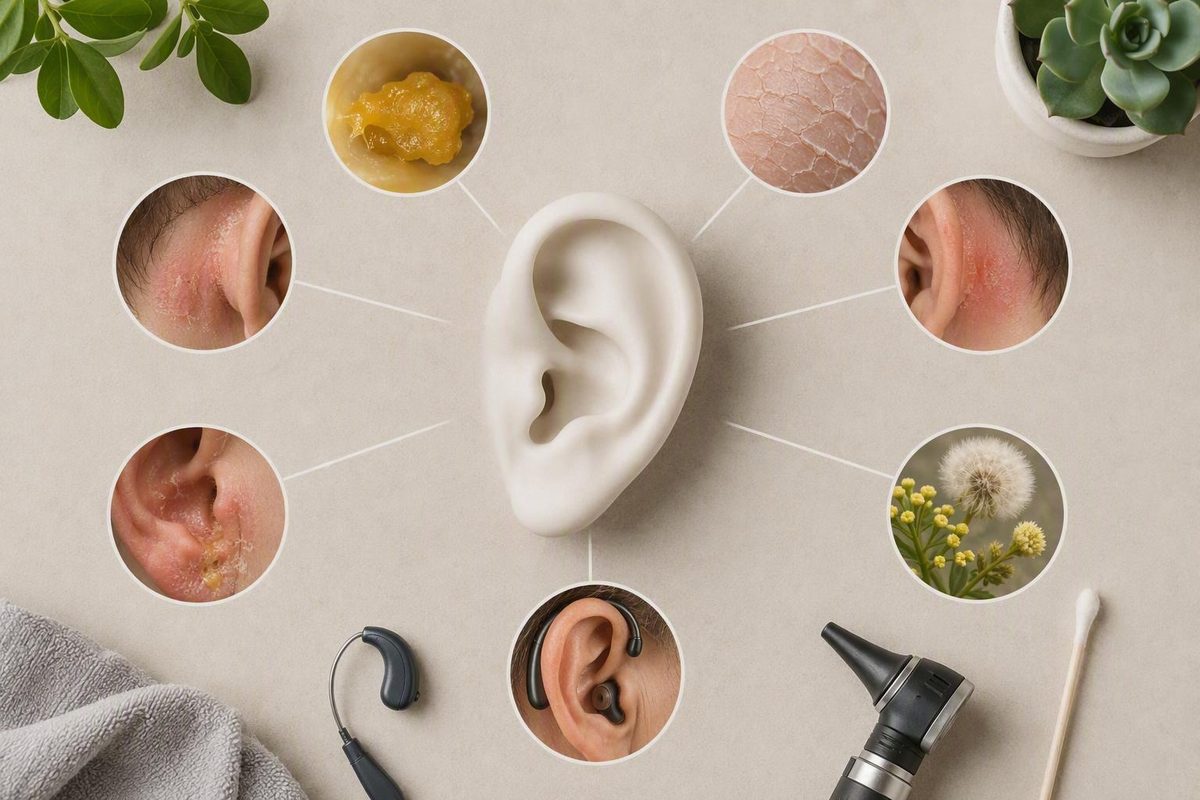
An itchy ear can seem to invite an obvious response: scratch it, clean it, or add a few drops. But ear itching is a symptom, not a diagnosis. Possible causes include excess earwax, loss of protective wax through over-cleaning, dry skin, eczema or psoriasis, contact dermatitis, outer-ear inflammation or infection, allergy, and irritation from hearing aids or earbuds.
The sensation alone rarely identifies the cause. Where the itch occurs, what happened before it began, and whether you also have pain, drainage, swelling, pressure, or hearing changes can help guide the next step. Because these patterns overlap, persistent or complicated symptoms often require an examination.
Start With the Location and Pattern of the Itch
Begin by locating the itch as precisely as possible:
- On the visible ear or behind it: Skin conditions and direct contact with jewelry, cosmetics, sunscreen, soap, shampoo, or hair products become more relevant.
- At the canal entrance or deeper inside: Dryness, wax imbalance, scratching injuries, contact irritation, and otitis externa are possibilities.
- With deeper pressure or fullness: Wax blockage, infection, and allergy-related swelling around the Eustachian tube can all create blocked or muffled sensations.
These are useful distinctions, not diagnostic boundaries. A skin condition can affect the canal without producing an obvious rash on the visible ear. A device may irritate both the canal entrance and the outer ear. Pressure that feels deep may come from wax, inflammation, or altered pressure behind the eardrum.
Fullness and muffled hearing are particularly easy to misinterpret. They may accompany impacted wax, but infection and allergy-related Eustachian tube inflammation can produce similar symptoms. During an allergic reaction, swelling around the Eustachian tube may disrupt pressure regulation and contribute to fluid buildup or a blocked-ear sensation, according to the PIH Health House Clinic’s explanation of allergy-related ear symptoms.
Four broad patterns can help organize the possibilities:
- Dry and flaky: Consider simple dryness, over-cleaning, eczema, psoriasis, seborrheic dermatitis, or contact dermatitis.
- Blocked and muffled: Wax buildup is possible, but infection and allergy-related pressure can overlap with this pattern.
- Wet and painful: Particularly after swimming or bathing, this raises concern for outer-ear inflammation or infection.
- Exposure-related: Symptoms may follow a new personal-care product, earring, piercing, earbud, hearing aid, food, animal exposure, or allergy season.
Before trying to treat the ear, note:
- When the itching began
- Whether it is constant or intermittent
- Whether it affects one or both ears
- Whether it has happened before
- Recent swimming, bathing, or heavy sweating
- Recent cotton-swab use or other ear cleaning
- New shampoo, conditioner, hair dye, spray, cosmetics, or sunscreen
- New earrings or piercings
- Hearing-aid, earmold, earplug, or earbud use
- Pain, discharge, odor, swelling, bleeding, fever, dizziness, or hearing changes
This short timeline may be more useful to a clinician than an attempt to diagnose the cause yourself.
Earwax Buildup, Dryness, and the Over-Cleaning Paradox
Earwax is not simply dirt. It helps protect the canal, contributes to waterproofing, and carries dead skin and debris outward. In most ears, wax gradually moves toward the canal opening without active cleaning. Objects inserted into the canal may push that wax inward instead of removing it, as explained in Cleveland Clinic’s guidance on earwax and itchy ears.
This creates an apparent paradox: both too much wax and removing too much wax can contribute to itching, but for different reasons.
When wax accumulates
Excess or impacted wax may irritate or obstruct the canal. Itching can occur with:
- Fullness or blockage
- Muffled hearing
- Pressure or discomfort
- Tinnitus
- Odor
- Occasionally, material that appears discharge-like
None of these symptoms proves wax impaction. Pain, pressure, and reduced hearing can also occur with an infection. A clinician generally needs to look into the ear to determine whether wax is blocking the canal and whether the canal or eardrum appears inflamed; University of Utah Health notes that wax blockage and infection can produce overlapping symptoms.
When cleaning removes too much
Frequent or intrusive cleaning can strip away protective wax and oils. The canal skin may then become dry, flaky, irritated, and more vulnerable to small injuries. Someone who cleans because the ear itches may experience brief relief while making the underlying irritation worse.
Cotton swabs can contribute in two directions at once:
- They may remove protective material from the outer canal.
- They may push wax farther inward and contribute to blockage.
They can also scrape the delicate canal lining. Fingers, fingernails, bobby pins, and other objects create similar risks.
Environmental conditions may add to dryness. Cold or dry outdoor air, indoor heating, and air conditioning may reduce skin moisture, although their presence does not prove that the environment caused the itch. A recurring dry, flaky pattern during low-humidity periods is only one clue among several, as outlined in this clinical overview of dryness and other causes of itchy ears.
Do not assume that itching means the ear needs more cleaning. It may mean the opposite.
Blind irrigation is not a safe default when the cause and eardrum status are unknown. Water may become trapped behind wax, and putting liquid into the ear requires additional caution when an eardrum perforation, ear tubes, active drainage, infection, injury, or previous ear surgery may be relevant. A clinician can inspect the canal, confirm whether wax is actually obstructing it, and select an appropriate removal method.
Eczema, Psoriasis, and Contact Dermatitis
The visible ear and ear canal are covered by skin, so they can develop many of the same inflammatory conditions as skin elsewhere on the body. Possibilities include:
- Eczema
- Psoriasis
- Seborrheic dermatitis
- Irritant contact dermatitis
- Allergic contact dermatitis
Clues may include dryness, flaking, scaling, redness, cracking, tenderness, or recurring irritation. These features support a skin-related possibility but do not confirm it. Infection, scratching, and simple dryness can produce some of the same changes.
Eczema or psoriasis can affect the skin lining the canal even when there is no obvious plaque or rash on the visible ear. Contact dermatitis may instead correspond closely to the place where a product, material, or piece of jewelry touches the skin. These overlapping skin-related causes are described in a medical overview of itchy ears and their potential causes.
Look for direct contact exposures
Products and materials that touch the ear—or wash over it—may trigger irritation or an allergic response. Relevant exposures include:
- Shampoo and conditioner
- Hair spray, styling products, and hair dye
- Soap and facial cleansers
- Cosmetics and skincare products
- Sunscreen
- Nickel-containing earrings
- New or healing piercings
- Earbuds and earplugs
- Hearing-aid shells, domes, tubing, or earmolds
An exposure timeline may reveal a pattern. Ask whether symptoms began after switching shampoo, coloring the hair, wearing new earrings, applying a new sunscreen, or changing an ear-worn device. Also consider whether the itching improves when the suspected product or device is not used.
Location can strengthen—but not prove—the connection. Irritation confined to the earlobe beneath an earring makes direct metal contact more relevant. Redness where an earmold rests suggests pressure, friction, or material sensitivity.
Avoid pushing ordinary skin creams, ointments, or prescribed products into the ear canal unless a clinician has specifically directed you to do so. A product suitable for the visible outer ear may not be appropriate deeper in the canal, and treatment depends on whether the underlying problem is dermatitis, infection, wax, or something else.
Outer-Ear Infection, Swimmer’s Ear, and the Itch-Scratch Cycle
Otitis externa is inflammation of the outer ear canal. It can have infectious or noninfectious causes, although “swimmer’s ear” commonly refers to a canal infection associated with retained moisture.
Water left in the canal after swimming or bathing can interfere with its protective environment and create conditions favorable to bacterial growth. The issue is not limited to swimmers: showers, baths, sweating, and moisture trapped by an ear-worn device may also contribute.
Another important factor is damaged canal skin. Cotton swabs, fingernails, bobby pins, and other objects can cause small abrasions. These breaks weaken the barrier that normally helps keep germs out. The McGovern Medical School ear-disease guide describes how scratching injuries can permit bacteria to enter and lead to a swimmer’s-ear-type infection.
This can create an itch-scratch cycle:
- Dryness, wax, allergy, or early inflammation produces an itch.
- Scratching temporarily relieves the sensation.
- Scratching damages the canal skin.
- The injury increases irritation and inflammation.
- Damaged skin becomes more vulnerable to infection.
- Worsening inflammation produces more itching and another urge to scratch.
An outer-ear infection may begin with itching. As it progresses, symptoms can include increasing pain, redness, canal or outer-ear swelling, warmth, drainage, tenderness, and hearing difficulty or blockage. Itching that develops into pain, redness, swelling, or drainage after water exposure deserves medical assessment rather than continued scratching or home experimentation, according to ENT guidance on otitis externa and other causes of itchy ears.
Bacterial and fungal canal infections can overlap in how they feel and look. That distinction matters because treatment is cause-specific.
Middle-ear infection should remain in perspective. It may cause pain, pressure, fever, fluid sensations, and hearing changes, and some people report itching. But itching is not usually its defining or primary feature. Examination helps determine whether the problem is in the canal, behind the eardrum, or elsewhere.
Environmental, Contact, and Food Allergies
Allergic reactions involve immune signaling and histamine release, which can contribute to inflammation and itching. Ear symptoms may be part of a broader allergy pattern, but ear itching alone does not identify a trigger or confirm an allergy.
Environmental allergies
Possible triggers include:
- Tree, grass, or weed pollen
- Mold
- Dust mites
- Animal dander
Environmental allergy becomes more plausible when ear itching occurs alongside sneezing, an itchy or congested nose, watery eyes, an itchy throat, or symptoms that track with a season, location, or animal exposure.
Allergies may affect the ear in more than one way. Itching around the visible ear or canal may reflect a local response. A blocked, pressurized, or muffled sensation may instead involve inflammation around the Eustachian tube, which helps regulate pressure between the middle ear and throat. These mechanisms can coexist, and the sensation alone may not reveal which structure is involved.
Contact allergy
A direct reaction is more plausible when symptoms map to the area touching a particular product or material. Nickel earrings are a familiar example. Shampoo, conditioner, cosmetics, sunscreen, hair dye, hearing-aid materials, and earbud components are other possibilities.
It may help to record:
- What touched the ear
- When contact occurred
- How quickly itching appeared
- Whether redness or scaling remained at the contact site
- Whether symptoms improved when the item was avoided
This is a way to organize observations, not a substitute for allergy evaluation.
Food-related reactions
Some food allergies can include itchy ears. Pollen-food allergy syndrome may also cause itching after certain raw fruits, vegetables, or tree nuts in a person with pollen allergy. Food-related ear itching may occur with other mouth, facial, skin, or respiratory symptoms, but it does not identify the responsible food by itself. These possible allergy patterns are summarized in WebMD’s medically reviewed guide to itchy ears.
Emergency warning: Call emergency services if a possible allergen exposure is followed by difficulty breathing or rapidly developing swelling of the face, lips, tongue, or throat. Do not wait to see whether the ear itching passes.
When a reproducible reaction appears to follow a particular food, avoid further exposure pending individualized medical guidance rather than using the ear symptom alone to make a long-term dietary diagnosis.
Hearing Aids, Earbuds, and Other Device-Related Irritation
Hearing aids, earbuds, earmolds, earplugs, and similar devices may contribute to itching through several mechanisms:
- Friction: Movement rubs against canal or outer-ear skin.
- Pressure or poor fit: A tight, oversized, or unstable device creates irritated contact points.
- Material sensitivity: Skin reacts to a device component or coating.
- Wax accumulation: Existing wax becomes more noticeable or problematic during device use.
- Device hygiene: Material on the device may irritate sensitive or inflamed skin.
- Trapped moisture: Water or sweat remains against the canal.
Timing and location provide useful clues. Itching that begins after a new device, appears mainly while wearing it, or occurs exactly where the device contacts the skin may suggest mechanical or contact irritation. It does not prove that the device material is responsible; wax, moisture, dermatitis, and infection can occur at the same time.
Device use and moisture should not always be treated as separate possibilities. Friction against damp, irritated skin can then amplify the problem. Scratching after removing the device adds another source of trauma.
Keep devices clean and dry according to the manufacturer’s instructions. Do not compensate by inserting cleaning tools into the ear. If a hearing aid seems loose, tight, painful, or persistently itchy, ask the hearing professional who fitted it to review the fit and discuss possible material sensitivity. Hearing-aid irritation related to fit, materials, or retained moisture is discussed in this patient guide from Michigan ENT & Allergy Specialists.
A fit adjustment is not the complete answer when itching comes with pain, drainage, marked swelling, redness, odor, bleeding, or a change in hearing. Those features warrant medical assessment for wax, inflammation, injury, or infection.
A Symptom-and-Trigger Guide to Possible Causes
This table is a comparison tool, not a diagnostic checklist. More than one category may fit, and multiple factors can occur together.
| Pattern | Possible cause categories | Supporting clues | Relevant recent exposures | Appropriate next step |
|---|---|---|---|---|
| Dry and flaky | Simple dryness, over-cleaning, eczema, psoriasis, seborrheic dermatitis, contact dermatitis | Flaking, scaling, redness, cracking, or recurrent irritation; the canal may be affected without an obvious external rash | Cotton swabs, dry conditions, heating or air conditioning, new soap, shampoo, cosmetics, hair dye, sunscreen, or jewelry | Stop probing the canal and pause suspected irritants when practical. Arrange an examination if symptoms persist, recur, spread, or become painful. |
| Blocked and muffled | Wax buildup; overlapping possibilities include infection or allergy-related pressure | Fullness, reduced hearing, pressure, tinnitus, discomfort, or odor | Recent cotton-swab use, earplug or device use, allergy symptoms, or a recent respiratory illness | Do not assume the cause is wax or irrigate blindly. Seek assessment if blockage persists or hearing changes are noticeable. |
| Wet or painful after swimming | Otitis externa or another form of canal inflammation | Itching that progresses to pain, redness, swelling, drainage, tenderness, or hearing difficulty | Swimming, bathing, sweating, retained water, scratching, or cotton-swab use | Keep objects and unselected liquids out of the ear and obtain medical assessment, particularly if pain or drainage develops. |
| Visible-ear rash or contact-point itching | Irritant or allergic contact dermatitis, eczema, or psoriasis | Redness, scaling, cracking, swelling, or itching where an item touches | Earrings, piercings, hair products, cosmetics, sunscreen, hearing aids, or earbuds | Stop the suspected exposure when practical. Seek advice if the reaction persists, involves the canal, or becomes swollen or painful. |
| Itching with sneezing or watery eyes | Environmental allergy; possible Eustachian tube inflammation if pressure is present | Itchy nose or throat, congestion, watery eyes, or a seasonal or location-related pattern | Pollen, mold, dust mites, or animals | Track exposures and discuss persistent symptoms with a clinician. Breathing difficulty or facial, tongue, or throat swelling requires emergency care. |
| Itching after a particular food | Food allergy or pollen-food allergy syndrome | Repeated timing after the same food, especially with mouth, throat, facial, skin, or respiratory symptoms | Raw fruits, vegetables, tree nuts, or another suspected food | Avoid further exposure pending medical guidance when a reproducible reaction is suspected. Use emergency services for breathing difficulty or rapidly developing facial, tongue, or throat swelling. |
| Itching mainly with an ear-worn device | Friction, pressure, poor fit, material sensitivity, wax, device hygiene, or trapped moisture | Symptoms at contact points, after prolonged wear, or after introducing a new device | New hearing aid, earmold, earbud, earplug, exercise, or bathing | Clean and dry the device as directed and have hearing-aid fit reviewed. Seek medical care for pain, drainage, swelling, or hearing changes. |
| Itching that becomes painful or starts draining | Developing canal inflammation or infection; skin injury may be involved | Increasing pain, swelling, redness, warmth, discharge, odor, or hearing difficulty | Water exposure, scratching, inserted objects, or device use | Arrange timely clinical assessment; bacterial and fungal causes cannot be reliably separated through self-assessment. |
These patterns—including dryness, wax, dermatitis, allergy, infection, and device irritation—have substantial symptom overlap, as reflected in this clinical summary of possible causes of itchy ears.
The absence of pain does not settle the question. Itching without pain can still result from dry skin, wax buildup, eczema, psoriasis, contact allergy, environmental allergy, device irritation, or early canal inflammation.
Persistence and recurrence are generally more useful as reasons for examination than as evidence of one diagnosis. An itch that repeatedly follows swimming, device wear, or a certain product provides a valuable clue, but the pattern still needs to be considered alongside what the ear looks like.
Safe Next Steps, Clinical Evaluation, and When to Get Help
A safe response begins with triage rather than a home remedy.
Level 1: Monitor brief, mild, isolated itching
Brief itching without pain, drainage, hearing change, swelling, or other symptoms may be monitored. During that time:
- Do not scratch or probe the canal.
- Clean only the visible outer ear.
- Keep the ear and ear-worn devices dry.
- Pause a newly introduced product or device when practical.
- Note whether symptoms follow swimming, cleaning, allergy exposure, or device use.
If the symptom repeatedly returns, review the pattern rather than repeatedly cleaning the ear. Recurrence may justify an examination for wax, skin inflammation, an exposure-related reaction, device irritation, or an early canal problem.
Level 2: Arrange clinical assessment
Seek professional assessment when itching is persistent, recurring, or worsening, or when it occurs with:
- Pain
- Drainage or active fluid
- Foul odor
- Fever
- Marked redness or swelling
- Bleeding
- Hearing changes
- Dizziness
- Balance problems
- Significant sleep disruption
- Interference with work or normal daytime activity
Pain, discharge, hearing changes, redness, swelling, dizziness, and balance symptoms are among the accompanying signs for which ENT patient guidance recommends medical assessment.
Dizziness or balance trouble does not automatically establish an emergency, but it is a reason for prompt professional advice, particularly when it is new, severe, persistent, or accompanied by hearing changes.
Level 3: Seek emergency care for severe allergic symptoms
Call emergency services when a possible allergen exposure is followed by difficulty breathing, rapidly developing swelling of the face, lips, tongue, or throat, or other rapidly worsening signs of a severe systemic reaction. Do not rely on the severity of the ear itching to judge the seriousness of the reaction.
Why “try some drops” is not a universal answer
Treatment depends on the underlying cause:
- Wax blockage may require appropriate removal.
- Dermatitis may require trigger avoidance and treatment selected for the affected location.
- Bacterial and fungal infections require different approaches.
- Allergy management differs from infection treatment.
- Device irritation may call for cleaning, drying, fit changes, or material review.
The safety of putting liquid into an ear also depends on the condition of the eardrum and the person’s history. Do not improvise with alcohol, vinegar, peroxide, oils, moisturizers, medicated drops, or irrigation when the diagnosis is uncertain—especially if there may be an eardrum perforation, ear tubes, active drainage, an infection or canal injury, or previous ear surgery. Guidance on itchy ears specifically cautions against liquid ear treatments when a person has an eardrum perforation or tubes (Michigan ENT & Allergy Specialists).
Repeated peroxide use can irritate canal skin, while cotton swabs may push a blockage farther inward. If pain, drainage, bleeding, or a hearing change is present, individualized assessment is safer than trial-and-error treatment.
What a clinician may do
An evaluation may include:
- Symptom history: When the itching began, whether it recurs, and which other symptoms are present.
- Exposure review: Swimming, cotton-swab use, new products, jewelry, allergy patterns, foods, hearing aids, and earbuds.
- Otoscope examination: Inspection of the canal and eardrum.
- Wax assessment: Determining whether wax is present, impacted, or unrelated to the symptoms.
- Inflammation assessment: Looking for dryness, scaling, abrasions, swelling, drainage, or signs of infection.
- Professional wax removal: When blockage is confirmed and removal is appropriate.
- Cause-specific treatment: Prescription treatment may be considered depending on the findings.
- Device review: A hearing professional may assess fit, pressure points, cleanliness, and material concerns.
- Selective allergy evaluation: This may be useful when symptoms consistently follow an environmental, food, or contact exposure.
Prevention should also follow the suspected cause. Clean only the visible outer ear rather than entering the canal. Keep ears and devices dry. Follow device-cleaning instructions. Avoid products or metals that repeatedly cause irritation. Correct poor device fit instead of tolerating ongoing friction.
Ear itching may come from wax imbalance, dry or inflamed skin, allergy, trapped moisture, infection, or an ear-worn device—but the sensation alone cannot reveal which one is responsible. Stop scratching or probing the canal, review recent water and product exposures, and arrange an examination when symptoms persist or occur with pain, drainage, swelling, fever, hearing changes, dizziness, or bleeding. Breathing difficulty or facial, tongue, or throat swelling after a possible allergen exposure requires emergency care.
Frequently Asked Questions
Why does my ear itch when there is no pain?
Itching without pain can occur with dry canal skin, loss of protective wax from over-cleaning, wax buildup, eczema, psoriasis, contact dermatitis, allergy, or device friction. It may also be an early sign of canal inflammation before pain develops.
The absence of pain does not identify the cause or guarantee that the ear is unaffected. Avoid scratching and monitor brief, isolated itching. Arrange an examination if it persists, recurs, or develops into pain, discharge, swelling, bleeding, or a hearing change.
How can I tell earwax buildup from an ear infection?
You usually cannot distinguish them with certainty from symptoms alone. Wax buildup may cause itching, fullness, pressure, tinnitus, discomfort, or muffled hearing. Infection may cause some of the same symptoms and becomes more concerning when pain, fever, drainage, redness, or swelling develops.
An otoscope examination allows a clinician to see whether wax is blocking the canal and whether the canal or eardrum appears inflamed. Avoid cotton swabs and blind irrigation while the cause is uncertain.
Can allergies make the inside of my ears itch?
Yes. Environmental allergies, direct contact reactions, food allergy, and pollen-food allergy syndrome can include ear itching. Environmental allergy is more plausible when itching occurs with sneezing, congestion, watery eyes, or an itchy nose or throat. Allergy-related swelling around the Eustachian tube may also cause pressure, fluid buildup, or a blocked sensation rather than a straightforward canal itch.
Ear itching alone does not confirm an allergy or identify an allergen. Difficulty breathing or rapidly developing facial, tongue, or throat swelling after exposure requires emergency care.
Can hearing aids or earbuds cause itchy ears?
They can contribute through friction, pressure, poor fit, material sensitivity, trapped moisture, wax accumulation, or device hygiene. Symptoms that begin with a new device or occur primarily at its contact points support—but do not prove—a device-related cause.
Keep the device clean and dry according to its instructions. Ask the hearing professional who fitted a hearing aid to review persistent itching or poor fit. Pain, drainage, swelling, bleeding, odor, or hearing changes call for medical assessment rather than fit adjustment alone.
Is it safe to use cotton swabs, peroxide, oil, or ear drops for itching?
Cotton swabs should not be inserted into the canal. They can remove protective wax, scratch the skin, and push wax deeper.
Peroxide, oils, alcohol, vinegar, moisturizers, and medicated or wax-softening drops are not interchangeable remedies. Whether a liquid is appropriate depends on the cause and on factors such as eardrum integrity, ear tubes, drainage, infection, and previous surgery. When those details are unknown—or when pain, drainage, bleeding, or hearing changes are present—avoid putting substances into the canal and seek individualized advice.