
Ear Crackling When Moving Your Jaw: Causes & Clues
Compare TMJ, earwax, pressure dysfunction, fluid and infection clues, plus when painless crackling can be monitored and which warning signs need assessment.
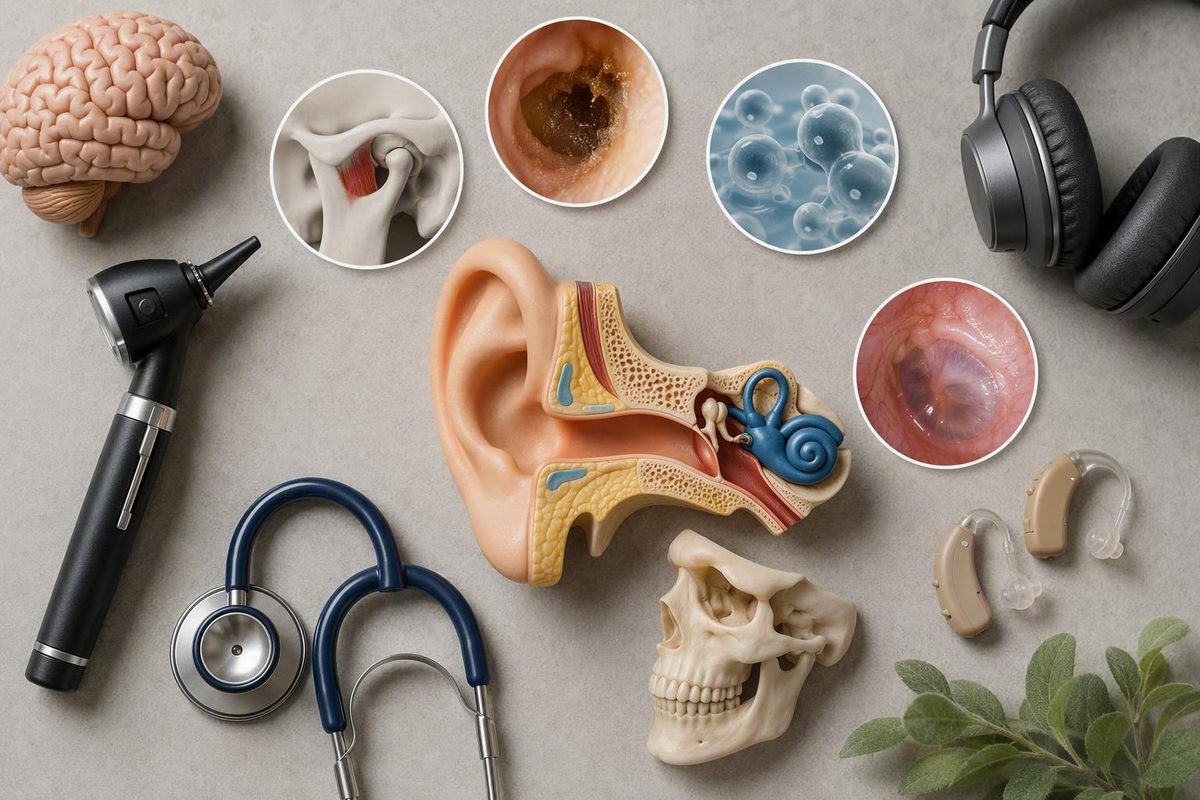
A crackling sound in your ear when moving your jaw may come from the temporomandibular joint (TMJ), which sits directly in front of the ear. However, timing alone does not prove a temporomandibular disorder (TMD). Jaw movement can also shift earwax or coincide with pressure and fluid movement inside the ear.
The symptoms accompanying the sound—not just the sound itself—help determine whether monitoring is reasonable or whether you should arrange an examination.
Quick answer: jaw movement narrows the possibilities but does not diagnose the cause
Your TMJ connects the lower jaw to the skull and moves whenever you chew, speak, yawn, or open your mouth. Because the joint is directly in front of the ear, clicking, popping, crackling, or grating from it can feel as though it is happening inside the ear.
Painless jaw clicking or popping is common and often does not require treatment when the jaw opens normally, does not lock, and there are no other symptoms. Painful joint sounds, stiffness, limited movement, and locking are more consistent with a disorder that needs assessment, according to the National Institute of Dental and Craniofacial Research’s TMD guidance.
The perceived location can still be misleading. Excess earwax may crackle as the jaw moves. Eustachian tube dysfunction, middle-ear fluid or infection, and less commonly middle-ear muscle spasms can produce similar sounds.
Jaw movement is therefore a useful clue, but it cannot confirm TMD or rule out an ear condition.
Compare the possible causes by the symptoms that come with the sound
Several jaw and ear problems overlap in how they sound. The patterns below can help you describe the symptom to a clinician, but they cannot provide a reliable diagnosis at home. The ear-related possibilities and associated symptoms are summarized in WebMD’s medically reviewed overview of ear crackling.
| Possible source | Typical trigger or sound pattern | Accompanying clues | Appropriate next step |
|---|---|---|---|
| Jaw joint or TMD | Clicking, popping, crackling, or grating while chewing or opening and closing the mouth | Jaw or temple pain, morning tightness, headaches, stiffness, chewing difficulty, restricted opening, or locking | Monitor painless noise with normal function; arrange dental or medical assessment if it becomes painful, persistent, or limiting |
| Earwax buildup | Crackling during chewing or another jaw movement | Blocked sensation, discomfort, muffled hearing, or reduced hearing in the affected ear | Have the ear canal inspected; the sound alone cannot confirm wax |
| Eustachian tube dysfunction | Popping or crackling during swallowing, yawning, or pressure changes as well as jaw movement | Fullness, pressure, congestion, or muffled hearing after a cold, sinus symptoms, allergies, flying, or another pressure change | Seek assessment if symptoms persist, recur, become painful, or affect hearing |
| Middle-ear fluid or infection | Crackling, bubbling, or pressure-related sounds | Ear pressure, pain, impaired hearing, fever, or drainage | Obtain prompt medical assessment when infection symptoms or worsening hearing are present |
| Middle-ear myoclonus | Clicking, buzzing, or crackling that may be repetitive or rhythmic and may occur independently of chewing | Recurrent episodes without obvious congestion or jaw pain | Arrange an ear and hearing evaluation; this is a less common possibility |
Jaw or temple pain and impaired movement make a jaw-related source more plausible. Fullness, muffled hearing, congestion, or popping during swallowing and yawning point more toward wax, pressure dysfunction, or middle-ear involvement. Ear pain accompanied by fever or drainage should not automatically be attributed to the jaw.
These symptom clusters are imperfect. Ear pressure can accompany a jaw disorder, while wax or fluid may become especially noticeable during chewing. An examination may therefore need to include the ear, the jaw, or both.
Use this symptom checklist before deciding what to do
A short record can make an appointment more productive. Track the following without treating the checklist as a diagnostic test:
- Side: Is the crackling in the left ear, right ear, or both?
- Trigger: Does it occur only while chewing, or also while swallowing, yawning, talking, opening wide, or sitting still?
- Jaw symptoms: Note jaw or temple pain, morning tightness, clenching, grinding, headaches, chewing difficulty, restricted opening, or locking.
- Ear symptoms: Record fullness, muffled hearing, tinnitus, dizziness, ear pain, fever, or drainage.
- Recent events: Consider colds, allergy or sinus symptoms, dental work, a facial injury, flying, diving, or another pressure change.
- Pattern: Is the crackling occasional, recurring, worsening, rhythmic, or disruptive to sleep or daily activities?
- Function: Can you open your mouth normally, eat comfortably, and hear as usual?
Also note whether you can reproduce the sound every time you make a particular movement. A consistent click near the joint may help focus a jaw examination. Noise that also occurs during swallowing, yawning, or after a respiratory illness may direct more attention toward the ear and its pressure-regulating system.
These observations help a dentist, physician, audiologist, or ENT clinician decide what to examine. They do not identify the cause by themselves.
Safe steps for mild jaw-related symptoms—and what not to try
If your symptoms are mild, appear jaw-related, and include none of the warning signs below, temporarily reducing strain on the joint may help:
- Choose softer foods while the jaw is irritated, then return to a normal varied diet as comfort allows.
- Avoid gum, hard or chewy foods, nail biting, and very wide mouth opening.
- Reduce daytime clenching. When you are not eating, relax your jaw and keep your teeth slightly apart.
- Gently massage sore jaw muscles.
- Apply a wrapped warm or cold pack according to comfort; do not put extreme heat or ice directly on the skin.
- Notice whether stress, poor sleep, or prolonged chewing aggravates the symptoms.
These measures are conservative and reversible. Exercises are a different matter: some are intended for specific joint or disc problems and should not be started simply because the jaw makes noise. NHS hospital guidance on TMD supports temporary diet modification, relaxation, massage, heat or cold, while noting that some jaw exercises are diagnosis-specific.
Do not insert cotton swabs, bobby pins, or other objects into the ear. They may push wax farther into the canal or cause injury. If wax is suspected, inspection is safer than trying to scrape it out, as cautioned in guidance on earwax-related crackling.
Do not use decongestants, antibiotics, ear drops, pressure maneuvers, pain medicines, or a mouthguard as universal solutions. Their suitability depends on the cause, your medical history, other medicines, and individual contraindications. A mouthguard or exercise program appropriate for one jaw problem may not be suitable for unexplained ear crackling.
If TMD is diagnosed, care generally begins with conservative, reversible options when appropriate. Permanent bite alteration, invasive procedures, and surgery should not be routine first responses to unexplained jaw noise.
When to monitor, make an appointment, or seek urgent help
There is no universal number of days after which every crackle requires the same treatment. Base the decision on persistence, accompanying symptoms, changes in hearing, and effects on normal function.
Monitoring may be reasonable when the sound is occasional and painless, your jaw opens and closes normally, your hearing has not changed, and you have no fullness, dizziness, fever, or drainage. Avoid repeatedly forcing your mouth open merely to test the noise.
Arrange a routine assessment if the crackling persists, keeps returning, becomes bothersome, or begins affecting chewing, sleep, hearing, or daily activities.
Prominent jaw pain, stiffness, locking, or concerns about clenching can be assessed by a dentist, primary-care clinician, or clinician experienced in TMD. Persistent ear pressure, hearing changes, drainage, or recurring ear symptoms may call for primary care, audiology, or ENT assessment. Cross-referral may be necessary because jaw and ear symptoms can overlap.
Seek prompt medical assessment for significant ear or jaw pain, pronounced pressure, fever, ear drainage, worsening hearing, marked dizziness, or recurrent ear infections. If hearing changes suddenly or markedly, contact a medical service promptly so it can determine how quickly you need to be examined. Ear-related warning signs warrant professional evaluation rather than an assumption that the TMJ is responsible, as outlined in audiology guidance on recurring crackling and associated symptoms.
Seek urgent clinical help if your jaw locks, mouth opening becomes severely restricted, or you cannot eat or drink. The NHS TMD guidance identifies locking, difficulty opening the mouth, and inability to eat or drink as reasons to seek urgent advice.
This is general health information, not a diagnosis or individualized medical advice.
What a professional evaluation may involve
An evaluation usually begins with your symptom history. The clinician may ask:
- When did the sound begin?
- Does it occur on one side or both?
- Which jaw movements or other actions trigger it?
- Do you have pain, pressure, hearing changes, dizziness, or drainage?
- Have you recently had a cold, allergies, sinus symptoms, dental work, an injury, or pressure exposure?
- Does your jaw feel stiff, restricted, or prone to locking?
- Do you clench or grind your teeth?
The physical examination may include:
- Inspecting the ear canal and eardrum for wax, fluid, infection, or another visible problem.
- Asking you to open, close, and move your jaw from side to side.
- Checking jaw range of motion and looking for locking or deviation.
- Feeling the jaw joint and chewing muscles for tenderness.
- Listening or feeling for a reproducible click, pop, or grating sensation.
- Arranging a hearing test when you report muffled hearing or another hearing change.
TMD does not have one standard diagnostic test. Clinicians generally use the symptom history and physical examination, sometimes supplemented by an X-ray, MRI, or CT scan. Imaging can be useful in selected situations, but it is not required for every person with jaw noise, according to NIDCR’s diagnostic guidance.
Treatment should match the finding. Wax management differs from treatment for an infection, Eustachian tube dysfunction, middle-ear fluid, muscle spasm, or a painful jaw disorder. An unexplained crackle by itself is not a reason for permanent bite changes, invasive procedures, or jaw surgery.
The practical rule is straightforward: an occasional painless crackle with normal hearing and jaw function may be monitored. Pain, locking, restricted opening, hearing changes, fever, drainage, dizziness, persistence, or worsening should move you toward professional assessment. Timing with jaw movement is a clue—not a diagnosis—and treatment should follow an examination of the jaw, the ear, or both.