
Hearing Aids for Low Frequency Hearing Loss: How to Choose
The best hearing aids for low frequency hearing loss are not defined by a brand, price tier, or style. They are devices that can be programmed and acoustically…
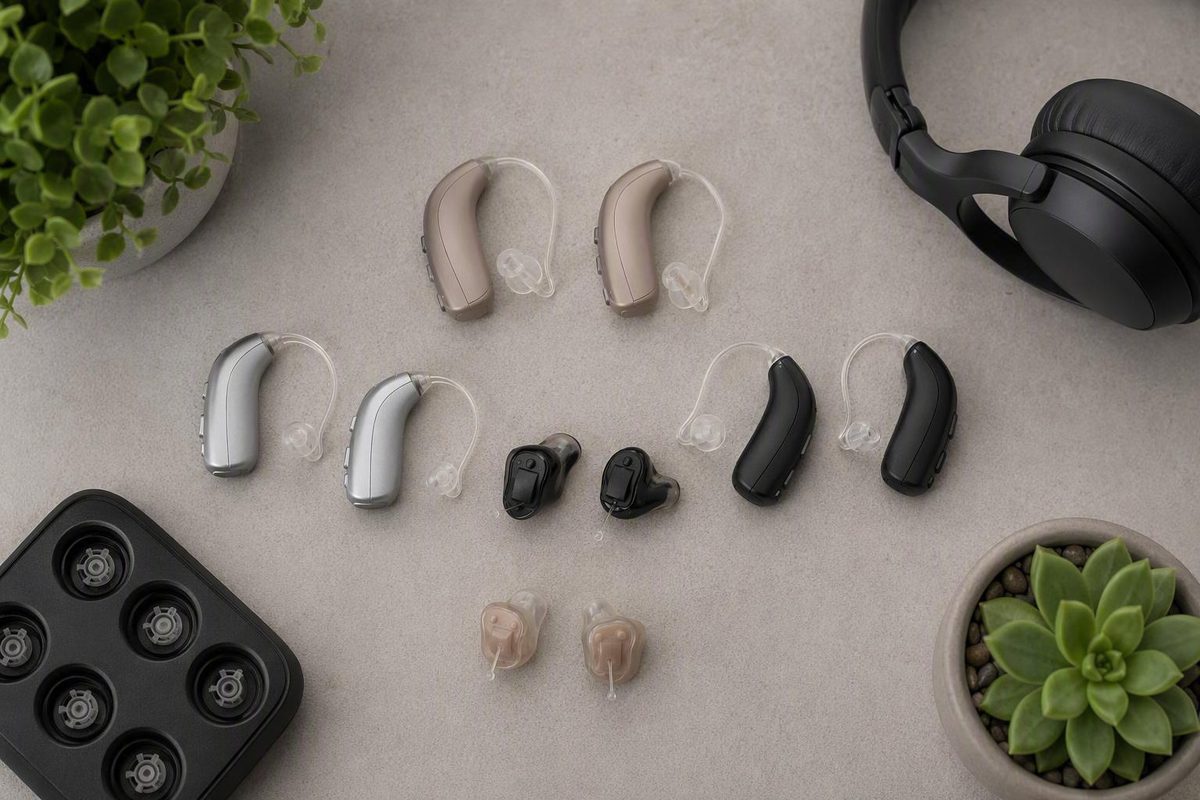
The best hearing aids for low frequency hearing loss are not defined by a brand, price tier, or style. They are devices that can be programmed and acoustically fitted to your individual audiogram without making speech boomy, masked, or uncomfortable.
That distinction matters because low-frequency—also called reverse-slope—hearing loss is not one uniform condition. It may be conductive, sensorineural, or mixed; stable or fluctuating; mild or severe; and present in one or both ears. Some causes should be medically addressed before amplification is considered.
Editorial note: This consumer guide synthesizes the cited medical, nonprofit, clinic, commercial, and specialist sources. Commercial and clinic sources are identified where their context is material. It provides general education, not a diagnosis or an individualized fitting prescription. See the site’s terms for its scope and limitations.
Start With a Hearing Test—and Know When Not to Shop Yet
Start with a clinical hearing test. Current testing should establish whether you have a low-frequency pattern, how severe the loss is at each tested frequency, and whether one or both ears are affected.
Neither can a subjective observation such as “deep voices sound quiet.” Similar complaints can arise from different hearing patterns, ear conditions, listening environments, and device problems.
A complete assessment may include examination of the ear canal, pure-tone testing, speech testing, and other measures selected by the clinician. Its purpose is not merely to qualify you for a hearing aid. It is also to distinguish among:
- Conductive loss: Sound transmission is reduced by a problem in the outer or middle ear.
- Sensorineural loss: The difficulty involves the inner ear or auditory nerve.
- Mixed loss: Conductive and sensorineural components are both present.
That distinction changes the next step. Earwax, middle-ear fluid, and some other conductive problems may be medically treatable, so buying an amplifier should not be the automatic first response. An examination may identify issues that a device cannot treat, which is why Mayo Clinic recommends a hearing exam before obtaining hearing aids.
When to seek assessment promptly
Johns Hopkins identifies a sudden change, drainage, dizziness, and a large difference between ears as reasons to seek physician evaluation rather than treating the problem as routine OTC candidacy (Johns Hopkins’ OTC hearing-aid guidance).
The right referral path is not identical for everyone:
- An audiologist measures hearing, analyzes the audiogram, assesses speech performance, and may select, program, verify, and adjust hearing aids.
- An otolaryngologist, or ENT physician, evaluates medical and surgical conditions affecting the ear.
An ENT may be the more direct starting point when symptoms suggest a medical condition, or an audiologist may recommend ENT evaluation after testing. An unexplained asymmetry, sudden change, or fluctuating pattern should not be treated as merely a shopping problem.
What Low-Frequency or Reverse-Slope Hearing Loss Sounds Like
Low-frequency hearing loss means reduced sensitivity to lower-pitched sounds. It is often called reverse-slope hearing loss because its audiogram runs in the opposite direction from the more familiar pattern in which high-frequency thresholds are poorer.
On an audiogram, frequency runs from lower pitches on the left toward higher pitches on the right. Hearing thresholds show how loud a tone must be before you detect it. In a reverse-slope pattern, thresholds are poorer in the low frequencies and comparatively better toward the high frequencies. The precise slope and degree of loss vary; not every reverse-slope audiogram looks the same.
Potentially difficult sounds include:
- Vowels and other low-frequency components of speech
- Deep or quiet voices
- Phone conversations
- Engine or traffic rumble
- Thunder
- Refrigerator hum
- Bass guitar, cello, drums, and other bass-rich music
These examples do not mean that every person will miss every sound. Severity, the specific frequencies affected, speech performance, and the listening environment all shape the experience. A clinic-produced overview from the House Institute similarly describes difficulty with deep voices, vowels, engines, bass music, thunder, and telephone speech (House Institute overview).
Some people function reasonably well in a quiet, face-to-face conversation but struggle with a group, a restaurant, telephone speech, or a particular person’s voice. That can make the loss easy to underestimate. A listener may hear that someone is speaking yet fail to catch enough useful speech information to follow comfortably.
Audibility is not the same as clarity
A central issue in fitting hearing aids for low frequency hearing loss is the difference between making sound audible and making it useful.
It does not prove the voice has become clearer. Too much bass can make words sound muddy or allow low-frequency room and traffic noise to compete with other speech information. Some listeners may also receive limited useful information from an affected frequency region, even when amplification makes it louder.
Reported associations include genetic or congenital factors, Ménière’s disease, autoimmune inner-ear conditions, childhood illness, viral illness, sudden hearing loss, and other medical conditions. These are possible associations, not diagnoses that can be made from audiogram shape alone. The supplied consumer sources conflict about the role of noise exposure, so that question should not be categorically answered without an individual clinical evaluation.
The Best Hearing Aid Is Determined by the Audiogram, Not a Ranking
The available evidence does not establish one universally best brand, model, or style for reverse-slope hearing loss. A technologically advanced product can still be a poor match if it cannot deliver usable low-frequency gain through an appropriate acoustic coupling—or if its fitting is not adjusted well.
Begin with six questions:
- Is the loss conductive, sensorineural, or mixed?
- How severe is it at each frequency?
- Is it bilateral, or is there a meaningful difference between ears?
- Is it stable or fluctuating?
- How much useful hearing remains in the middle and higher frequencies?
- Which situations most need improvement—quiet conversation, groups, phone calls, music, environmental awareness, or something else?
Then consider the practical factors: ear anatomy, skin sensitivity, manual dexterity, comfort, appearance preferences, confidence with apps and small controls, budget, and desired professional support.
A programmable multichannel hearing aid can adjust different frequency regions separately. That matters because a reverse-slope fitting generally requires targeted low-frequency changes, not one overall volume increase. Programmability alone does not guarantee that the available gain, compression, venting, receiver, physical fit, and feedback controls will work together successfully.
A condition-first decision table
| Hearing pattern or situation | First clinical question | Likely device pathway | Major caution |
|---|---|---|---|
| Stable bilateral sensorineural loss | How much useful hearing remains in each frequency region? | Individually programmed conventional hearing aids; a carefully selected OTC trial may be discussable if the loss is mild to moderate and otherwise uncomplicated | Maximum bass gain does not necessarily produce maximum clarity |
| Conductive or mixed loss | Is the conductive component medically treatable, and what remains after treatment? | Medical management first or alongside amplification; device choice based on the findings | Do not treat every conductive loss as a routine hearing-aid purchase |
| Fluctuating loss | How much do thresholds change, and what may be driving the fluctuation? | Repeat testing, medical coordination, and possibly alternative programs | One fixed setting may be inappropriate at different times |
| Asymmetric loss | Why is one ear different, and is each ear aidable? | Clinical evaluation followed by one- or two-device planning | Do not choose one or two aids by a blanket rule |
| Severe loss with limited conventional-aid benefit | How much useful aided speech understanding remains? | An optimized hearing-aid trial, assistive systems, and possible specialty-device or implant evaluation | More power is not necessarily more useful information |
One hearing aid or two?
When aidable hearing loss affects both ears, two hearing aids may improve access to sound from both sides and support more balanced listening. Mayo Clinic notes that two aids may help when hearing loss is present in both ears. That is a possibility, not a mandate.
If one ear differs substantially, the asymmetry should be evaluated before purchase. The decision depends on the cause, usable hearing, speech performance, comfort, and expected benefit in each ear—not merely on whether a retailer offers a pair discount.
They do not prove that a device can deliver a suitable reverse-slope fitting. The audiogram, acoustic fit, verification, and real-world response remain decisive.
Prescription vs. OTC Hearing Aids for a Reverse-Slope Audiogram
There are three relevant categories, not simply “prescription” and “OTC”:
- Professionally fitted prescription hearing aids are selected and programmed using measured hearing thresholds, then adjusted through follow-up care.
- Self-fitting OTC hearing aids use an app, in-device test, or guided setup to personalize amplification.
- Preset OTC hearing aids offer predetermined programs or more limited user adjustment.
In the United States, OTC hearing aids are intended for adults age 18 or older with perceived mild-to-moderate hearing loss. Self-fitting and preset products should not be treated as identical: self-fitting products can offer more personalization, while preset products generally provide less control (Consumer Reports’ guide to OTC hearing aids).
The crucial limitation is that OTC eligibility does not prove reverse-slope suitability.
Prescription care is often practical for an atypical audiogram because it can provide:
- Programming based on measured thresholds
- Clinician access to individual frequency regions
- Selection among domes, vents, receivers, and custom earmolds
- Assessment of physical fit and ear anatomy
- Verification and speech testing when appropriate
- Repeated adjustments based on real-world results
That does not mean prescription hearing aids always outperform OTC products. The supplied evidence contains no low-frequency-specific comparative trial establishing that outcome.
Who might reasonably discuss an OTC trial?
A cautious OTC trial may be reasonable to discuss when all of the following broadly apply:
- You are an adult with gradual, perceived mild-to-moderate loss.
- The difficulty is roughly similar in both ears.
- There are no medical warning signs.
- Testing has not identified a complex or treatable condition.
- You can confidently manage setup, app controls, cleaning, and troubleshooting.
- The product offers suitable adjustment, support, and a strong return policy.
Audiologist-led prescription care becomes more compelling when thresholds are unusual or complex, the loss is severe, hearing is asymmetric, symptoms progress or fluctuate, the cause is uncertain, self-fitting has failed, or you want substantial fitting support.
| Factor | Professionally fitted prescription | Self-fitting OTC | Preset OTC |
|---|---|---|---|
| Candidacy | Broad, depending on device and clinical findings | Adults with perceived mild-to-moderate loss | Adults with perceived mild-to-moderate loss |
| Programming method | Audiogram-based clinician programming | App, guided test, or user calibration | Predetermined settings or basic controls |
| Low-frequency control | Device-dependent, with clinician access to fitting controls | Varies by product and app | Generally more limited |
| Coupling options | May include multiple domes, vents, receivers, and custom molds | Product-dependent | Often limited |
| Professional verification | Can be included or requested | Not inherently included | Not inherently included |
| Follow-up support | Commonly available; confirm what the price includes | Remote or optional support varies | Often limited; verify before buying |
| User setup burden | Lower with clinician guidance | High | Moderate, although fewer controls can mean less personalization |
| Evidence limitation | Not every prescription aid can fit every reverse-slope loss successfully | Self-fitting does not guarantee an accurate reverse-slope response | Preset responses may not match an atypical audiogram |
Low-Frequency Fitting Mechanics: Gain, Venting, Earmolds, and Occlusion
Low-frequency gain means adding amplification where the audiogram and listening results indicate it is needed. It does not mean turning up every frequency together.
The physical connection between the hearing aid and ear—the acoustic coupling—can determine whether added bass reaches the eardrum. An open or highly vented fitting lets air and sound move through the ear canal, but it may also let amplified low-frequency energy escape. A closed dome or custom earmold can retain more of that output.
This is why the statement “open-fit hearing aids are comfortable and natural” is not enough to establish suitability. Open fits are commonly used when low-frequency hearing is relatively good and the primary need is high-frequency amplification. That is often the opposite of a reverse-slope fitting requiring substantial low-frequency output.
The occlusion tradeoff
Closing the ear canal creates another problem: the occlusion effect. Your own voice may sound plugged, hollow, boomy, or echo-like.
The fitter therefore has to balance two competing goals:
- Retain enough low-frequency output to improve audibility.
- Provide enough venting or acoustic relief to keep the user’s own voice comfortable.
There is no universal dome or vent size that solves this.
A technical article published in 2003 reported that, in its examples, a 2 mm vent could reduce output by as much as 13 dB at 250 Hz. That is an older case-level example, not a universal specification for current devices or every ear. Its durable lesson is that venting can materially change low-frequency output and should be evaluated rather than guessed (The Hearing Review’s technical discussion).
Why more low-frequency gain may make things worse
Excess bass may:
- Amplify HVAC, road, engine, and room noise
- Make speech sound muddy or boomy
- Mask useful mid- or high-frequency speech information
- Cause loudness discomfort
- Increase feedback risk if gain, seal, or fit is poorly balanced
- Add fatigue without improving understanding
In some cases, a clinician may investigate whether perception in the affected region is distorted or whether a cochlear dead region is suspected. It means additional amplification may add loudness without providing proportional speech information. The clinician may therefore compare different gain and bandwidth strategies instead of continuing to increase bass. The older technical literature supports this as a fitting principle, but its individual case reports do not establish one formula for current devices.
The practical takeaway is that the dome or earmold, vent, receiver, gain, compression, bandwidth, physical fit, and feedback settings function together as one acoustic prescription. Changing one component can alter the performance of the others.
Features That Matter—and Features That Do Not Prove a Better Fit
For reverse-slope loss, prioritize fitting capabilities before shopping for lifestyle extras.
Higher-priority fitting capabilities
- Multiple adjustable frequency channels: These let the fitter change low-frequency amplification without raising the entire response.
- Appropriate low-frequency gain range: The device must have usable output where it is needed, delivered through the selected coupling.
- Flexible compression: Soft, moderate, and loud inputs may require different treatment to balance audibility and comfort.
- Feedback management: The device must control feedback while preserving the intended response.
- Savable programs: Alternative settings can be compared without erasing a useful baseline.
- Fine-tuning access: The fitting should permit meaningful changes after real-world testing.
Directional microphones and noise reduction may support listening in difficult environments, but they cannot remove every competing sound. A noise program may help in a restaurant, while separate programs may be useful for quiet speech, music, phone use, or fluctuating thresholds. Not everyone needs every program, and too many choices can make operation unnecessarily complicated.
Bluetooth, telecoils, rechargeable batteries, remote controls, and app adjustments can still matter. Direct streaming may simplify phone use; a telecoil may connect to compatible loop systems; rechargeability may help someone who struggles with small batteries. These are accessibility and convenience decisions, not proof of effective low-frequency fitting.
Larger behind-the-ear devices may accommodate more powerful receivers and broader fitting needs, but style alone does not determine success. A powerful device with the wrong vent or poor programming can perform worse than a smaller device that is appropriately selected and fitted.
A commercial, audiologist-authored editorial list has included Oticon Intent, ReSound Vivia, Widex Allure, and Phonak Sphere Infinio as examples of programmable prescription devices (Soundly’s low-frequency hearing-aid overview). The source provides no low-frequency-specific comparative outcomes, so those names do not support a winner, ranking, or model-specific effectiveness claim.
Do not compare products using stale specifications or headline prices. Model capabilities change, and prices may represent different combinations of hardware, fitting, molds, follow-up care, warranties, and support. Ask for current manufacturer documentation and a written explanation of what the provider’s price includes.
How to Test the Fitting Before the Return Window Closes
A fitting should be treated as a structured trial, not a one-time handoff. Before accepting the device, work through this appointment checklist:
- Review the audiogram frequency by frequency.
- Ask whether the loss appears conductive, sensorineural, or mixed.
- Ask what cause is suspected and whether medical evaluation is indicated.
- Discuss whether your history or earlier tests suggest stable or fluctuating hearing.
- Identify the proposed dome, vent, receiver, or custom earmold.
- Ask why that coupling was selected for the low-frequency target.
- Ask how the fitting will be verified.
- Confirm how follow-up adjustments work and whether they cost extra.
Ask whether real-ear measurements and aided speech testing are appropriate for your case. The supplied evidence does not establish one special universal verification target for reverse-slope loss, so measurement should be considered alongside speech performance, comfort, and daily experience.
Request paired comparisons where possible. For example, compare two versions that differ in low-frequency gain, compression, bandwidth, or program behavior. Do not assume that a software-generated default prescription is optimal for your perception.
Use an at-home scorecard
Rate each category separately on a consistent scale, such as 1 to 5:
| Category | What to notice |
|---|---|
| Audibility | Can you detect the voice or sound that was previously too soft? |
| Speech clarity | Are words easier to distinguish, not merely louder? |
| Own-voice quality | Does your voice sound natural, plugged, hollow, or boomy? |
| Physical comfort | Is there pressure, soreness, itching, or slippage? |
| Noise tolerance | Are room, traffic, or engine sounds manageable? |
| Listening fatigue | After extended use, are you less strained or more exhausted? |
Test the same situations with each candidate setting:
- A familiar deep voice
- Vowel-heavy speech
- Quiet conversation
- A group or restaurant
- A phone call
- Traffic or engine sounds
- Music with meaningful bass content
- Television
- Several hours of continuous wear
Keep short, specific notes. “Restaurant bad” is less useful than “voices were louder, but low room noise covered other speech cues after 20 minutes.”
What common outcomes may mean
- Louder but not clearer: The fitting may need a different gain, compression, or bandwidth strategy rather than more overall volume.
- Your own voice is boomy: The closed coupling may be retaining needed bass while creating too much occlusion. Venting, coupling, or gain may need rebalancing.
- Bass remains weak: The vent or open dome may be allowing low-frequency output to escape, or the device may not be reaching the intended response.
- Quiet speech improves but restaurants do not: Directionality, noise programming, communication strategies, or expectations may need attention.
- Sound varies from day to day: Repeat testing may be needed to determine whether hearing itself is fluctuating.
- Pain or persistent soreness occurs: Stop using the painful fitting and have its physical fit reassessed. Pain should not be accepted as a normal part of acclimatization.
Where tolerable, regular use across several weeks can provide better evidence about comfort, benefit, and adjustment needs. Becoming accustomed to unfamiliar amplified sound can take time, but that is different from tolerating pain, excessive loudness, or consistently unusable speech. General buying guidance likewise distinguishes an adjustment period from a device that causes pain (NCOA hearing-aid buyer’s guide).
Compare the complete purchase, not just the device
Before paying, obtain written terms for:
- Return window
- Restocking or professional fees
- Warranty length and scope
- Repairs and loaner devices
- Loss-and-damage coverage
- Number and duration of included follow-ups
- Charges for custom molds or remakes
- Supplies and routine maintenance
- Remote versus in-person support
Realistic Results and Options When Conventional Hearing Aids Are Not Enough
Hearing aids may improve access to lower-pitched sound and make communication easier. They amplify and process sound; they do not restore full hearing, reverse underlying sensorineural injury, or eliminate every source of background noise.
Benefit can also vary by task. That is not necessarily a complete failure. It shows why environmental awareness, audibility, clarity, comfort, and speech performance should be evaluated separately.
Practical strategies can supplement amplification:
- Reduce the distance between listener and speaker.
- Face the speaker and improve lighting for visual cues.
- Reduce television, fan, or kitchen noise during conversation.
- Ask one person to speak at a time in groups.
- Use direct audio streaming or an assistive listening system where available.
- Choose seating that puts important talkers in front of you rather than behind you.
When a conductive or other medical condition is present, treatment of the underlying cause may precede or accompany amplification. The correct pathway depends on what examination and testing identify.
When other technologies may enter the discussion
Bone-conduction devices may be considered when an appropriate conductive or mixed component is present. They are not a general substitute for conventional hearing aids in everyone with a reverse-slope audiogram.
Cochlear-implant evaluation may be considered in selected severe cases when appropriately fitted hearing aids provide limited useful benefit. Candidacy cannot be inferred merely from the shape of an unaided audiogram; aided performance and specialist evaluation matter. A clinic-produced overview places bone-conduction devices in the context of conductive components and implant consideration in severe cases with limited conventional-device benefit (Audiology Island’s treatment overview).
The practical hierarchy is straightforward:
- Confirm the audiogram and investigate the cause.
- Fit conservatively around useful residual hearing.
- Verify the acoustic response.
- Test speech, comfort, and daily situations separately.
- Adjust the fitting iteratively.
- Consider other technologies only when clinically appropriate.
Frequently Asked Questions
Are open-fit hearing aids good for low-frequency hearing loss?
Usually not when substantial low-frequency amplification must be retained. Open fittings let acoustic energy escape from the ear canal and are commonly used when low-frequency hearing is relatively good but high-frequency hearing is poorer. Mayo Clinic describes open-fit devices in that preserved-low-frequency context, which differs from many reverse-slope fittings.
An open fitting may still work in an individual case with limited bass-gain needs. Its response should be evaluated, and a more closed dome or earmold can be compared if low-frequency output is inadequate.
Can OTC hearing aids be programmed for reverse-slope hearing loss?
Some self-fitting OTC aids adjust amplification through an app or built-in hearing test, while preset OTC aids offer less personalization. However, OTC eligibility—adult age 18 or older with perceived mild-to-moderate loss—does not establish that a particular product can accurately match a reverse-slope prescription.
Check whether the device allows meaningful low-frequency adjustment, whether suitable coupling options are available, what support is provided, and whether you can return it after real-world testing. Complex, asymmetric, fluctuating, progressive, or severe loss favors professional evaluation and fitting.
Do I need a closed dome or custom earmold for low-frequency amplification?
Not automatically, but you may need a more closed coupling to prevent amplified low-frequency sound from escaping. A closed dome may be sufficient in some ears; others may need a custom earmold for retention, comfort, or a more predictable acoustic seal.
The tradeoff is occlusion: a tighter fit may make your own voice sound plugged, hollow, or boomy. The right choice comes from comparing retained bass, own-voice quality, acoustic leakage, feedback, and comfort—not from assuming the tightest earmold is always best.
Why do men’s voices sound louder but not clearer with my hearing aids?
The hearing aids may be increasing low-frequency loudness without improving the speech information your auditory system can use. Excess low-frequency output can also mask other speech cues or amplify competing room noise.
Ask the fitter to compare different low-frequency gain, compression, and bandwidth settings rather than simply raising overall volume. The dome, vent, or earmold should also be reassessed because it changes how much amplified bass reaches the ear.
Should I wear one hearing aid or two for low-frequency hearing loss?
If aidable loss affects both ears, two hearing aids may provide access to sound from both sides and support more balanced listening. But the choice depends on each ear’s thresholds, speech understanding, comfort, and the cause of the loss.
A substantial difference between ears should be clinically evaluated before deciding. One aid is not automatically wrong, and two are not automatically better in every asymmetric or medically complex case.
Confirm the audiogram and cause first. Then decide whether the complexity favors prescription care or permits a cautious OTC trial. Prioritize frequency-specific programming and appropriate acoustic coupling, compare settings in daily life, and use the return period and follow-up visits to refine the result. Success is not buying the most heavily marketed model or maximizing bass; it is finding the clearest, most comfortable setting that provides useful information for your particular hearing pattern.