
Noise Sensitivity Earplugs Matched to the Setting
Filtered plugs are often more practical when speech, music, or situational awareness should remain relatively clear.
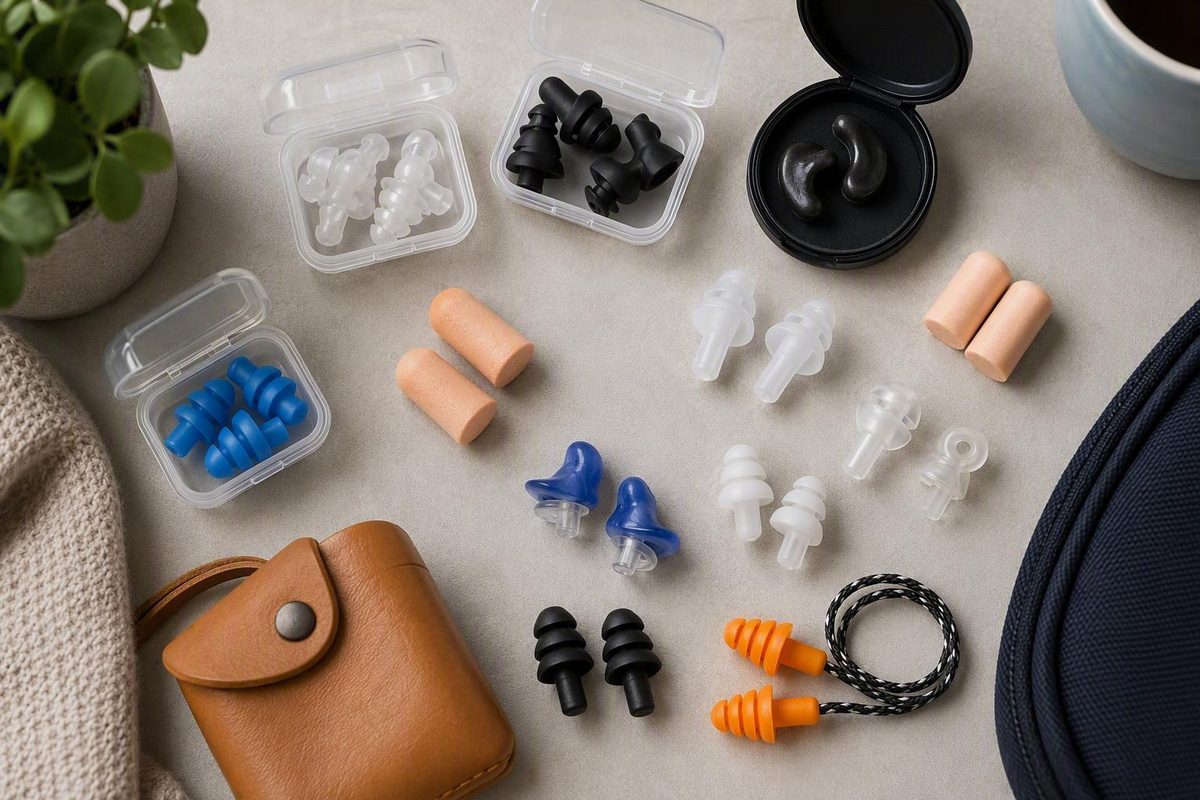
Noise sensitivity ear plugs can make an office, commute, social gathering, flight, concert, or other noisy setting more manageable. The most useful pair, however, is not necessarily the one with the largest decibel number on the package.
A better choice matches the protector to the situation: how intense the sound is, whether it may be hazardous, how long the protection will be worn, what still needs to be heard, and whether the plugs remain comfortable and secure. Everyday relief, protection from hazardous noise, and treatment of an underlying condition are separate goals.
What earplugs can—and cannot—do for noise sensitivity
Earplugs lower the intensity of sound entering the ears. They do not create silence, and passive earplugs do not electronically cancel sound. Even a correctly fitted protector reduces rather than eliminates sound.
For someone who becomes overwhelmed by ordinary background noise, that reduction may provide useful breathing room. It may make clattering dishes less intrusive, soften nearby conversation, or reduce the intensity of a crowded train. This is best understood as situational coping support—not evidence that the device treats the cause of the sensitivity.
It is also important to separate sound intolerance from hazardous sound exposure:
- In an ordinary office, the goal might be comfort and concentration while retaining speech.
- At a concert, the goal may include reducing potentially harmful exposure while preserving music quality.
- Around machinery, firearms, racing vehicles, or exceptionally loud tools, the priority is hearing protection selected under the rules for that workplace or activity.
- During sleep, pressure and comfort may matter more than speech clarity, but the wearer must still consider any alarms or emergency cues they rely on.
The National Institute on Deafness and Other Communication Disorders states that loud sound can cause noise-induced hearing loss and tinnitus. It recommends avoiding loud sound, increasing distance, or lowering the volume when possible, with earplugs or protective earmuffs used when those measures are insufficient. The agency also emphasizes that hearing protectors lower sound intensity rather than blocking all sound.
A sensory-relief product used in a café is therefore not automatically suitable for industrial machinery, shooting, motorsports, or another hazardous environment. In those settings, follow the applicable workplace, range, venue, or activity rules and use the rating system, fitting procedure, and protector type those rules require.
Several overlapping terms appear in product marketing and general discussions of sound sensitivity. They are not interchangeable diagnoses:
- Hyperacusis is commonly used for ordinary sounds being perceived as unusually intense, uncomfortable, or painful.
- Misophonia is commonly used for strong reactions to particular trigger sounds rather than simply to overall volume.
- Phonophobia refers to fear of sound.
- General noise sensitivity is a broad description and does not identify a particular condition.
These descriptions are useful for understanding how products are positioned, but they are not a diagnostic guide. For example, Loop associates its products with autism, ADHD, anxiety, PTSD, misophonia, phonophobia, and hyperacusis on a commercial page for noise sensitivity. That association identifies target customers and proposed uses; it does not show that an earplug treats a medical, psychiatric, or neurodevelopmental condition.
The realistic expectation is narrower: earplugs may reduce exposure to distressing sounds or support coping in a particular setting. The supplied manufacturer pages, retailer guides, marketplace listings, and personal reviews do not establish clinical effectiveness for chronic sound intolerance.
Keep the goals distinct:
- Relief: making a tolerable but uncomfortable setting more manageable.
- Protection: reducing exposure to potentially harmful noise.
- Treatment: assessing and addressing an underlying hearing, neurological, psychological, or other health concern.
A product may contribute to the first two goals when appropriately selected and fitted. It should not be presented as accomplishing the third.
Start with the situation, not the brand
Before comparing filtered plugs, foam plugs, reusable silicone, custom molds, or named products, answer four questions:
- What is the sound environment? Is it conversation, traffic, music, snoring, machinery, impact noise, or a mixture?
- Is the sound uncomfortable or potentially hazardous? Sensory discomfort and hearing risk can overlap, but they are not interchangeable.
- How long will protection be worn? A plug that feels acceptable for 20 minutes may create pressure after several hours.
- What must remain audible? Consider speech, announcements, alarms, children, machinery changes, traffic, or emergency warnings.
For awareness-dependent situations, begin with the lowest effective attenuation: enough reduction to make the setting manageable without unnecessarily removing useful information.
Maximum attenuation can be counterproductive in a classroom, meeting, café, or caregiving setting. Speech may become harder to follow, internal sounds may become more prominent, and the wearer may loosen or repeatedly remove the plug. Stronger protection still has an essential role in genuinely loud environments. The principle is not that less is always better; it is that attenuation should match the task and any applicable safety requirements.
A two-level kit can be more practical than expecting one universal pair to handle every situation:
- Moderate filtered protection for daytime settings where communication or awareness matters.
- Stronger foam plugs or properly fitted earmuffs for temporary loud exposure or other situations where broader reduction is required.
One affiliate-supported reviewer who compared products in homes, coffee shops, supermarkets, city streets, gyms, and other everyday settings likewise found that moderate- and higher-reduction options served different purposes. The comparison emphasized seal consistency, comfort, occlusion, walking noise, and communication rather than only the nominal rating as a record of individual experience.
A package rating has limited practical value if the protector hurts, works loose, or interferes with the task so much that it is removed. In hazardous noise, correct and continuous use is especially important.
Whenever practical, reduce the sound itself before relying solely on wearable protection:
- Turn down the source.
- Increase the distance from it.
- Close a door or move to a quieter space.
- Take planned breaks.
- Leave the area.
- Shorten the exposure.
- Replace unnecessarily loud equipment where feasible.
Earplugs are one layer of sound management, not a substitute for controlling avoidable noise.
Filtered, foam, silicone, moldable and custom earplugs compared
The main types differ in how they seal, how they affect different frequencies, how repeatable the fit is, and how they influence communication.
| Type | How it works | Typical strengths | Common trade-offs | Reuse | Fit considerations | Appropriate use cases | Evidence limitations |
|---|---|---|---|---|---|---|---|
| Filtered or high-fidelity | Uses an acoustic filter intended to reduce sound more evenly across frequencies | Speech or music may sound clearer than with broadly attenuating plugs | Does not guarantee that every warning or conversation remains audible; filters and tips may create pressure | Usually reusable | Correct tip size and a complete seal still matter | Offices, cafés, commuting, social settings, concerts | Design intent does not prove equal attenuation or clarity for every wearer |
| Expandable foam | Rolled down, inserted, and held while it expands in the canal | Inexpensive; capable of substantial broad attenuation when fitted correctly | Can muffle speech and reduce awareness; insertion consistency varies | Often disposable or limited-use | Tight rolling, sufficient insertion, and holding during expansion are important | Sleep, backup protection, temporary loud exposure, some workplaces | Published ratings assume specified test conditions and proper fitting |
| Reusable pre-molded silicone | Uses shaped tips, flanges, or earbud-style seals | Washable when permitted; quick insertion; often supplied in several sizes | Universal shapes may loosen, press on the canal, or fail to seal one ear | Reusable | Each ear may require a different size | Travel, commuting, daytime use, repeated short use | Comfort and attenuation remain anatomy-dependent |
| Moldable silicone or wax | Soft material is shaped at or around the canal entrance | Avoids deep insertion and may suit people who dislike internal pressure | Can collect lint or hair; the seal must be recreated; removal requires care | Depends on product instructions | Follow the placement directions and do not push the material deeper than instructed | Sleep and occasional comfort use | Materials and approved uses vary by product |
| Adjustable | Provides multiple mechanical or filter-based attenuation settings | One device may cover several moderate-use environments | Higher cost, more parts, and possible setting errors | Reusable | The plug must remain correctly sealed in every mode | Moving between focus, commuting, and social settings | Adjustable modes do not establish superior protection or fit |
| Custom-molded | Made from impressions of the wearer’s ears, with solid or filtered options | Repeatable insertion; may help with frequent use, long wear, unusual anatomy, music, or communication | Higher initial cost; finished comfort depends on the impression and fit | Reusable | Usually involves professional impressions and may require adjustment | Frequent occupational use, musicians, difficult anatomy, repeated failure with universal plugs | Custom plugs do not automatically attenuate more than correctly fitted foam |
| Canal cap | Uses pods or plugs held near or in the canal by a band | Convenient for intermittent exposure and frequent removal | Band pressure, limited fit choices, and model-dependent attenuation | Usually reusable | Must be seated consistently each time | Intermittent workplace exposure where permitted | Not a universal substitute for required plugs or earmuffs |
| Earmuff | Cushioned cups surround the ears | Avoids in-canal pressure and is easy to inspect | Bulky; may create heat or clamp pressure | Reusable | Cushions must maintain continuous contact with the head | Tools, workshops, or users who cannot tolerate plugs | Glasses, hair, hats, or other gaps can weaken the seal |
| Dual protection | Combines earplugs with earmuffs | Adds protection for exceptionally noisy settings | Greater isolation, heat, communication difficulty, and cost | Varies | Both protectors must fit correctly | Some industrial work, shooting, and exceptionally loud tools | Ratings are not added together, and protection does not double |
Filtered or musician-style plugs are intended to reduce sound more evenly across pitches. That makes them a practical candidate when conversation or music clarity matters. “High fidelity,” however, does not mean transparent hearing. Fit, filter selection, hearing ability, and the sound’s frequency all influence what remains audible.
Foam plugs work differently. A compressed plug expands inside the canal to create a seal. They can provide substantial attenuation at low cost, but only when rolled, inserted, and held correctly. They are not categorically unsuitable for noise sensitivity; they may simply be less convenient when speech and environmental cues are priorities.
Reusable silicone plugs should not be confused with moldable silicone. A pre-molded model normally uses a shaped tip or flange inserted as directed. Moldable silicone or wax is generally shaped at or around the canal entrance. Placement instructions vary, so do not improvise.
Custom plugs are made from impressions of the wearer’s ears and may be useful for frequent insertion, prolonged wear, unusual anatomy, or configurable filters. One audiology-clinic guide estimates a typical cost of $150–$250 per pair, including impressions and fabrication, while explicitly noting that correctly fitted foam can still provide effective protection and that custom products do not inherently block more sound than properly fitted foam plugs. Prices vary by provider and options.
For exceptionally noisy settings, dual protection may be required or recommended under the applicable rules. Earplug and earmuff ratings should not simply be added together, and wearing both does not double the published reduction.
A use-case guide for work, commuting, sleep, concerts and loud events
No single design is ideal for every environment. The matrix below is a shopping framework, not safety clearance. For hazardous or regulated activities, the governing workplace or activity requirements take priority.
| Scenario | Practical starting point | What may need to remain audible? | Main cautions |
|---|---|---|---|
| Office or study space | Moderate filtered or reusable plug | Colleagues, announcements, alarms | Keyboard sounds, footsteps, and the wearer’s own voice may become more prominent |
| Classroom | Low-to-moderate filtered protection, if permitted | Instructor, classmates, alarms | Follow school or workplace rules; do not assume speech will remain clear |
| Café or social event | Moderate filtered plug | Conversation, staff, companions | Excessive attenuation may increase isolation |
| Commuting | Moderate filtered plug; active noise cancellation may help some steady background sound | Announcements, traffic, other passengers, emergency cues | A product marketed for awareness cannot guarantee detection of every signal |
| Parenting or caregiving | Lowest effective attenuation, used selectively | Children, cries, speech, alarms, cooking signals | Do not rely on informal testing as proof that supervision remains safe |
| Sleep | Soft foam, flexible silicone, or moldable plugs | Any alarm or emergency cue relevant to the wearer | Side-sleeping pressure, loosening, and removal difficulty |
| Concert or live event | Appropriately rated high-fidelity protection | Music, companions, venue announcements | Fit and an identifiable rating matter; “music” marketing is not enough |
| Air travel | Filtered or reusable plugs for moderate reduction; foam for stronger broad reduction | Crew instructions and alarms | Pressure comfort varies; earplugs are not treatment for ear or pressure problems |
| Noisy work | Protection selected under the employer’s hearing-conservation and safety procedures | Required communication systems, warnings, machinery changes | Do not substitute an everyday sensory product for required occupational PPE |
| Power tools | Correctly inserted foam, properly fitted earmuffs, or specified activity protection | Warnings and tool-condition cues required by the task | Some tools or environments may require dual protection |
| Motorsports | Protection meeting the activity’s rules and communication requirements | Required instructions and warnings | Engines, wind, communication systems, and exposure duration complicate selection |
| Shooting | Shooting-specific protection under range or activity rules | Range commands and safety signals | Impulse noise requires a formal protection plan, not an everyday comfort plug |
For offices, classrooms, cafés, commuting, caregiving, and social settings, the practical priorities are moderate attenuation, comfort, communication, and preservation of necessary cues. A controlled listening check can reveal whether a plug makes speech or a familiar alarm harder to hear, but it cannot establish safety during driving, cycling, supervision, equipment operation, or another real-world task.
For sleep, compare more than softness. A protruding stem can press against a pillow, a flange may irritate the canal, and a moldable plug may shift. Consider how easily the protector can be removed and what alerts the wearer depends on. If reliably detecting an alert is essential, do not assume that being able to hear it once under test conditions guarantees it will always be detected.
At concerts, filtered or musician-style protection may be preferable because it is intended to lower intensity more evenly across frequencies. Look for an identifiable standardized rating and product-specific documentation rather than relying only on terms such as “concert,” “music,” or “acoustic.”
For temporary loud exposure, correctly inserted foam plugs and properly sealed earmuffs remain practical options. For industrial work, shooting, motorsports, or exceptionally loud tools, follow the applicable employer, range, venue, or activity requirements. NIDCD identifies concerts, motorsports, shooting, rehearsals, noisy workplaces, and similar loud settings as situations in which hearing protection may be needed.
If in-canal pressure is intolerable, earmuffs are a legitimate alternative. The cushions must maintain contact with the head; glasses, thick hair, hats, facial hair, or other obstructions can create leaks and reduce effectiveness, as described in the NIDCD overview of hearing-protector types.
Active noise-canceling earbuds or headphones are another possible option for some steady, low-frequency background sounds, such as engine or ventilation hum. Results vary by model, seal, signal, and wearer.
How to read NRR, SNR and advertised decibel claims
Decibel figures can look directly comparable even when they come from different rating systems—or from no identified system at all.
NRR, or Noise Reduction Rating, is described in a consumer hearing-protection guide as a standardized laboratory-based measure of the potential reduction provided when a protector is used correctly. It is not a promise that every wearer will receive the printed reduction under real-world conditions.
SNR, or Single Number Rating, is a different attenuation label used on products in other markets. The supplied evidence does not include the underlying standards documents needed for a detailed technical conversion between NRR and SNR. The safe consumer conclusion is therefore limited: do not treat an SNR number as numerically interchangeable with an NRR number. For occupational calculations, use the method required by the relevant regulator, employer, or hearing-conservation program.
When evaluating a decibel claim, place it in one of four evidence categories:
- Standardized rating named by the maker: The company identifies NRR, SNR, or another recognized system.
- Rating stated without supplied documentation: A recognized label appears, but the listing does not provide the standard, laboratory report, or conditions.
- Unstandardized vendor claim: The seller says “up to X dB” without identifying the rating system.
- Informal reviewer measurement: An individual reports a personal or nonstandard test that is not equivalent to certified laboratory data.
Do not subtract the package number directly from an environmental reading and treat the result as guaranteed sound at the ear. Likewise, do not translate a rating into an exact percentage reduction in perceived loudness. The supplied sources do not support either shortcut.
Actual attenuation can vary with:
- Ear-canal anatomy
- Tip or plug size
- Seal quality
- Insertion depth
- Movement during speaking or chewing
- The frequencies present in the sound
- Correct and continuous wear
- Wear, dirt, hardening, or damage
- Earmuff gaps caused by glasses, hair, hats, or other obstructions
Consider several differently sourced examples:
- Loop reports 16 dB SNR filtered reduction for Engage 2.
- Loop Quiet 2 is listed with up to 24 dB SNR.
- Vibes carries a reported NRR of 15.
- Some foam or push-in products have higher stated NRRs.
These figures do not create a direct performance ranking. The Loop figures are SNR specifications, the Vibes figure is NRR, and any reviewer’s own measurement belongs in a separate evidence class. Loop’s international commercial page presents Engage 2’s 16 dB SNR and Switch 2’s adjustable modes as manufacturer specifications rather than individualized results.
CURVD’s broad “up to 30 dB” statement is harder to interpret. Without an applicable model, rating system, test method, and test conditions, it cannot be meaningfully ranked against a documented NRR or SNR.
Product examples: compare features and evidence, not marketing superlatives
The table below reflects captured U.S. prices and product information available on August 18, 2026. Prices, sale terms, packages, availability, and specifications can change. Every benefit and attenuation figure is attributed to a manufacturer, retailer, marketplace, or reviewer; none is presented as an independent clinical finding.
| Product | Captured price | Reported attenuation or modes | Included features and positioning | Source and documentation status |
|---|---|---|---|---|
| Loop Engage 2 | $34.95 | 16 dB SNR filtered reduction | Marketed for reducing everyday background noise while retaining conversation | Price from the U.S. commercial page; attenuation from a separate manufacturer page. SNR named, but no laboratory report was supplied in the evidence. Commercial specifications |
| Loop Quiet 2 | $24.95 | Up to 24 dB SNR | Silicone; four tip sizes; washable; carry case; marketed for sleep, focus, travel, commuting, and noise sensitivity | Marketplace listing repeating product claims. SNR named, but no test report was supplied. Marketplace listing |
| Loop Switch 2 | $59.95 | Three adjustable modes | Selectable reduction for different environments | Manufacturer commercial listing; the evidence does not establish superior comfort or protection |
| EARPEACE Everyday | $34.95 | Manufacturer-reported 22 dB PRO filters | Three earplug sizes, filters, and carrying case; marketed for lower volume with awareness and clarity | Manufacturer claim without a supplied formal rating standard or laboratory report. Manufacturer product page |
| CURVD examples | $17.45–$19.95 sale prices | Broad vendor claim of up to 30 dB | Silicone products marketed for everyday sound, events, focus, and sensory relief | Commercial listing that does not identify the applicable model, rating standard, or test conditions. Vendor sales page |
The premium for Loop Switch 2 buys adjustability. It does not establish better comfort, clinical benefit, or protection for a particular wearer.
For Quiet 2, the captured listing described a reusable silicone design with four tip sizes, washability, a carry case, and up to 24 dB SNR. It also stated that reduction depends on insertion and fit. Those are marketplace specifications, not guaranteed individual outcomes.
EARPEACE’s page combines manufacturer specifications with customer reviews. Individual reviewers reported issues including discomfort, filter pressure, difficult removal, soiling, and case inconvenience. These comments do not establish typical performance, but they illustrate why supplying several sizes does not guarantee a comfortable fit.
CURVD displayed sale examples including CLIQ at $17.45 and Live or Everyday variants from $19.95. Because its broader “up to 30 dB” statement does not identify the applicable product, standard, or test conditions, it should be treated as an unstandardized vendor claim.
One autistic reviewer named Vibes as a preferred daily option, Mack’s foam plugs for sleep, and Decibel Defense earmuffs for stronger blocking. The reviewer found Loop less comfortable than Vibes personally and disclosed the use of affiliate links in the individual-experience article. That experience may identify features worth investigating, but it cannot establish a universal winner.
When comparing products, do not use marketplace stars, customer totals, or dramatic testimonials as evidence of typical effectiveness. Instead, ask:
- Is the attenuation figure NRR, SNR, another standard, or undefined?
- Is the specific test standard or laboratory report available?
- Are several tip sizes included?
- Can each ear use a different size?
- Are replacement tips or filters available?
- Is the product washable, and must filters be removed first?
- Does the shape suit side sleeping?
- Can the plug be removed without tools or excessive pulling?
- What is the current return policy for a fit-dependent item?
- Is adjustability useful in the settings you actually encounter?
- What will replacement parts, disposable plugs, and cleaning supplies cost over time?
Fit, comfort and care determine real-world usefulness
A suitable earplug should feel secure and provide consistent reduction without pain, persistent pressure, irritation, repeated loosening, or difficult removal. “Soft” material does not guarantee comfort because canal shape, insertion depth, flange geometry, and pressure points differ between users—and sometimes between a person’s two ears.
Reusable-plug fit checklist
- Start with the manufacturer’s recommended tip size.
- Insert the plug exactly as directed rather than assuming every earbud-style product works the same way.
- Compare the seal and comfort in both ears.
- Speak, chew, and walk to assess your own voice, jaw movement, and impact noise.
- Turn your head and change facial expression to see whether the seal breaks.
- Confirm that the plug remains secure without being forced.
- Check whether necessary speech or familiar alerts become harder to hear, while recognizing that this cannot establish safety.
- Try another size if one side feels loose, painful, or markedly different.
Common signs of a poor seal include:
- The plug protrudes much farther than the instructions illustrate.
- Reduction is noticeably uneven between ears.
- Attenuation changes during talking, chewing, or movement.
- The plug repeatedly backs out.
- Strong pressure is required to keep it in place.
- The seal changes whenever the outer ear is touched.
- The plug must be forced into position.
How to insert foam earplugs
Foam technique matters:
- With clean hands, roll the plug into a narrow, crease-free cylinder.
- Reach over the head and adjust the outer ear as the manufacturer directs.
- Insert the compressed plug sufficiently into the canal according to its instructions.
- Hold it in place while it expands.
- Check that both plugs appear and sound similarly seated.
Do not cut or tear foam plugs to alter their shape. Connect Hearing’s consumer guide describes foam performance as dependent on compression, insertion, expansion, and a complete seal in its comparison of earplug materials.
Comfort involves more than initial softness. Watch for:
- Canal pressure: The tip may be too large, too rigid, or the wrong shape.
- Side-sleeping pressure: A loop, stem, or filter housing may press against the pillow.
- Walking impact noise: Footfalls may become more noticeable.
- Boomy speech: The wearer’s own voice may sound hollow or unusually loud.
- Internal sounds: Chewing, breathing, or swallowing may become more prominent.
- Jaw movement: Talking or eating may shift the seal.
- Removal difficulty: A deeply seated plug without an accessible grip may be unsuitable.
For reusable plugs, follow the model-specific cleaning instructions. Where the manufacturer permits:
- Remove acoustic filters before washing.
- Wash only the designated components with warm soapy water.
- Rinse as directed.
- Let every component dry completely.
- Reinsert filters only after the plugs are dry.
- Store the set in its case away from dirt, heat, and damage.
Not every filter, foam plug, wax plug, or moldable product can be washed. Cleaning instructions should not be transferred from one model to another.
Replace plugs when they are torn, hardened, misshapen, damaged, persistently dirty, or no longer seal consistently. Replace tips and filters according to the relevant instructions. There is no single replacement schedule that applies to every material and usage pattern.
If a plug hurts, do not force it. Try another tip size, another shape, a moldable design, earmuffs, or professional fitting. Pain is not evidence of an effective seal.
Safety limits, alternatives and when to seek professional help
Passive earplugs do not block all sound, but they can reduce awareness of conversation, alarms, traffic, machinery, children, and emergency warnings. The practical safety question is not simply whether something can still be heard. It is whether the information required for the activity remains reliably detectable and understandable under real conditions.
Do not assume blanket approval for wearing earplugs while driving, cycling, supervising children, operating equipment, shooting, or performing safety-critical work. Applicable laws, employer policies, range rules, venue requirements, and task-specific procedures take priority. A filtered plug marketed for awareness does not guarantee that a particular warning will remain audible.
Too much attenuation can also create practical problems:
- Social isolation
- Communication difficulty
- Repeated removal and reinsertion
- Increased awareness of internal sounds
- Boomy speech and chewing
- Difficulty locating sounds
- Missed notifications or instructions
These are reasons to use no more reduction than the situation requires.
Claims about “overprotection” require caution. The supplied evidence does not establish the long-term effect of routine earplug use in safe environments for people with chronic sound intolerance. It would be inappropriate either to claim that frequent use definitely worsens sensitivity or to promise that unrestricted use is risk-free. If protection is becoming necessary in a growing number of ordinary settings, seek individualized guidance rather than continually escalating attenuation.
Alternatives and complements include:
- Lowering the source volume
- Increasing distance
- Leaving or shortening the exposure
- Taking quiet breaks
- Closing doors or using sound-absorbing furnishings
- Wearing earmuffs instead of in-canal plugs
- Using canal caps for permitted intermittent exposure
- Obtaining custom-filtered protection
- Trying active noise cancellation for selected steady background sounds
- Keeping separate moderate- and high-protection options
Professional assistance with protector selection or custom fitting is reasonable when universal-fit plugs repeatedly hurt, loosen, fail to seal, or must be used frequently for occupational exposure. A hearing professional can also help distinguish a fitting problem from an ear or hearing concern.
Commercial consumer guidance on noise sensitivity recommends professional assessment when sensitivity becomes sudden, severe, painful, or changes alongside tinnitus or hearing changes rather than treating it only as a product-selection problem. Because the supplied source is not a clinical triage guideline, it should not be used to determine urgency or diagnose a cause; contact an appropriate clinician for individualized advice.
Before purchasing, use this checklist:
- Intended setting: Where will the plugs actually be worn?
- Required awareness: Which voices, alarms, or warnings must remain audible?
- Rating system: Is the figure NRR, SNR, another recognized label, or undefined?
- Documentation: Is the relevant standard or laboratory report available?
- Fit options: Are several sizes included, and can each ear use a different size?
- Return policy: Can an unsuitable fit be returned under the current terms?
- Cleaning: Which parts are washable, and must filters be removed?
- Replacement parts: Are tips, filters, and cases available separately?
- Evidence quality: Is the claim standardized, manufacturer-reported, informal, or promotional?
- Total cost: Include replacement parts, disposable plugs, cleaning, and possible professional fitting.
Frequently asked questions
Are filtered earplugs better than foam earplugs for noise sensitivity?
Not universally. Filtered plugs are often more practical when speech, music, or situational awareness should remain relatively clear. Foam may be preferable when stronger broad reduction, low cost, or sleep use is the priority.
The deciding factors are the setting, fit, comfort, required awareness, and whether the product is appropriate for hazardous exposure. A correctly fitted foam plug can outperform a poorly sealed filtered plug, while a moderate filtered plug may be easier to wear consistently in a communication-heavy environment.
Can earplugs treat hyperacusis, misophonia, autism-related sensory overload, or anxiety?
The supplied evidence does not establish earplugs as treatment for those conditions. They may reduce exposure to distressing sound or provide situational coping support, but that is different from treating an underlying cause.
Commercial pages that associate earplugs with hyperacusis, misophonia, autism, ADHD, anxiety, PTSD, or phonophobia are describing target customers and proposed uses. They should not be interpreted as clinical evidence.
What is the difference between NRR and SNR?
NRR and SNR are different attenuation-rating systems. They should not be treated as numerically interchangeable, and neither figure guarantees the reduction an individual wearer will receive.
The supplied evidence does not include the underlying standards needed to provide a reliable conversion formula. For regulated or occupational exposure, use the interpretation and calculation method required by the relevant authority or hearing-conservation program.
Can frequent earplug use make noise sensitivity worse?
The supplied evidence does not provide a firm answer. Some commercial guidance warns about excessive protection in safe environments, but it does not provide adequate clinical evidence to establish when, whether, or for whom worsening occurs.
A cautious approach is to use the lowest effective attenuation, avoid unnecessary isolation, and seek individualized advice if protection becomes necessary in an expanding range of ordinary settings. This avoids two unsupported claims: that frequent use definitely worsens sensitivity, and that unrestricted use has no potential downside.
When are custom earplugs worth the cost?
Custom plugs may be worth considering when protection is worn frequently or for long periods, universal tips repeatedly hurt or loosen, anatomy makes a stable seal difficult, or configurable filters are needed for music, communication, or occupational tasks.
They may provide more repeatable insertion and a wider choice of filters, but they do not automatically block more sound or feel better than every universal-fit product. Their value depends on the impression, finished fit, selected material or filter, frequency of use, and access to adjustments if the first fit is uncomfortable.
The practical rule is simple: choose the least attenuation that makes the setting manageable while preserving the sounds needed for communication and safety, then confirm fit and comfort before paying for advanced features. Keep stronger, appropriately selected protection available for genuinely loud exposure, treat product claims as specifications rather than treatment evidence, and seek professional assessment when sound sensitivity is sudden, severe, painful, changing, or accompanied by tinnitus or hearing changes.