
Samsung Galaxy Buds FDA OTC Clearance: What It Covers
Samsung’s cleared Galaxy Buds feature uses familiar fitting software, but prescription care still differs in verification, physical fit, and follow-up.
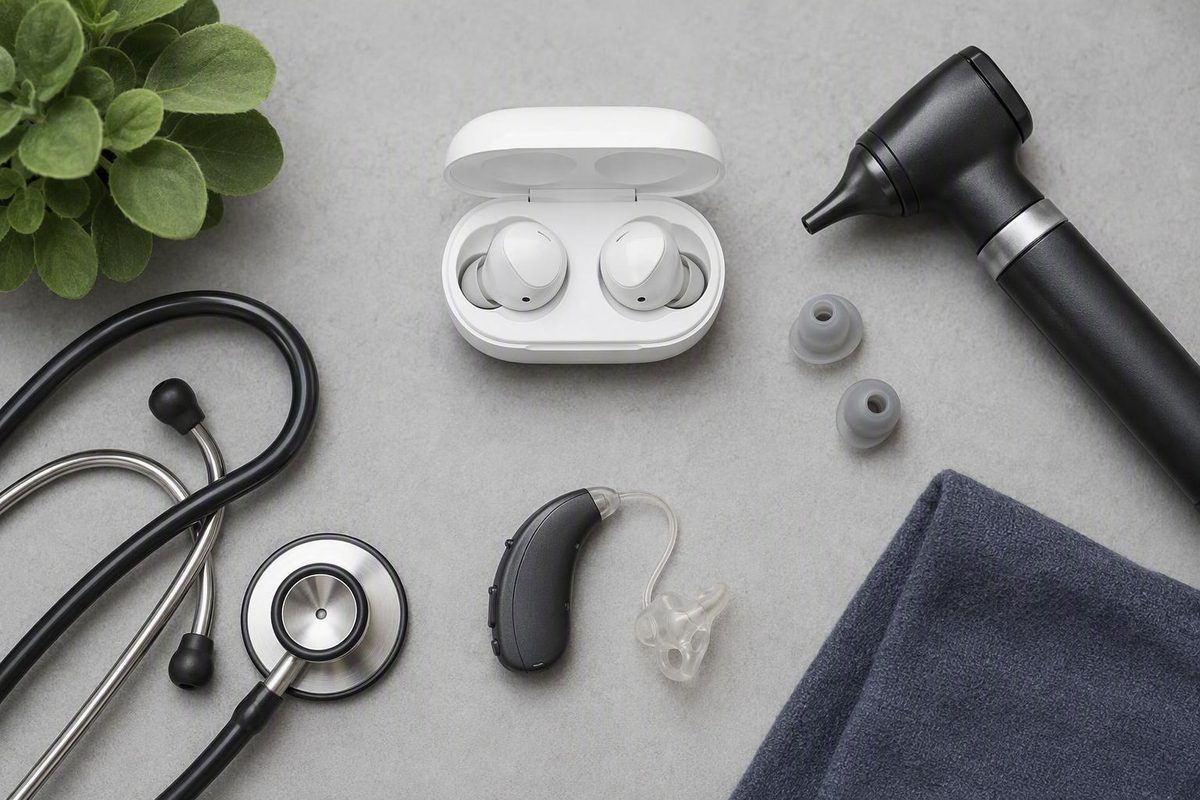
Samsung’s August 11 announcement does not make Galaxy Buds the equal of a $4,600 prescription hearing-aid package. The FDA-cleared Hearing Aid Feature brings self-fitting amplification to Galaxy Buds3 Pro and Galaxy Buds4 Pro, but the price comparison reaches only part of what prescription care can include: the fitting formula, not real-ear verification, customized physical fit, or audiologist follow-up. Samsung also had not launched the feature or disclosed its price. Samsung identifies the intended users, supported earbuds, system requirements, and planned rollout.
The precise regulatory claim is narrower than many headlines suggest. Samsung announced FDA clearance for a software-based OTC Hearing Aid Feature operating within a compatible Galaxy system. It did not announce that every Galaxy Buds model is a cleared hearing aid or that its earbuds reproduce the complete prescription fitting process.
| Confirmed | Current Position | Limit |
|---|---|---|
| Named earbuds | Galaxy Buds3 Pro and Buds4 Pro | Other Buds models are not established as supported |
| Intended users | Adults 18 or older with perceived mild-to-moderate loss | Not intended for severe or profound loss |
| Access | No prescription or clinic visit required | Compatible Galaxy hardware and software still required |
| Rollout | United States and select approved markets in Q4 2026 | Exact date, price, and market list were not disclosed |
Choose which parts of a prescription package matter to you, then change the hypothetical allocation to see what Galaxy Buds do and do not replicate.
The default is an equal-share scenario for the $4,600 comparison used in launch coverage. Change the allocation and uncheck anything you do not personally value.
This is not Samsung’s price. Samsung’s feature price or subscription policy was not disclosed.
Galaxy Buds reproduce the software-based self-fitting layer in this comparison. Real-ear verification, customized physical fit, and audiologist follow-up are not established as part of Samsung’s consumer process.
| Value This | Package Component | Galaxy Replicates It? | Your Allocation |
|---|---|---|---|
| Yes | |||
| No | |||
| No | |||
| No |
Source note: Samsung announcement and AudioXpress reporting. The $4,600 figure is the comparison cited in launch coverage. Component allocations marked ~ are adjustable assumptions, not reported market prices; Samsung’s purchase price remains —.
Why The Parity Claim Sounds Plausible
The received view has a solid foundation. Samsung is not merely adding a generic ambient-sound control and calling it a hearing aid. The company announced FDA clearance for an OTC feature intended for adults with perceived mild-to-moderate hearing loss, with a self-administered hearing test and individualized amplification.
The reported fitting process uses NAL-NL2, a prescription method used in audiology to calculate amplification targets. Samsung says its approximately five-minute test presents pure tones separately to each ear, produces an audiogram, and applies frequency-specific amplification. Reported processing also includes noise suppression and beamforming.
Secondary reporting describes meaningful validation work. AudioXpress reports a roughly 30-day, 103-participant multicenter study comparing perceived benefit in self-fit and clinician-fit groups, with a non-inferiority result. It also reports a 367-participant comparison between Samsung’s test and clinical pure-tone audiometry, with a median absolute threshold difference of 3.75 dB. AudioXpress reports the studies, NAL-NL2 fitting approach, regulatory particulars, and system architecture.
That evidence makes the software comparison legitimate. An eligible Galaxy user may receive amplification based on a clinically familiar prescription method without first obtaining a prescription or attending a fitting appointment. For uncomplicated mild-to-moderate hearing difficulty, that convenience is the point of the OTC pathway.
The consensus is therefore right about access and the importance of the software. It goes too far when it converts a shared fitting method or favorable self-fitting study into equality with an entire professionally delivered hearing-aid package.
The Same Algorithm Does Not Mean The Same Fitting
A fitting formula calculates targets. It does not establish that the sound reaching a particular eardrum matches those targets after the earbuds are inserted.
Professional fittings can include real-ear measurement, in which output is measured in the individual ear canal and adjusted against prescribed targets. They can also include selection among physical styles, domes, receivers, and other fit options, followed by adjustments as the wearer uses the devices in daily life.
Samsung’s reported process is different. The compatible Galaxy device handles onboarding, the hearing test, self-fitting, controls, instructions, safety information, and the interface. The earbuds handle audio processing, amplification, and output. That is a complete consumer system, but it is not the same delivery model as clinician-directed selection, verification, and follow-up.
| Component | Galaxy Buds Feature | Prescription Route |
|---|---|---|
| Fitting formula | NAL-NL2-based self-fitting reported | Clinician can use prescription targets |
| Output verification | No real-ear verification established | May include real-ear measurement |
| Physical fit | Consumer earbud and available tips | Broader style, dome, and receiver selection |
| Follow-up | User controls; clinician tools unresolved | Professional review and fine-tuning |
The $4,600 comparison also needs a financial caveat. Neither Samsung’s announcement nor the reviewed specialist reporting provides a defensible dollar allocation among algorithm development, hardware, verification, physical fitting, and follow-up. The calculator above uses equal shares only as a transparent starting scenario. Those shares are not reported prices.
Samsung had not disclosed the Galaxy feature’s price, whether it would be included with the earbuds, or whether a subscription would apply. A purchase-price winner therefore cannot yet be calculated from the available evidence.
FDA Clearance Applies To A Defined System
The correct term is FDA cleared, not FDA approved. Clearance applies to a defined product, configuration, intended population, and use. It does not establish that every Samsung earbud is a medical device, that the feature suits every type of hearing loss, or that it performs better than dedicated OTC or prescription hearing aids.
AudioXpress identifies the submission as K261187, product code SCR, through a Traditional 510(k) pathway, with a reported decision date of July 31, 2026 and Apple’s hearing-aid software as the predicate. Those particulars remain attributed to that secondary source because the corresponding FDA database entry, decision summary, and cleared labeling were not available for this review.
A predicate comparison also does not mean Samsung’s feature is identical to Apple’s. Research or authorization involving Apple’s product cannot establish Samsung’s independent performance.
The available evidence supports this compatibility chain:
- Galaxy Buds3 Pro or Galaxy Buds4 Pro.
- A compatible Samsung Galaxy phone or other eligible Galaxy device.
- One UI 8 or later.
- Required earbud firmware and device software.
- Commercial activation in the user’s market.
- An adult user within the perceived mild-to-moderate range.
Owning Buds3 Pro or Buds4 Pro is therefore not enough by itself. Support for non-Samsung Android phones has not been established, and One UI 8 compatibility alone does not prove that every phone or tablet will qualify.
Samsung planned availability in the United States and select approved markets during Q4 2026. Commercial availability had not been confirmed, and no exact release date, complete country list, eligible-device list, price, or subscription policy was available. The Hearing Review reports the Q4 2026 plan and the absence of a specific date or price.
Veterans Face A Process Comparison, Not Just A Device Comparison
For a veteran already using or considering VA audiology, the meaningful comparison is not automatically a $4,600 cash purchase versus consumer earbuds. The available source material provides no figure for a veteran’s out-of-pocket cost, eligibility, or the value of any VA-provided care. Those questions depend on the veteran’s circumstances and cannot be priced from Samsung’s announcement.
The practical divergence is the care process. The Galaxy route is self-administered: the user runs the test, accepts or adjusts the resulting profile, manages the earbud fit, and works within Samsung’s supported hardware and software. The prescription route centers professional assessment, device selection, fitting, verification, and follow-up.
A veteran who values only convenient, occasional amplification may find the Galaxy system’s software and familiar earbud format sufficient once compatibility, availability, and price are confirmed. A veteran who depends on amplification throughout the day may place more value on verified output, stable fit, extended-wear comfort, reliability, and access to adjustments.
That distinction does not make OTC access inferior by definition. It identifies what the lower-friction route removes. The algorithm may be clinically familiar while responsibility for testing, fitting, troubleshooting, and deciding when to seek further care shifts toward the user.
The Performance Evidence Remains Narrow
Samsung describes its Hearing Test as medical-grade, clinically validated, and comparable in accuracy to an audiologist’s evaluation. Those remain company-reported claims. Samsung names the National Acoustic Laboratories and Samsung Medical Center in development, and Vanderbilt University Medical Center, San Jose State University, and the University of Memphis as validation sites.
The reported participant counts and threshold result are encouraging, but they do not prove parity across every outcome that matters to a long-term hearing-aid user. A non-inferiority finding for perceived benefit should not be translated into equal speech understanding in noise, comfort, reliability, support, or performance for every hearing pattern.
Independent real-world evidence was not provided for:
- Battery duration with hearing-aid mode active.
- Comfort and fit stability over hours of continuous wear.
- Speech understanding across restaurants, vehicles, groups, and outdoor noise.
- Reliability across phones, firmware versions, and regions.
- Sustained benefit over months.
- Safety outcomes or adverse-event rates.
- Direct performance against dedicated OTC or prescription hearing aids.
Fit is especially relevant because an audiogram and fitting formula cannot correct every problem caused by an inconsistent acoustic seal or a physically unsuitable earbud. Reinserting an earbud or changing its tip can change the listening result even when the software profile stays the same.
The Intended User Range Sets A Firm Boundary
Samsung describes the feature as intended for adults 18 or older with perceived mild-to-moderate hearing loss. “Perceived” allows an adult to recognize hearing difficulty and pursue an OTC option without first obtaining a prescription. It does not turn the self-test into a comprehensive diagnosis.
Samsung says the test may classify results as normal, mild, moderate, severe, or profound. That wider test range does not expand the Hearing Aid Feature’s intended use. Severe and profound hearing loss remain outside the reported indication. The Hearing Wire identifies severe and profound loss as outside the feature’s intended range.
The feature should not replace professional care for sudden, one-sided, rapidly changing, painful, severe, profound, or otherwise concerning hearing problems. Samsung likewise states that it is not a substitute for diagnosis or treatment by a qualified clinician. Hearing Health & Technology Matters reports the OTC access and professional-care qualification.
What Buyers Can Verify Before Paying
A buyer considering Galaxy Buds specifically for hearing support should verify the exact earbuds, paired Galaxy device, operating-system build, firmware, Samsung account region, and market activation. Product listings that merely say “Galaxy Buds” do not establish access to the cleared feature.
Several commercial and practical details remain unresolved:
- Whether existing Buds3 Pro units receive the feature through an update.
- Which Galaxy phones and tablets qualify.
- Whether the feature is included, separately purchased, or subscription-based.
- Whether regional hardware, firmware, account settings, or carrier builds affect access.
- Whether users can import a clinician-measured audiogram or export Samsung’s results.
- Whether an audiologist can review or fine-tune the fitting.
- How Samsung Health stores, retains, shares, and protects audiograms and noise-exposure information.
The clearance is a genuine expansion of OTC hearing access. It supports a software-based, self-fitting option for an eligible adult already within Samsung’s ecosystem. It does not erase the parts of prescription care delivered outside the DSP chip: individualized verification, physical fitting choices, and follow-up when the first settings are not enough.