
Galaxy Buds Hearing Aid vs AirPods Pro: 2026 Guide
Compare Samsung and Apple hearing-aid modes by eligibility, phone support, fitting, endurance gaps, controls, and suitability for daily wear.
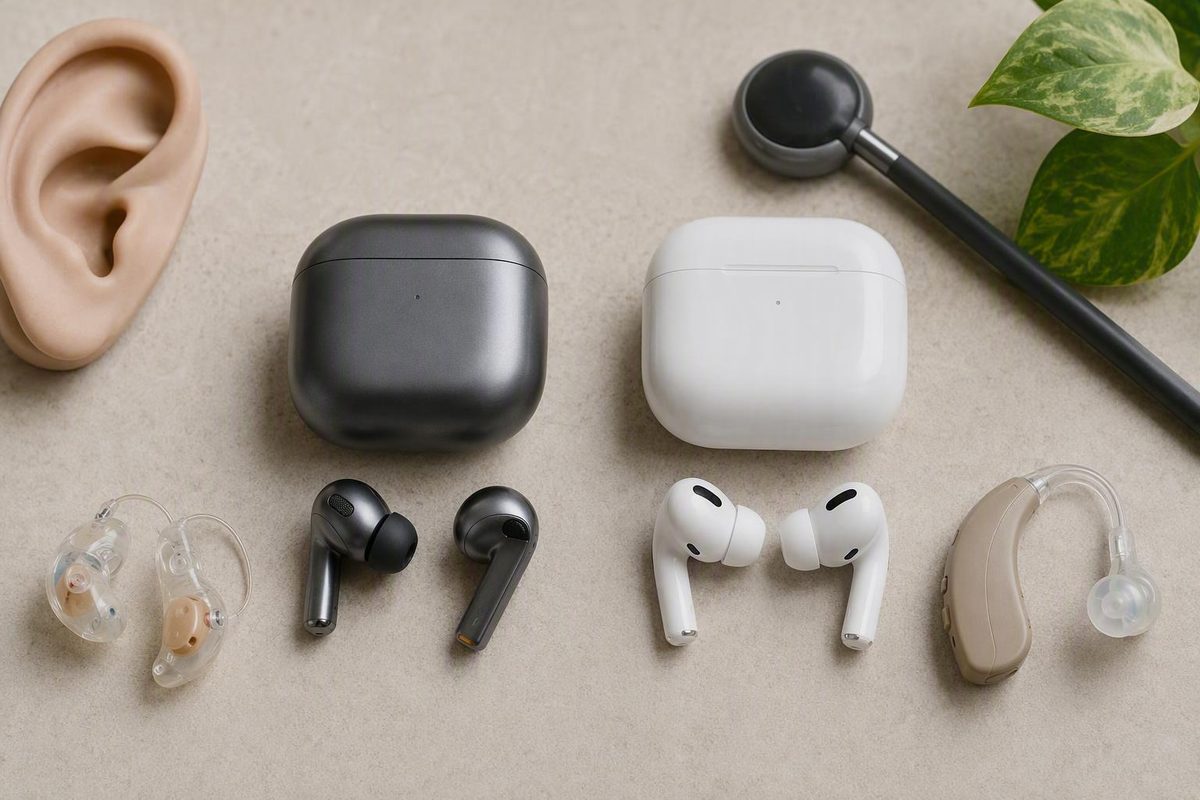
AirPods Pro 2 or AirPods Pro 3 are the practical hearing-aid choice today for eligible iPhone and iPad users. Samsung’s FDA-cleared Galaxy Buds3 Pro and Buds4 Pro software is the corresponding option for Galaxy users, but its US rollout was reported for Q4 2026 and still requires confirmation for the exact phone, firmware, One UI version, and country. There is no evidence that either system delivers better hearing performance.
Choose your phone, hearing difficulty, daily wear time, and spending plan; the tool gives you a fit result and a sortable evidence table.
This screens for ecosystem fit and daily-use demands. It does not diagnose hearing loss or compare sound quality.
Your default selections match Apple’s documented eligibility and phone requirements. Confirm regional availability and current software before setup.
No comparative hearing-performance, hearing-aid battery, or price figures were supplied.
Best documentation and present availability for eligible Apple users.
Requires confirmed rollout, compatible Galaxy hardware, One UI, firmware, and country support.
Prioritize this route for red flags, needs outside OTC eligibility, or dependable extended wear.
| AirPods Pro 2 Documented | Compatible updated iPhone or iPad | Not specified in supplied evidence | — | — |
| AirPods Pro 3 Documented | Compatible updated iPhone or iPad | Not specified in supplied evidence | — | — |
| Galaxy Buds3 Pro Reported Q4 2026 rollout | Compatible Galaxy device; One UI 8 or later reported | NAL-NL2 reported | — | — |
| Galaxy Buds4 Pro Reported Q4 2026 rollout | Compatible Galaxy device; One UI 8 or later reported | NAL-NL2 reported | — | — |
— means no dependable figure was supplied. Sources: Apple Support documentation; Hearing Review and eWeek reporting on Samsung’s FDA-cleared software and planned rollout.
Availability Favors AirPods Until Samsung’s Rollout Is Confirmed
Apple documents its Hearing Aid feature for AirPods Pro 2 and AirPods Pro 3. It requires current earbud firmware, a compatible and updated iPhone or iPad, and availability in the user’s country or region. Apple says it is intended for adults aged 18 or older with perceived mild-to-moderate hearing loss. Apple’s support documentation explains eligibility, setup, controls, and regional requirements.
Samsung received FDA clearance on August 11, 2026, for integrated Hearing Test and self-fitting OTC Hearing Aid software, according to hearing-industry reporting. The software is also intended for adults aged 18 or older with perceived mild-to-moderate hearing loss. The reported US release window was Q4 2026, not immediate general availability. Hearing Review reports the clearance and planned rollout.
| System | Eligible Earbuds | Phone Requirement | Current Position |
|---|---|---|---|
| Apple | AirPods Pro 2 and 3 | Compatible, updated iPhone or iPad | Documented where regionally available |
| Samsung | Galaxy Buds3 Pro and Buds4 Pro | Reported compatible Galaxy device with One UI 8 or later | US rollout reported for Q4 2026 |
This is an availability verdict, not a sound-quality ranking. The supplied evidence contains no controlled comparison of speech understanding, fitting accuracy, gain, feedback, processing delay, directionality, noise handling, comfort, or hearing-aid-mode battery endurance.
Galaxy owners should not treat FDA clearance as proof that the feature is installed. A store may sell the named earbuds before the required Hearing Aid software is available on a particular phone or in a particular country.
Regulated Hearing Aid Mode Is Not Ordinary Ambient Sound
Transparency and Ambient Sound modes route surrounding sound through an earbud’s microphones. They can make it easier to hear announcements, traffic, coworkers, or nearby conversation without removing the earbuds. Making that sound louder does not by itself establish personalized fitting or regulated OTC hearing-aid status.
Samsung’s older Ambient Sound feature falls into this category. A user may see Ambient Sound in the Galaxy Wearable interface even when the new Hearing Test and Hearing Aid workflow is unavailable.
The reported 2026 Samsung system is different. It tests each ear, creates an audiogram, and uses that hearing profile to shape environmental amplification. Apple’s system similarly combines a hearing test or imported professional audiogram with personalized amplification.
Media personalization is another distinct function. Apple calls its implementation Media Assist and applies hearing-profile adjustments to music, video, phone calls, and FaceTime. Environmental Hearing Aid amplification and media volume can be adjusted separately.
Hearing protection also has a separate purpose: reducing exposure to loud environmental sound rather than amplifying sounds that are difficult to hear. Apple documents active Hearing Protection for supported AirPods Pro under specified operating conditions. The supplied Samsung evidence does not establish a comparable regulated function.
Phone Compatibility Determines Which System Is Usable
Apple requires AirPods Pro 2 or AirPods Pro 3 with current firmware and a compatible iPhone or iPad running current software. The mobile device is needed for the hearing test and initial setup. Regional restrictions still apply, so supported hardware does not guarantee that the regulated feature is enabled in every market.
Samsung’s planned system was reported for Galaxy Buds3 Pro and Galaxy Buds4 Pro paired with a compatible Galaxy device running One UI 8 or later. This remains a reported prelaunch requirement because complete first-party Samsung compatibility documentation was not supplied. eWeek reports the models, One UI requirement, and rollout window.
The following Samsung details were not established in the supplied evidence:
- The complete list of compatible Galaxy phones and tablets
- Minimum earbud firmware versions
- The final list of supported countries
- An exact US release date
- Whether every regional variant of each named model qualifies
- Final first-party setup and troubleshooting instructions
Do not assume complete cross-platform support. Ordinary Bluetooth playback may work across ecosystems while the regulated hearing test, fitting, health records, and advanced controls remain tied to the manufacturer’s platform. An Android phone is not documented as a substitute for Apple’s required iPhone or iPad. An iPhone or non-Samsung Android device is not established as a setup platform for Samsung’s system.
Before buying, confirm the exact earbud generation, phone model, operating-system version, earbud firmware, country, and feature name. The interface must identify Hearing Aid, not merely Transparency, Ambient Sound, equalization, or a general accessibility control.
Both Tests Take About Five Minutes, but Validation Differs
Both systems are described as testing each ear separately in approximately five minutes, creating an audiogram, and using the result to personalize amplification. Those similarities do not prove identical accuracy, safeguards, fitting behavior, or clinical equivalence.
Apple Documents Its Test Conditions
Apple says its test covers frequencies from 250 Hz to 8 kHz. The result includes a decibel hearing level value for each ear, a hearing-loss classification, an audiogram, and recommended next steps. Apple documents the test range, preparation, results, and quality checks.
The test should be completed in a quiet room with ear tips that form a suitable seal. The system checks fit and monitors ambient noise. It may pause if the earbuds move or the room becomes too loud, and it may ask the user to reposition an earbud or change the tip.
Debris, a poor seal, a recent cold, sinus or ear infection, allergies, or recent loud-noise exposure may affect the result. A result that conflicts with everyday experience warrants a repeat test or professional testing.
Samsung Reports NAL-NL2-Based Fitting
Samsung’s test is reported to use pure-tone audiometry to assess each ear and create an audiogram in about five minutes. Reporting says it classifies hearing as normal, mild, moderate, severe, or profound.
The resulting profile reportedly feeds the NAL-NL2 fitting formula, with noise reduction and beamforming intended to emphasize sounds from the front. Naming a fitting formula does not show how closely the earbuds meet its prescribed targets across different ears, seals, and environments.
Samsung has reportedly described the test’s accuracy as comparable to an audiologist’s evaluation. That is a manufacturer claim. The supplied evidence does not include enough independent validation detail to treat the self-test and a comprehensive professional assessment as interchangeable.
An earbud test can indicate which tones require a higher presentation level. It cannot identify the medical cause of hearing difficulty, fully measure speech understanding, guarantee performance in noisy conversation, or establish that every user is an appropriate OTC candidate.
Apple Provides More Documented Controls
Apple permits setup from either its AirPods hearing test or an audiogram supplied by a hearing healthcare professional. Documented controls include overall amplification, left-right balance, tone, ambient-noise reduction, own-voice amplification, and Conversation Boost.
Conversation Boost focuses on a person speaking directly in front of the wearer. It is primarily a one-on-one conversation tool, not a guarantee of clear speech in every restaurant, vehicle, crowd, or group discussion.
Apple stores detailed audiograms in the Health app. Results can be exported as a PDF, and a clinician-provided audiogram can be added for Hearing Assistance setup. Apple also says configured settings are stored on the AirPods, allowing environmental amplification to continue when the paired iPhone or iPad is not nearby.
Samsung hearing-test results and noise-exposure information are reportedly available through Samsung Health. The supplied evidence does not establish whether Samsung will support professional-audiogram import, clinical-result export, profile transfer to replacement earbuds, or personalized operation when the phone is absent.
| Capability | AirPods Pro | Galaxy Buds Pro Models |
|---|---|---|
| Professional audiogram import | Documented | Not established |
| Health-platform storage | Apple Health, documented | Samsung Health, reported |
| Operation without nearby phone after setup | Documented | Not established |
| Personalized calls and media | Media Assist, documented | Not established |
Apple’s broader documentation makes its system easier to evaluate before purchase. It does not prove superior speech understanding, fitting accuracy, or natural sound.
Battery, Price, and Hearing Performance Remain Unresolved
No dependable hearing-aid-mode battery figures were supplied for any of the four earbud models. Conventional music-playback or active-noise-cancellation tests should not be presented as continuous environmental-amplification endurance.
Comparable prices were also not supplied. A defensible price ranking is therefore unavailable. Value depends partly on whether the buyer already owns a compatible phone and earbuds, whether a phone change would be required, and how many hours of assistance are needed each day.
No supplied source directly compares the current Apple and Samsung regulated modes. A credible test would need matched measurements of speech understanding in quiet and noise, fitting accuracy, stable gain, feedback, processing delay, directionality, own-voice quality, comfort, seal retention, setup reliability, and continuous hearing-aid-mode endurance.
Until those measurements exist, claims that one sounds clearer or performs better in noise go beyond the evidence.
Sealed Earbuds Trade Discretion for Wear-Time Limits
AirPods Pro and the named Galaxy Buds use in-ear tips that depend on a suitable seal. That seal supports testing and sound delivery, but it can make the wearer’s own voice feel blocked or boomy. Fit can also shift while talking, eating, or moving.
These products are consumer earbuds first. They combine calls, entertainment, noise control, and situational hearing assistance in one familiar device. Their charging cases also suit intermittent use.
Dedicated OTC and prescription hearing aids are designed primarily around amplification and extended wear. Depending on the model, they may offer a more open physical fit, hearing-specific controls, remote support, or professional follow-up. An audiologist-reviewed assessment of AirPods describes them as potentially useful for situational assistance while finding dedicated hearing aids more suitable for some users’ all-day wear and difficult environments. Soundly discusses these situational-use tradeoffs.
The evidence does not support a universal comfort winner. Some people prefer a sealed earbud; others cannot tolerate it for several hours.
Choose AirPods, Wait for Galaxy Buds, or Buy a Dedicated Aid
Choose AirPods Pro 2 or AirPods Pro 3 conditionally if you already use a compatible iPhone or iPad, the feature is available in your region, and you are an adult with perceived mild-to-moderate loss. Apple offers the clearest documented route for self-testing, professional-audiogram import, environmental controls, media personalization, and result export.
Choose Galaxy Buds mode only after Samsung’s rollout is confirmed for the exact Buds3 Pro or Buds4 Pro model, Galaxy phone, One UI release, firmware, and country. Its reported NAL-NL2 fitting and Samsung Health integration make it a credible ecosystem option, but prelaunch reporting is not a compatibility guarantee.
A dedicated OTC hearing aid is the stronger comparison when dependable all-day support, a hearing-specific physical design, or remote assistance matters more than music and call integration. A professionally fitted device is more appropriate when the user needs help interpreting results, structured follow-up, difficult-environment adjustments, physical-fit assistance, or support beyond the intended OTC range.
Apple directs people with severe or profound hearing loss, sudden hearing changes, or continued hearing difficulty to speak with a doctor. Earbud tests do not diagnose the cause of hearing loss.
Common Compatibility Questions
Can Galaxy Buds Be Used in Hearing Aid Mode Now?
Not as a general assumption. Trade reporting described FDA clearance with a US rollout planned for Q4 2026. Confirm activation for the exact earbuds, Galaxy device, One UI version, firmware, and country. Existing Ambient Sound controls do not confirm that the regulated software is installed.
Which Earbuds Are Included?
Apple documents AirPods Pro 2 and AirPods Pro 3. Trade reporting identifies Galaxy Buds3 Pro and Galaxy Buds4 Pro. Earlier AirPods and similarly named Galaxy Buds should not be assumed compatible.
Can an Audiologist’s Audiogram Be Imported?
Apple documents professional-audiogram import and PDF export. Audiogram import for Samsung’s reported Galaxy Buds feature was not established by the supplied evidence.
Can These Earbuds Replace Dedicated Hearing Aids?
They may provide useful situational assistance for some adults with perceived mild-to-moderate loss. They are not guaranteed replacements for dedicated OTC or professionally fitted hearing aids, particularly when extended wear, follow-up support, or difficult listening environments are the priority.