
Earplugs Protect Hearing but Don’t Treat Tinnitus
In hazardous noise, they reduce further risk. Reduced masking can make existing ringing seem louder temporarily without proving new damage.
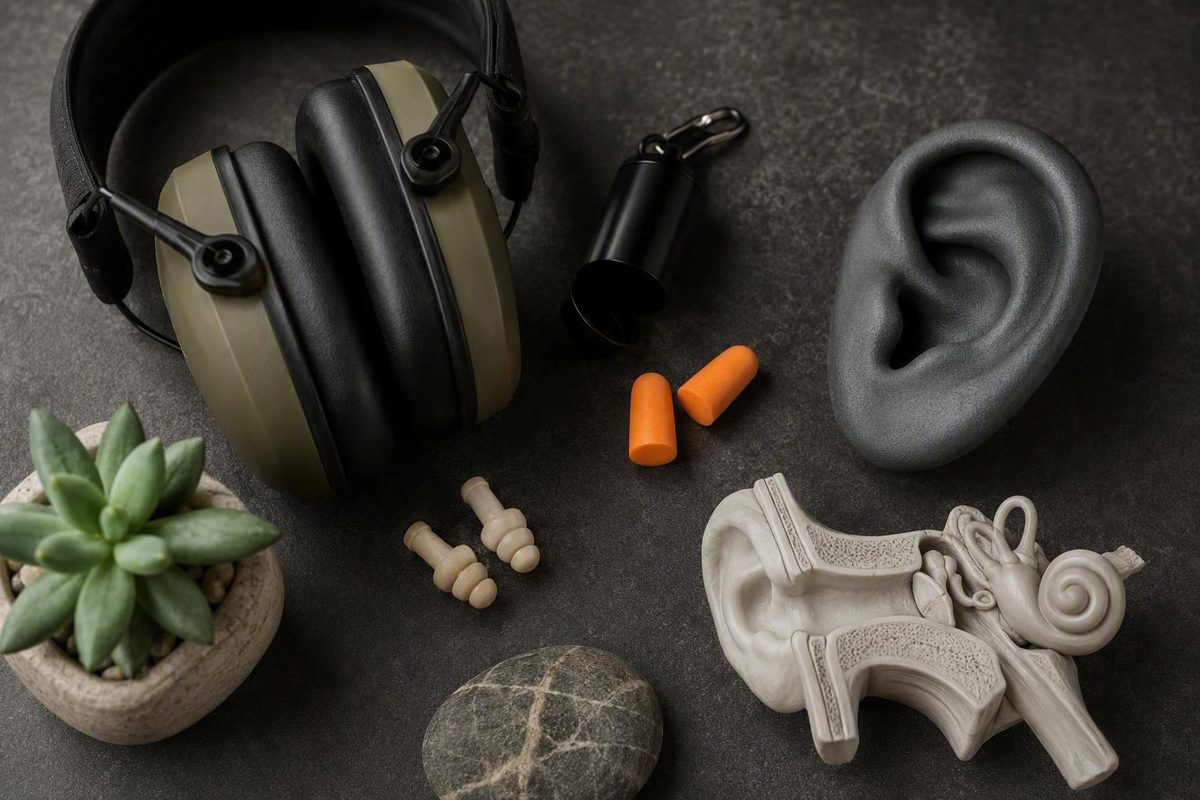
Earplugs can reduce hazardous sound reaching your ears and help prevent noise-induced hearing loss and associated tinnitus when loud noise cannot be avoided. They do not cure or block established tinnitus. If ringing seems louder only while your ears are plugged, one plausible explanation is that less outside sound is masking it—not that the plugs have physically worsened your hearing. The practical goal is targeted protection that fits properly and suits the setting, not maximum sound reduction everywhere. NIDCD recommends first avoiding, reducing, or moving away from loud sound and using hearing protectors when those options are not possible.
The short answer: protection, not tinnitus treatment
Earplugs act on external sound. They lower the intensity of concerts, tools, machinery, gunfire, engines, and other environmental noise before it reaches the inner ear. That can reduce the risk of additional noise-related injury.
Tinnitus is different: it is a perceived sound without a corresponding external source. Because the ringing, buzzing, hissing, or roaring is not coming from the room around you, sealing the ear canal cannot block it as it blocks a loudspeaker or power tool.
This distinction answers the three common versions of the earplug tinnitus question:
- Can earplugs help? Yes, by protecting against hazardous noise that could damage hearing or aggravate symptoms.
- Can earplugs cure existing tinnitus? No. They are hearing protectors, not tinnitus treatment.
- Can earplugs make tinnitus sound worse? They can make it more noticeable temporarily by reducing the environmental sound that normally competes with it.
A change in perception while the plugs are inserted is not, by itself, evidence of new hearing damage. A persistent change after a concert, blast, tool use, or other loud exposure is different: the exposure may have affected your hearing.
Three rules to remember
- Use earplugs for hazardous noise.
- Do not expect them to treat established tinnitus.
- Investigate persistent changes instead of assuming the plugs caused them.
Why tinnitus can sound louder when your ears are plugged
In an ordinary room, ventilation, traffic, conversation, appliances, and other low-level sounds partly cover tinnitus. Insert earplugs and much of that external sound becomes quieter. The tinnitus may then stand out because the contrast has increased. This reduced-masking effect is a recognized explanation for why tinnitus can seem louder while hearing protection is worn.
Think of a small light visible at dusk. The light has not necessarily become brighter when night falls; its surroundings have become darker. Earplugs can create a similar contrast between tinnitus and the sound around it.
Timing offers a useful clue:
- If the ringing becomes prominent soon after inserting the plugs and returns to its usual level after removal, reduced masking is a plausible explanation.
- If the change continues after the plugs are removed—especially following hazardous noise—do not dismiss it as masking.
- If the change comes with pain, pressure, discharge, muffled hearing, or difficulty fitting the plug, an ear-canal or hearing problem may need examination.
The occlusion effect may also contribute. Sealing the ear canal can make internally transmitted sounds—such as your voice, chewing, footsteps, or breathing—seem fuller or louder. For some people, that altered internal sound environment may make tinnitus more prominent. It does not prove that the plug damaged the ear. Both reduced masking and the occlusion effect are discussed in this clinically reviewed earplug safety overview.
Claims that routine earplug use inevitably causes hyperacusis, raises the brain’s “central gain,” or prevents tinnitus habituation go beyond the available evidence. You do not need protection continuously in ordinary safe environments, but fear of those claims should not stop you from protecting your hearing when noise is genuinely hazardous.
When tinnitus makes hearing protection more—not less—important
Existing tinnitus is not a reason to leave your ears unprotected around damaging noise. First turn down the sound, move farther away, use a quieter tool or process, or limit your exposure time. When those measures are insufficient, wear suitable hearing protection.
Common situations include:
- Concerts, clubs, festivals, and amplified rehearsals
- Fireworks and shooting
- Power tools, lawn equipment, and shop machinery
- Motorcycling and motorsports
- Industrial machinery and noisy workplaces
- Other prolonged or repeated high-noise activities
Risk depends on more than a single decibel reading. Loudness, exposure duration, repetition, distance from the source, and whether the sound is continuous or impulsive all matter. Long or repeated exposure around or above 85 dBA is a useful warning benchmark, but it is not a universal boundary below which every sound is harmless or above which injury is certain. A single intense impulse can also injure hearing, and risk rises as sound becomes louder, closer, or longer-lasting, according to NIDCD guidance on noise-induced hearing loss.
For occupational sound at or above approximately 100 dBA, or for impulsive noise, NIOSH recommends wearing earmuffs over earplugs. Double protection does not make gunfire, explosions, or other extreme noise automatically safe; distance, barriers, exposure reduction, and safe operating practices still matter. NIOSH also cautions against both inadequate protection and excessive attenuation that interferes with communication or encourages removal of the protector, as explained in its hearing-protector selection guidance.
Research at music events supports a narrower conclusion than some earplug marketing suggests. A systematic review found scarce evidence overall, although one randomized concert trial reported smaller short-term hearing-threshold shifts among people assigned to wear earplugs. The review searched literature only through June 22, 2015, and just two studies remained for data extraction. Its findings support immediate protection at concerts but do not establish that earplugs prevent chronic tinnitus in every user or setting. See the systematic review indexed by PubMed.
Choose the earplug by setting, fit, and communication needs
There is no universally best earplug. Choose according to the sound, how long you will wear protection, whether you need to understand speech or music, and what fits securely without pain.
| Setting | Practical option | Why it may fit | Main limitation |
|---|---|---|---|
| Concerts or music | Filtered or high-fidelity plugs | Can reduce intensity more evenly across pitches, preserving more clarity | Fit and attenuation vary; they do not make unlimited exposure safe |
| Power tools or noisy work | Properly fitted foam or pre-molded plugs | Portable, practical, and available in multiple sizes | Poor insertion can sharply reduce protection |
| Shooting or extreme impulsive noise | Earplugs plus protective earmuffs where recommended | Adds protection for very high or impulsive sound | No combination blocks all sound or makes every exposure safe |
| Frequent occupational or music use | Professionally fitted custom plugs | May improve comfort and consistency for some users | Higher cost and not automatically superior without suitable filters and fit |
| Narrow, curved, or difficult ear canals | Another plug size or earmuffs | Avoids forcing an unsuitable plug | May require professional fitting help |
| Sleep in a noisy environment | Comfortable sleep plugs | Can reduce disruptive external noise | May increase tinnitus awareness and reduce awareness of alarms |
| Communication-critical settings | Flat-attenuation or filtered protection | May preserve speech cues better than maximum attenuation | Must still provide enough protection for the measured exposure |
These options reflect NIDCD and NIOSH guidance emphasizing appropriate attenuation, comfort, fit, and communication needs rather than simply choosing the highest package rating.
If a plug hurts, repeatedly loosens, or cannot be inserted comfortably, do not force it. Try a different size or design, switch to earmuffs, or ask an audiologist or occupational hearing professional for fitting help.
Consumer noise-cancelling earbuds are not automatically substitutes for rated hearing protection.
For sleep, account for non-acoustic risks as well. Reducing bedroom noise may help, but blocking too much sound could prevent you from hearing a smoke alarm, emergency alert, telephone, child, or another person who needs help. Commercial hearing-care guidance describes this practical risk but does not quantify how often such events occur.
Fit matters more than the number printed on the package
Noise Reduction Rating (NRR) and Single Number Rating (SNR) are laboratory-based rating systems. They are not interchangeable, and neither should simply be subtracted from an environmental decibel reading to promise an exact sound level at your eardrum.
Real-world attenuation can be substantially lower than the package rating. NIOSH therefore recommends choosing protection according to required attenuation, fit, comfort, and work conditions—not the package number alone.
For disposable foam plugs, use this basic fit sequence:
- Start with clean, dry hands.
- Roll the plug as directed into a narrow, crease-free shape.
- Reach over your head and gently straighten the ear canal if the instructions advise it.
- Insert the plug gently. Do not push until it hurts.
- Hold it in place while it expands.
- Check for a comfortable, secure seal and similar protection in both ears.
- Remove it slowly rather than pulling it out abruptly.
Never cut or tear a foam plug to make it smaller because that can compromise the seal and reduce its effectiveness. Do not force foam, silicone, or pre-molded plugs into an ear canal that is painful, irritated, unusually narrow, or difficult to fit. NIDCD’s hearing-protector guidance supports gentle insertion, a comfortable and secure fit, and using earmuffs when plugs cannot be fitted properly.
Protection also depends on keeping the device on. Briefly removing an earplug for a conversation or taking earmuffs off during the loudest part of an event can undermine the benefit of wearing them during the rest of the exposure.
When reliable attenuation is important, individual fit testing can measure the reduction a particular wearer achieves with a particular protector. A limited systematic review found that fit testing paired with extensive personalized instruction showed promise for improving immediate protection, while simple instruction alone did not show the same clear benefit. The review included only three studies with 756 participants, and the outcome was short-term attenuation—not prevention of tinnitus—as summarized in the NIOSH fit-testing review.
The best protector is therefore one that supplies enough attenuation, fits correctly, remains comfortable, and stays on throughout the exposure. Excessive attenuation can interfere with speech, warning signals, or situational awareness and may tempt the wearer to remove it.
Troubleshoot ringing, fullness, pain, or muffled hearing after earplug use
Use the timing and accompanying symptoms to decide on the next step rather than trying to diagnose the cause at home.
- Remove the plugs in a safe, quiet setting. If the ringing returns to its usual baseline, reduced masking is a plausible explanation.
- Consider what happened before the change. If symptoms began after a concert, gunshot, blast, power tool, machinery, or another loud event, the exposure itself may be responsible. Avoid further hazardous noise while arranging an assessment.
- Notice additional ear symptoms. Fullness, muffled hearing, itching, pain, discharge, or repeated insertion difficulty may indicate wax, irritation, poor fit, or another problem that requires examination.
- Stop forcing the plug. Switch to a comfortable alternative rather than repeatedly pushing an unsuitable device deeper.
- Arrange a hearing evaluation if tinnitus or suspected hearing loss persists. NIDCD recommends having your hearing tested when hearing loss is suspected.
Repeated insertion may push wax farther into the canal or interfere with its natural outward movement. Contaminated reusable plugs may also contribute to irritation or infection. The cited practical guidance describes these potential complications but does not establish how often they occur. Clean reusable protection according to the manufacturer’s instructions, handle plugs with clean hands, and replace products that are dirty, degraded, torn, hardened, or otherwise damaged rather than following one universal schedule. Sleep-earplug guidance from Boots Hearingcare also describes possible wax, infection, and blocked-ear symptoms.
Do not try to determine from symptoms alone whether the problem is wax, infection, poor fit, or acoustic injury. An audiologist can test hearing, while an appropriate medical professional can examine the ear canal and assess pain, discharge, inflammation, or other concerns.
Some tinnitus patterns can accompany problems requiring timely care, but the available authoritative sources here do not support a detailed emergency-triage checklist. Seek prompt professional assessment for a sudden or substantial hearing change or for tinnitus accompanied by severe or otherwise concerning symptoms. New one-sided or pulse-synchronous tinnitus should also be discussed promptly with an appropriate clinician rather than diagnosed at home.
Appropriate timing depends on severity, associated symptoms, recent noise exposure, medical history, and whether hearing has changed.
What to use when silence—not noise—is the problem
If earplugs make tinnitus intrusive at bedtime or in a quiet room, gentle background sound may reduce the contrast between tinnitus and silence. Depending on your preferences and environment, that might mean a fan, quiet nature audio, soft music, or a bedside sound source. The goal does not have to be complete masking; a low, comfortable level that makes tinnitus less dominant may be enough.
If you have hearing loss, properly selected hearing aids may restore access to environmental sound, and some devices include tinnitus-related sound features. Selection should follow an appropriate hearing assessment, and neither hearing aids nor sound enrichment will eliminate tinnitus for everyone.
For sleep, balance five practical considerations:
- How much external noise actually needs to be reduced
- Whether greater quiet makes tinnitus harder to ignore
- Whether the plug remains comfortable throughout the night
- Whether the device can be kept clean and in good condition
- Whether you can still detect alarms and emergencies
Earplugs may help when traffic, a partner’s snoring, or intermittent outside noise is the main problem. If the room is already quiet and tinnitus is the disturbance, gentle sound enrichment may be more useful than further sound reduction.
Use earplugs as targeted hearing protection, not as tinnitus treatment. Reduce or leave hazardous noise when possible, choose a comfortable protector suited to the activity, fit it correctly, and keep it on throughout the exposure. If ringing merely stands out while your ears are plugged, reduced masking may explain it. If the change persists or comes with hearing loss, pain, fullness, discharge, or other concerning symptoms, obtain a professional assessment.