
Hearing Aid for High Frequency Hearing Loss: How to Choose
Learn when an open-fit hearing aid helps high-frequency hearing loss, when a more closed fitting is needed, and which fitting checks to request.
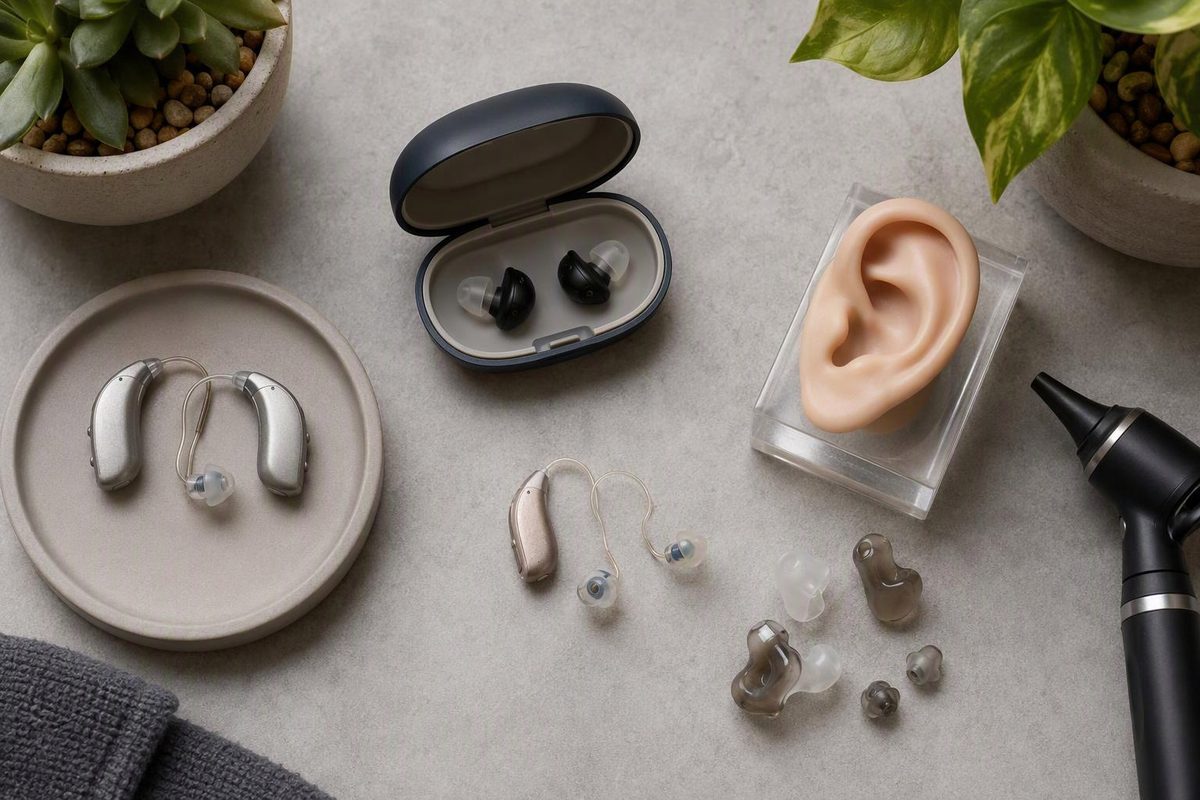
A good hearing aid for high-frequency hearing loss amplifies the higher-pitched sounds you struggle to hear without unnecessarily amplifying lower pitches you hear well. Digital hearing aids can be programmed to amplify different frequencies by different amounts; the right choice depends on your hearing test, not a particular brand or price tier. NIDCD explains this frequency-specific programming.
If your low-frequency hearing is good and your high-frequency loss is mild to moderate, an open-fit hearing aid is a reasonable starting point to discuss. An open fitting leaves the ear canal partly open rather than sealing it. If the higher pitches need much more amplification, a more closed fitting—sometimes using a less-vented custom earmold—may be necessary. The useful comparison is between fittings that deliver enough sound comfortably, not simply between device names. A review of open and closed fittings explains these trade-offs.
Start with the full hearing test
High-frequency hearing loss means reduced hearing for higher pitches, often with better hearing for lower ones. That describes a pattern, not its cause or how much help a particular device will provide.
Ask an audiologist to review your audiogram, the chart showing the quietest sounds you can hear at different pitches in each ear. The assessment should establish the type and degree of loss and include speech testing. If restaurants or group conversations are your main difficulty, ask about speech-in-noise testing: results in quiet may not capture the problem you need the aids to address. ASHA’s adult hearing-aid guidance recommends comprehensive assessment and explains the value of speech testing in noise.
A sudden hearing change needs medical care immediately, not a hearing-aid shopping appointment. This includes a change over hours or a few days, especially in one ear. NIDCD treats sudden deafness symptoms as a medical emergency. Worse hearing in one ear, one-sided ringing, pain, drainage, fluctuating hearing or vertigo also warrant medical evaluation before self-selecting a device, according to FDA warning guidance.
Open-fit, custom mold or in-the-ear?
A receiver-in-canal (RIC) hearing aid has a small body behind the ear and a thin wire leading to a speaker in the ear canal. That speaker can use either a soft dome or a custom earmold. RIC describes the device’s layout; it does not mean the fitting is necessarily open. A custom mold can also have a vent, so “custom” does not automatically mean closed. ASHA describes these styles and fitting considerations.
| Option to discuss | When it may suit you | Main trade-off |
|---|---|---|
| Open dome or generously vented fitting | Good low-frequency hearing with manageable high-frequency amplification needs | Less plugged-up own-voice sound, but limited amplification before whistling feedback |
| More closed dome or less-vented custom earmold | Greater high-frequency amplification needs, or an open fitting that cannot meet targets | Better control of sound leakage, but potentially more plugged-up sensation |
| Custom in-the-ear hearing aid | Preference for an in-ear device or different handling needs | Venting, comfort and available output still need individual assessment |
Open fittings let more natural sound enter the ear and can reduce the occlusion effect—the boomy or hollow sound of your own voice when the canal is blocked. However, they can also reduce the benefits of directional microphones and noise reduction. These are established acoustic trade-offs in the open-versus-closed fitting review, not reasons to rule an option in or out without testing it.
Is frequency lowering worth having?
Frequency lowering moves or compresses some higher-frequency information into a lower range. It is worth discussing when useful high-frequency speech information remains inaccessible with conventional amplification.
It is not automatically better for every sloping hearing loss. The settings matter: stronger processing can alter sound quality or speech cues. Audiology researchers explain these trade-offs in a clinical discussion of frequency lowering.
Ask your provider to explain why the feature is needed, verify its output and compare your speech understanding and sound quality with it on and off. A feature name is not proof of benefit.
Can an OTC hearing aid work?
In the U.S., OTC hearing aids are intended for adults 18 and older with perceived mild-to-moderate hearing loss. They are not intended to treat severe or profound loss. Self-fitting models offer customization through tests, software or apps. FDA explains the eligibility and device categories.
An OTC device may be an option for an uncomplicated mild-to-moderate pattern. But if your audiogram shows severe loss at higher pitches despite good low-frequency hearing, seek professional advice rather than assuming OTC suitability from the sounds you still hear easily. Prescription care allows the output and physical fitting to be selected for that more demanding pattern.
What to request before committing
Ask for real-ear measurement: a tiny microphone tube measures what the hearing aid actually delivers in your ear. ASHA calls it the gold standard for verifying a fitting against evidence-based targets across speech frequencies and at different input levels. Software predictions alone are not the same measurement. ASHA also recommends checking comfort and maximum output.
Meeting those targets does not guarantee effortless conversation: some people still have difficulty understanding speech in noise despite adequate amplification. That is why testing benefit matters as well as measuring output. ASHA distinguishes fitting verification from outcome assessment.
Before paying, confirm:
- Whether high-frequency speech targets can be met with the proposed dome or mold.
- How you will assess whether speech is clearer—not merely louder—in your difficult settings.
- Who provides adjustments and what follow-up costs.
- The written return deadline, refund deductions and warranty terms.
During the trial, note specific examples: missed words, whistling, your own voice sounding boomy, or dishes sounding uncomfortably sharp. Bring those notes to the adjustment visit. Our guide to what a hearing aid fitting should include explains the checks to expect.