
Hearing Aid for Moderate Hearing Loss: Which Type Fits?
Compare hearing aid styles for moderate hearing loss, see when OTC is reasonable, and learn which fitting checks matter before buying.
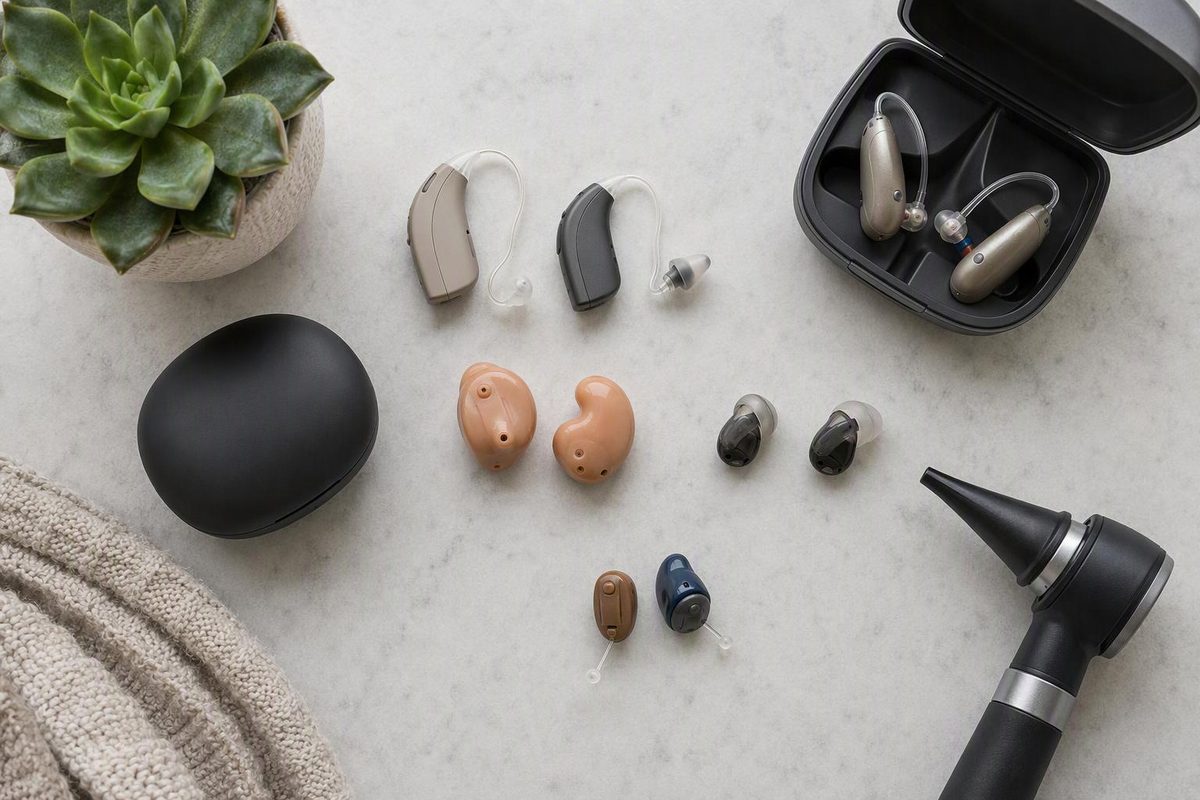
Moderate hearing loss can be fitted with behind-the-ear, receiver-in-the-canal, or custom in-ear hearing aids. Some adults can also consider over-the-counter (OTC) devices. The useful question is not which brand is “best for moderate loss,” but which device can deliver the amplification you need at each pitch, with comfortable sound and controls you can use. NIDCD explains that selection depends on the kind and severity of loss, needs, and lifestyle—not price alone.
What “moderate” changes about your choice
In the classification published by ASHA, moderate hearing loss is 41–55 decibels hearing level (dB HL); moderately severe loss is 56–70 dB HL. These describe hearing-test thresholds, not hearing aid volume settings or the amount of amplification you need.
Ask to see your audiogram, the graph of hearing thresholds at different pitches. A description such as “moderate overall” does not tell you whether your hearing is similar across pitches or substantially worse at some of them. That matters because digital hearing aids can be programmed to amplify different frequencies by different amounts. NIDCD describes this frequency-specific adjustment.
For example, moderate loss across both low and high pitches may require a different ear tip or earmold from hearing that is relatively good at low pitches but moderate at high pitches. Do not assume an open dome is appropriate simply because the loss is moderate. Open fittings let low-frequency amplified sound escape and can limit the amplification available before whistling feedback occurs. A more closed dome or custom earmold may therefore be needed when substantial amplification is required. The trade-off is a potentially more plugged-up sound to your own voice. A review of open and closed fittings explains these acoustic limits.
Which hearing aid styles are worth comparing?
The moderate-loss label alone does not require the largest device—or exclude a small one.
| Style | Why consider it for moderate loss? | What to check before choosing |
|---|---|---|
| Receiver-in-the-canal (RIC/RITE) | A small body sits behind the ear, with the speaker in the canal. It can use a dome or an earmold. | Whether the selected speaker and ear tip provide enough amplification for your complete audiogram; try it with your glasses. |
| Behind-the-ear (BTE) | This style covers a broad range, from mild through profound loss, and can deliver sound through an earmold. | Comfortable fit behind the ear, insertion of the mold, and controls you can operate. |
| Custom in-the-ear (ITE) | Fits in the outer ear and can serve mild through severe loss. Some models offer a telecoil for compatible hearing loops. | Whether the shell is comfortable and the specific model includes the features you need. |
| In-the-canal or completely-in-canal (ITC/CIC) | Less visible options that can serve mild through moderately severe loss. | Small parts may be harder to handle; space for batteries and features is more limited. |
These style descriptions and hearing-loss ranges come from FDA’s hearing aid overview and NIDCD’s style guidance. The suitability of a particular model still needs checking: a style name is not a fitting guarantee.
If both ears have hearing loss, ask about a pair rather than choosing one aid solely to reduce the purchase price. NIDCD generally recommends two aids for bilateral loss, including benefits for understanding speech and locating sounds.
Is OTC reasonable at the moderate end?
In the United States, OTC hearing aids are intended for adults aged 18 or older with perceived mild-to-moderate hearing loss. A prescription, medical examination, and professional fitting are not required to buy them. Self-fitting OTC models offer more customization through tests, software, or apps than models limited to volume controls and preset programs. FDA explains these options.
An OTC trial can be reasonable if you fit that intended-use group, can manage the setup, and have clear return terms. But “mild-to-moderate” on the box is not proof that a device meets your needs. Seek professional assessment if you cannot hear speech even in a quiet room, do not hear loud sounds well, or get insufficient benefit from OTC aids. FDA identifies these situations as reasons to seek hearing-healthcare help. Prescription aids can be programmed for your individual loss and may be needed for more significant or complicated hearing loss.
Before shopping, seek medical evaluation for pain, drainage, vertigo, fluctuating hearing, worse hearing in one ear, or ringing only in one ear. These are among FDA’s warning signs. A sudden unexplained hearing drop needs immediate medical care, not a hearing aid trial; NIDCD treats sudden deafness symptoms as a medical emergency.
What to request before committing
For a professionally fitted device, ask for real-ear measurement: a small probe microphone measures the sound delivered in your ear. The clinician can compare soft, conversational, and loud speech with prescribed targets and check output against your loudness tolerance. Manufacturer software’s initial settings alone are not equivalent to this measurement. A clinical review explains verification and its role in fitting. Our hearing aid fitting guide explains what else the appointment should include.
Before paying, get the return deadline, nonrefundable fees, adjustment arrangements, repair coverage, and total cost in writing. During the trial, test specific tasks: a quiet conversation, your usual TV volume, phone calls, and a noisy setting you regularly visit. Record whether speech is clearer—not just louder—and report discomfort or feedback for adjustment. Hearing aids do not restore normal hearing or completely separate speech from background noise, so judge the purchase by useful improvement in your everyday listening. NIDCD’s buying and adjustment guidance supports these checks.