
Oticon Reveal vs Phonak EON: Which Should You Trial?
Compare Reveal and EON Sphere on noise processing, battery, Bluetooth, Auracast, CROS, fitting range, technology tiers, and trial priorities.
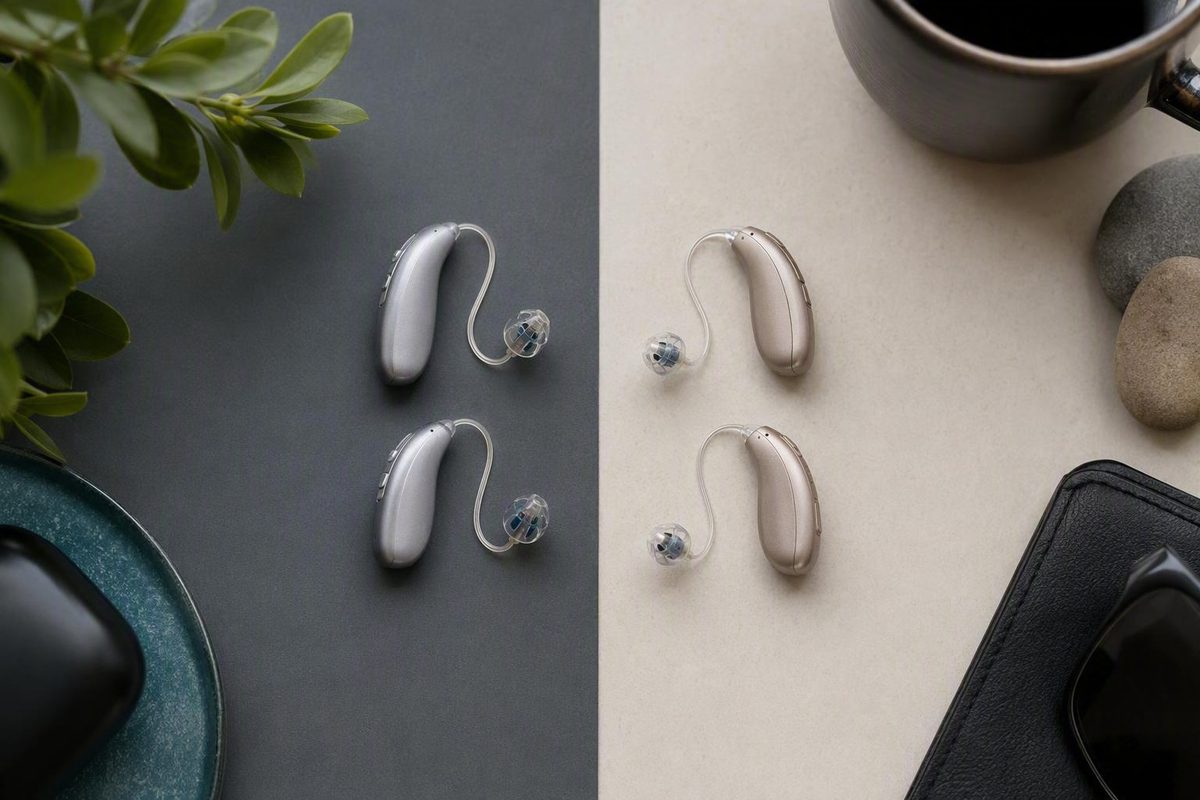
There is no proven overall winner between Oticon Reveal and Phonak EON. Trial Audéo EON Sphere first if your main problem is extracting speech from severe noise coming from several directions. Trial Oticon Reveal first if you want speech support while retaining more awareness of other voices and meaningful sounds around you. No independent study has tested both under the same fitting and listening conditions.
That verdict applies specifically to EON Sphere, not every product carrying the EON name. Sphere contains the dedicated HYPERSONIC processor used for Spheric Speech Clarity 3.0. Audéo EON R does not, while CROS EON R serves a different purpose for single-sided unaidable hearing loss.
Select your priorities; the tool ranks the models and exposes unresolved specifications.
Choose the problems that matter most. The ranking reflects documented design and compatibility—not a head-to-head clinical result.
Oticon Reveal
Best-supported trial reason: speech support with more surrounding context.
Rechargeable miniRITE; CROS RE reported, but complete pairing details remain unresolved.
Audéo EON Sphere
Best-supported trial reason: speech extraction from severe, diffuse noise.
Dedicated HYPERSONIC processor; not the reported receiver for CROS EON R.
EON R / CROS EON R
Best-supported trial reason: a compatible EON route for single-sided unaidable loss.
No dedicated Sphere speech-separation processor.
Sortable Model Comparison
More Columns
| Key Fit | |||
|---|---|---|---|
| Oticon Reveal Rechargeable miniRITE | ~24 hours from one clinic comparison; unmatched conditions | Orders opened Aug. 24, 2026 | Broader-scene speech support; CROS RE reported |
| Audéo EON Sphere RIC with dedicated HYPERSONIC processor | Up to 38 hours advertised; ~22–24 hours with substantial use and ~11–12 with Spheric continuously active in one review | U.S. orders opened Aug. 24–26, 2026 | Severe diffuse noise; levels 90, 70 and 50 reported |
| EON R / CROS EON R Non-Sphere RIC and CROS transmitter | — in supplied evidence | U.S. orders opened Aug. 24–26, 2026 | CROS EON R reportedly pairs with EON R, not Sphere |
Feature Evidence Matrix
The selector does not award a size winner because no equivalent cross-brand dimensions or weights are available.
Sources: Oticon and Phonak/Sonova launch reporting, The Hearing Review, The Next Web, one clinic comparison, clinician observations and retailer tier information cited in the article. Manufacturer claims are not independent head-to-head findings.
Reveal Preserves More of the Scene; EON Sphere Separates It
Oticon describes Reveal as running Speech AI and Context AI concurrently. Speech AI identifies and enhances speech, while Context AI recognizes and balances surrounding sound. The evidence establishes two named AI systems, not two independently confirmed deep neural networks.
The intended result is access to speech without stripping away as much potentially useful context. That may suit a family gathering where attention moves between people around a table. It may also appeal to someone who finds tightly focused noise programs isolating or unnatural.
Phonak EON Sphere combines Spheric Speech Clarity 3.0 with AutoSense OS AI 8.0. Spheric Speech Clarity separates speech from background noise, while AutoSense classifies the listening environment and adjusts hearing-aid features. The dedicated HYPERSONIC processor allows both to operate concurrently, according to launch reporting (The Next Web’s EON architecture report).
This makes EON Sphere the stronger design-based choice for a first trial when voices disappear into intense, diffuse noise. It does not prove that Sphere will produce better word recognition for a particular wearer.
The distinction is processing philosophy rather than an AI-label contest. “Dual AI,” “two AI systems,” and generation numbers describe what manufacturers are attempting to accomplish. They do not predict how many words an individual will understand.
Oticon and Phonak also report outcomes under different protocols. Reveal’s reported noise-suppression findings and Phonak’s signal-to-noise findings cannot be subtracted or ranked as though they came from one experiment. Manufacturer findings about brain response, speech understanding, listening effort, gain, wind and feedback management are not independent Reveal-versus-EON results.
Restaurants Favor Sphere’s Design, While Groups May Favor Reveal
For a loud restaurant or crowded reception, EON Sphere is the more logical first trial when the goal is maximum separation of one voice from noise arriving in several directions. Its dedicated processor was built around that task.
Reveal is the more logical first trial when several people exchange turns and retaining the wider conversational scene matters. Some listeners may experience that additional context as useful awareness; others may find it distracting.
Phonak says WindBlock 2.0 can reduce wind noise by up to 50 dB and improve signal-to-noise ratio by up to 30 dB. These are manufacturer “up to” claims, not independent findings or direct comparisons with Reveal (The Next Web’s summary of Phonak’s claims). They support testing EON outdoors but do not guarantee an individual advantage.
No controlled comparison answers which device handles a talker behind the wearer or a speaker moving around a room more effectively. Include both situations in a trial, first in relative quiet and then with competing noise.
| Listening Failure | First Trial | Main Limitation |
|---|---|---|
| One voice is buried by diffuse noise | EON Sphere | No matched restaurant trial |
| Speakers take turns around a table | Reveal | Awareness and naturalness are subjective |
| Noise programs feel overly restricted | Reveal | More context may be distracting |
| Wind masks outdoor speech | EON Sphere | Based on manufacturer claims |
| Talkers move or speak from behind | Both | Product descriptions do not predict the result |
| One side cannot use amplification | Resolve CROS first | Sphere reportedly cannot receive CROS EON R |
Coupling can change the result. An open dome permits more external sound to enter the ear directly. For suitable losses, that may reduce the closed-ear sensation, but it also gives the hearing aid less control over competing noise and low-frequency sound. A closed dome or custom earmold can provide greater acoustic control while changing comfort, occlusion and perceived naturalness.
Discussion of predecessor products supports this fitting principle, not a performance claim about Reveal or EON (HearingNow’s explanation of coupling and noise control). A comparison is not fair if one device uses an open dome and the other a sealed mold without accounting for that difference.
Battery Claims Do Not Establish a Runtime Winner
Phonak advertises up to 38 hours for EON. It also says EON Sphere is 25% smaller and 20% lighter than the previous Sphere generation and that its HYPERSONIC processor uses 37% less power than that predecessor. None of those figures compares EON directly with Reveal, and complete conditions for the 38-hour maximum are unavailable in the supplied evidence.
Audiologist Cliff Olson reported approximately 22–24 hours of EON Sphere use with substantial streaming and AI use. He observed approximately 11–12 hours when Spheric processing remained continuously active. Those are one reviewer’s observations rather than universal runtime estimates (Doctor Cliff Olson’s EON Sphere review).
A clinic comparison reports approximately 24 hours for Reveal. It does not provide a matched battery test or detailed first-party conditions, so that estimate cannot be compared directly with Phonak’s 38-hour advertised maximum (Clarity Hearing Care’s launch comparison).
Test runtime from a complete charge while reproducing your normal streaming, calls, wireless connections, noise exposure and program use. Record the remaining battery at bedtime. That personal result is more useful than comparing an advertised maximum with a reviewer’s demanding-use observation.
There is also no defensible cross-brand size winner. Phonak’s percentages use the previous Sphere as the baseline, while equivalent official Reveal dimensions and weight are unavailable.
Both Support Auracast but Use Different Wireless Approaches
Reveal launch coverage reports Bluetooth LE Audio, Auracast, streaming, hands-free calls, Made for iPhone support and Android optimization (The Hearing Review’s Reveal launch report). These platform descriptions do not guarantee every feature with every phone, computer, television or operating-system release.
The EON portfolio is reported to support Bluetooth Classic, Auracast, Roger Direct, streaming, hands-free calls and two active Bluetooth connections. EON may therefore be the more natural shortlist choice for someone already using Roger microphones or regularly switching between two connected devices. Reveal may attract a buyer building around LE Audio.
Auracast requires a compatible broadcaster, phone, transmitter, television accessory or venue system. “Made for iPhone,” “optimized for Android” and similar labels are not universal compatibility guarantees.
At the fitting, test the exact phone and operating system you use. Place incoming and outgoing calls, stream speech and music, switch between your phone and computer, reconnect after leaving Bluetooth range and demonstrate television or Roger accessories. Confirm whether two connections remain active and whether the quoted model—not merely the wider portfolio—supports each promised function.
EON Sphere, EON R and CROS EON R Are Not Interchangeable
The EON portfolio contains three distinct configurations:
- Audéo EON Sphere has the dedicated HYPERSONIC processor for Spheric Speech Clarity 3.0.
- Audéo EON R is a non-Sphere receiver-in-canal model without that dedicated processor.
- CROS EON R sends sound from an unaidable side to a compatible hearing aid on the better-hearing side.
If a review says “EON is better in noise,” confirm that it means EON Sphere. The design-based case for advanced real-time separation depends on Sphere’s dedicated processing.
Clinician and retailer reports list EON Sphere at 90, 70 and 50 technology levels. Levels 90 and 70 reportedly allow Spheric Speech Clarity to activate automatically, while level 50 requires selection of a separate manual program. Reported denoising strength also increases from level 50 to 70 and 90 (ZipHearing’s model and tier listing). A review of Sphere 90 should not be assumed to describe Sphere 50.
EON models are described as covering mild-to-profound hearing loss when equipped with suitable receivers. That does not establish suitability for an individual audiogram. Required output, speech discrimination, feedback margin, ear anatomy and handling ability still need professional evaluation.
Third-party clinician and clinic reports say CROS EON R pairs with non-Sphere EON R rather than EON Sphere. Someone could otherwise choose Sphere for its noise strategy and later discover that it cannot form the required CROS system. Verify the current regional compatibility chart and request a live demonstration with the exact transmitter and receiving hearing aid.
Reveal launch reporting identifies a rechargeable miniRITE and CROS RE, but the supplied evidence does not establish its complete fitting range, technology levels, receiver options or CROS pairings. Request Oticon’s current fitting guide and have the complete proposed configuration written on the quote.
Verified Fitting Can Change the Brand Comparison
A hearing aid’s processor does not work independently of its physical and clinical fitting. Receiver power, wire length, dome or earmold, venting, feedback margin, prescribed gain and program settings can all change performance.
Real-ear measurement uses a probe microphone to measure output in the wearer’s ear and compare it with the selected prescription. Fitting software predictions alone do not show the exact output delivered at the eardrum. Olson’s EON review emphasizes real-ear verification and reports that fitting and programming materially affect performance (Doctor Cliff Olson’s EON Sphere review).
Olson also observed that obtaining maximum EON Sphere noise control may require an appropriately fitted custom earmold rather than an open dome. That is one clinician’s observation, not a rule for every wearer. Coupling must match the hearing loss, ear anatomy, comfort requirements and listening objective.
Where possible, compare both products through the same clinic. Ask for equivalent prescriptive targets, real-ear verification and the best clinically appropriate coupling for each model. Do not force both into the same dome merely to make the hardware appear equal.
Comparisons involving Oticon Intent and Phonak Infinio Sphere cannot establish how Reveal and EON perform. Those earlier products can illustrate fitting principles but cannot supply a winner for this comparison.
A Matched Trial Should Reproduce the Actual Failure
Begin with a precise complaint. Severe noise surrounding one speaker points toward an EON Sphere trial. Losing track when a group changes speakers points toward Reveal. Dependence on Roger or two simultaneous Bluetooth connections favors investigating EON. LE Audio priorities favor investigating Reveal. Single-sided unaidable hearing loss makes CROS compatibility the first decision.
Arrange an audiologic assessment and professionally verified fitting. Have the provider document the exact model and technology level, receiver, wire, dome or earmold, fitting target, real-ear result, feedback calibration, enabled programs and accessories.
Test both devices in the same kinds of situations: quiet conversation, diffuse restaurant noise, a changing group, speech from behind, moving talkers, wind, a car, television, phone calls and switching between devices. Start each battery day fully charged.
Record speech understanding, listening effort, comfort, awareness, sound quality, own-voice quality, loud-sound tolerance, connection stability and remaining battery. A device that produces somewhat clearer speech but is exhausting, uncomfortable or unreliable may not be the better daily choice.
Pricing cannot be compared reliably from the available evidence. ZipHearing advertised an EON Sphere pair at $4,598, including one year of local care, a 45-day trial and a three-year warranty. It separately listed charges for later appointments and loss-related terms. This was a commercial package, not a stable market-wide price or an equivalent Reveal quote (ZipHearing’s price and service listing).
Compare the complete quote, including fitting, follow-up visits, real-ear verification, earmolds, chargers, remote microphones, television accessories, CROS hardware, warranty, loss deductible, repairs and fees after the included service period.
The Evidence Supports a Trial Order, Not a Winner
No independent shared-protocol trial appears in the available evidence. A meaningful comparison would require the same participants, prescription, real-ear verification, coupling, speech material, noise arrangement, programs and outcome measures.
For now, EON Sphere is the stronger first trial for severe, diffuse background noise, while Reveal is the stronger first trial for speech support that preserves more of the surrounding scene. If CROS is required, resolve compatibility before comparing ordinary binaural features. Make the final choice after matched fittings and real-world use rather than from AI names or unmatched manufacturer claims.